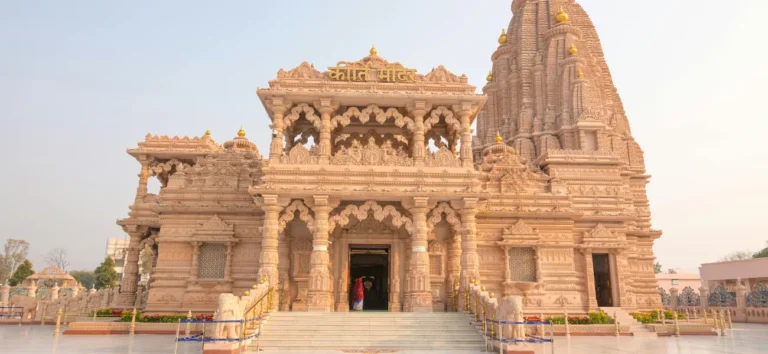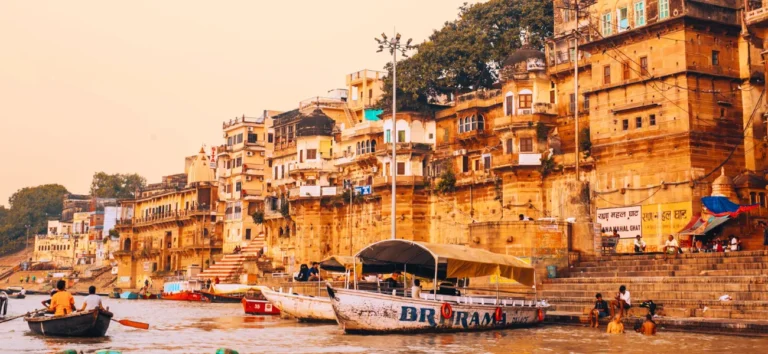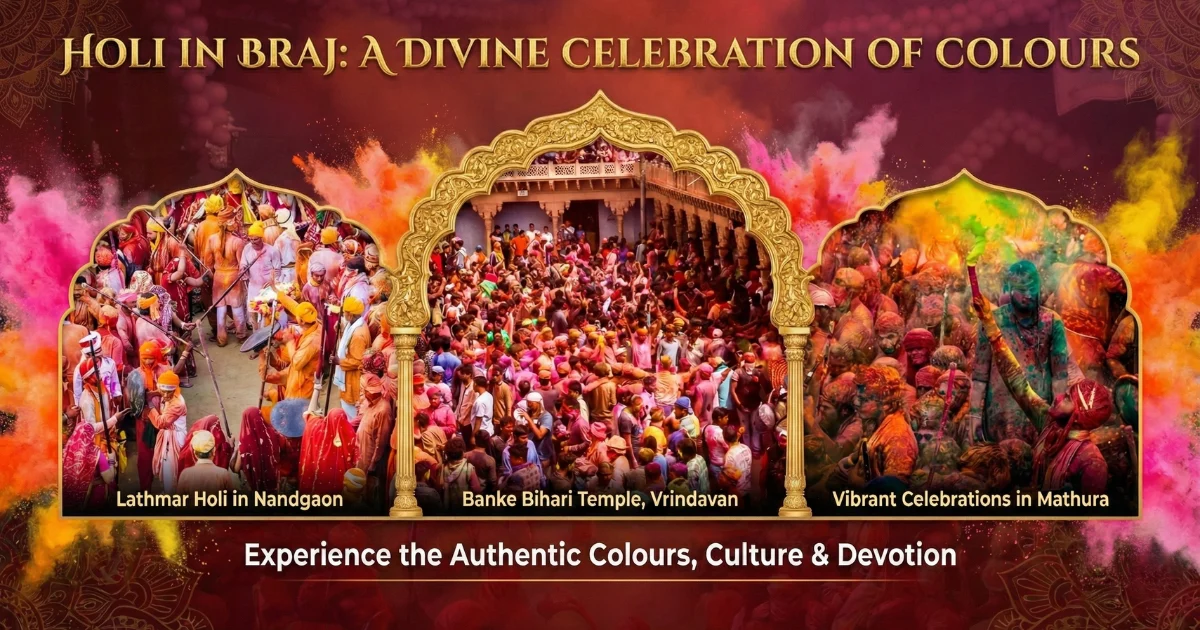
Holi in the Braj region is not something you arrive for and finish in a day. It begins much earlier, quietly, sometimes without you even realising it. A temple bell rings differently. Songs linger longer in the air. Villages start preparing before colours ever appear. This is Braj Bhoomi, the land where Lord Krishna lived, laughed, argued, teased, and loved. Holi here grows out of those stories, not as history, but as routine.
Highlights
ToggleUnlike city Holi celebrations that peak and disappear within hours, Holi in Braj follows its own rhythm. It moves with the Hindu calendar, with temple rituals, with village customs that have not changed for generations. There is devotion before colour, patience before celebration, and meaning before excitement. That is what makes Holi in Braj feel so different.
The region includes places like Mathura, Vrindavan, Barsana, Nandgaon, and Gokul. Each place celebrates Holi in its own way, tied closely to Krishna’s life. Together, these celebrations form what people call Braj Holi, not a festival, but a season.
Why Holi in the Braj Region Feels Different
The first thing you notice in Braj is that Holi is not rushed. It unfolds over many days. Some mornings are filled with bhajans, others with flowers, others with laughter and colour. Temples guide the celebrations, not stages or loudspeakers. Natural gulal and flower petals are preferred, especially inside temple spaces. Even when crowds grow large, the mood stays devotional.
What makes Braj special is not scale, but continuity. Saints, widows, local families, and travellers all celebrate together. There is no clear line between who is participating and who is watching. Everyone becomes part of the same flow. That sense of shared experience is hard to find elsewhere.
How Holi Unfolds Across Braj Bhoomi
Holi in Braj usually begins in the last week of February and continues until early March. The early days belong to villages like Barsana and Nandgaon, where Holi is played as ritual, not entertainment. These are not casual gatherings. Each movement, song, and exchange follows a pattern shaped over centuries.
As days pass, the focus shifts to Vrindavan and Mathura. Temple Holi slowly gives way to wider celebrations. By the time Rangwali Holi arrives, the entire region feels ready, not tired. If you follow this sequence, Holi feels complete. If you arrive only for the final day, you see colours but miss the journey.
Different Forms of Holi in the Braj Region
Lathmar Holi in Barsana and Nandgaon
Lathmar Holi is often the first thing people associate with Braj. In Barsana and Nandgaon, this tradition comes alive exactly as it always has. The story is familiar. Krishna and his friends visited Barsana to tease Radha and her companions. The women responded playfully, chasing them away with sticks.
Today, men from Nandgaon arrived carrying shields. Women of Barsana hold lathis. The exchange looks dramatic, but it is symbolic and controlled. There is no aggression, only ritualised play. This form of Holi exists only in Braj, and nowhere else. Because of the crowds and strict timings, experiencing it properly requires patience and planning.
Phoolon Wali Holi in Vrindavan
Phoolon Wali Holi feels like the opposite of Lathmar Holi. Celebrated mainly inside Vrindavan temples, especially at the Banke Bihari Temple, this Holi replaces colours with flowers. Thousands of petals fall as kirtans fill the air.
There is no rush here. Families, elderly devotees, and first-time visitors often find this the most peaceful Holi experience in Braj. It is less about excitement and more about emotion. Many people leave the temple quiet, almost reflective.
Widow Holi in Vrindavan
Widow Holi is one of the most moving parts of Braj Holi. For a long time, widows were excluded from festivals. In Vrindavan, that changed. Today, widows participate openly, playing with flowers and soft colours.
There is no spectacle here. Just dignity, inclusion, and acceptance. For many visitors, witnessing Widow Holi reshapes how they understand both Holi and Vrindavan itself.
Holi in Mathura, Krishna’s Birthplace
Holi in Mathura carries a different weight. At the Shri Krishna Janmabhoomi Temple, devotees gather from across India and beyond. The celebrations spread from temples to streets and ghats, but devotion remains central.
Mathura Holi feels grounded. Less symbolic than Barsana, less soft than Vrindavan, but deeply rooted. It is where Braj Holi feels complete.
Dhulandi, the Final Day
Dhulandi is the day when restraint loosens. Colours fill the air across Braj. Gulal is shared freely. Groups move through streets singing, laughing, greeting strangers like old friends. Even then, the celebration feels communal, not chaotic. This is Holi’s release, after days of preparation and ritual.
Best Time to Visit for Holi in Braj
To experience Braj Holi properly, plan to be here between 25 February and 4 March 2026. This window allows you to see ritual-based Holi, temple Holi, and full colour celebrations without rushing.
Morning hours are always calmer, especially near temples. By afternoon, crowds increase and movement slows.
What to Wear and How to Prepare
- Wear simple cotton clothes you are ready to part with
- Comfortable walking footwear is essential
- Carry a scarf or dupatta for protection
- Avoid valuables and keep phones secure
- Drink water regularly and rest when needed
In Braj, patience matters as much as preparation.
Travel and Stay During Braj Holi
Holi is the peak season in the Braj region. Hotels in Mathura and Vrindavan fill up early. Traffic restrictions are common, and public transport becomes unpredictable. Staying close to temple areas helps reduce stress.
Covering multiple places like Barsana, Nandgaon, Vrindavan, and Mathura requires timing awareness and local understanding. Many travellers quietly prefer planning their journey with Mathura Vrindavan Tourism, simply because local knowledge makes the experience smoother without turning it into a rushed schedule.
A Quiet Closing Thought
Holi in the Braj region is not about how many places you cover or how colourful your clothes become. It is about standing in a temple courtyard while petals fall, watching villagers sing songs older than memory, and realising that here, Holi is not recreated every year. It simply continues.
If you want to see Holi the way it has always been lived, not performed, Braj Bhoomi is the only place where the festival still feels exactly like itself.
A Simple Way to Remember Mathura Holi
Mathura doesn’t shout during Holi.
It opens itself.
Contact Mathura Vrindavan Tourism Today:
Call Us: +91 7300620809
WhatsApp Us: +91 7300620809
Visit Our Website: Mathura Vrindavan Tourism
Email: mathuravrindavantourism.com@gmail.com
If you go expecting chaos, you might miss the calm beneath it. But if you allow the city to set the pace, things fall into place. You leave tired, stained with colour, maybe slightly disoriented. But you also leave with a sense that you didn’t just attend a festival. You walked through something that has been lived the same way for centuries.
And that feeling stays long after the colour washes off.
FAQs – Holi in Braj Region
1. When is the best time to experience Holi in the Braj region?
The best time to experience Holi in the Braj region is between 25 February and 4 March 2026. This period covers all major events, from Lathmar Holi in Barsana and Nandgaon to Phoolon Wali Holi, Widow Holi, and the main Rangwali Holi.
2. Is Holi in the Braj region different from Holi in other parts of India?
Yes, Holi in Braj is very different. It is spread over many days, guided by temple rituals and village traditions. Unlike city Holi, it focuses more on devotion, bhajans, flowers, and symbolic rituals rather than loud music and synthetic colours.
3. Is Holi in Mathura and Vrindavan safe for tourists?
Holi in Mathura and Vrindavan is generally safe for tourists if basic precautions are followed. Morning hours are calmer, temple areas are well managed, and respectful behaviour ensures a positive experience. Guided travel is recommended for first-time visitors.
4. What should I wear during Holi in the Braj region?
Wear simple cotton clothes that you do not mind getting coloured. Full sleeves are better for protection. Comfortable walking shoes, a scarf or dupatta, and minimal accessories are advisable, especially during temple Holi and village celebrations.
5. Can families and senior citizens enjoy Holi in Braj?
Yes. Certain celebrations like Phoolon Wali Holi and temple Holi in Vrindavan are especially suitable for families and senior citizens. These events focus on flowers, bhajans, and devotion rather than aggressive colour play.
6. What is Lathmar Holi and where does it take place?
Lathmar Holi is a traditional Holi celebration held in Barsana and Nandgaon. It is based on Radha–Krishna legends where women playfully chase men with sticks. It is symbolic, ritualised, and unique to the Braj region.
7. Do I need to book hotels in advance for Holi in Braj?
Yes, booking hotels well in advance is essential. Holi is peak season in the Braj region, and accommodations in Mathura and Vrindavan often sell out weeks or even months ahead of time.
8. Are colours used during Holi in Braj safe?
In temples and traditional events, natural colours and flower petals are preferred. However, during street Holi on Dhulandi, synthetic colours may be used in some areas. Carrying protective eyewear and washing immediately after celebrations is recommended.
9. Is photography allowed during Holi celebrations?
Photography rules vary by location. Many temples, especially Banke Bihari Temple, strictly prohibit photography during Holi. In villages like Barsana, photography may be allowed from designated areas but restrictions are enforced for safety.
10. How many days should I plan for a complete Braj Holi experience?
Ideally, plan 7 to 8 days to experience Braj Holi properly. This allows you to cover Barsana, Nandgaon, Vrindavan, Mathura, and Gokul without rushing and to witness both ritual-based and colour-based celebrations.