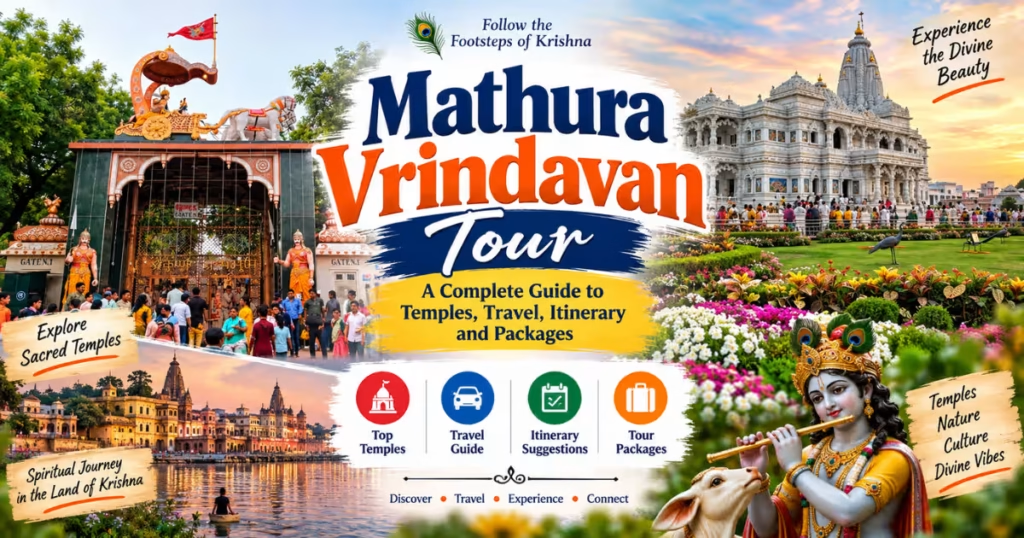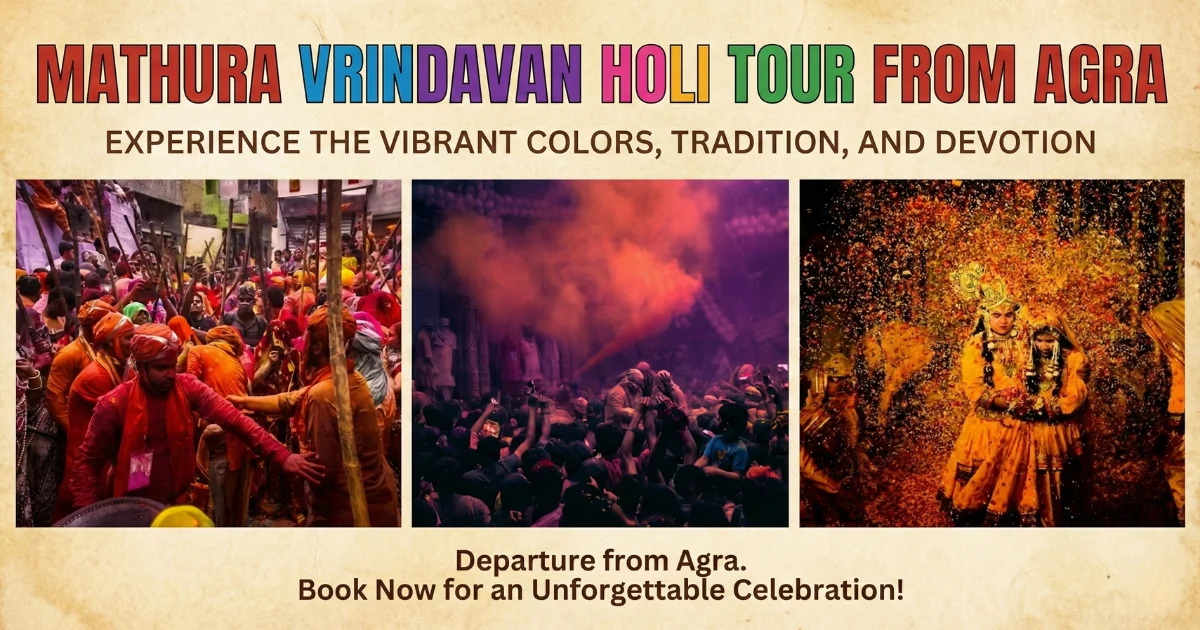
Holi in Mathura and Vrindavan is never just about colour. Anyone who has spent even a single morning here during the Holi season knows that. It is about timing. About standing in the right courtyard at the right hour. About understanding which village wakes first, which temple closes early, and which celebration is meant to be watched quietly rather than joined loudly.
Highlights
ToggleFor many travellers, Agra becomes the starting point. It makes sense geographically. But once you leave Agra and move towards Braj Bhoomi, the journey stops being about distance and starts becoming about rhythm. A Mathura Vrindavan Holi tour from Agra works best when it follows the pace of Braj, not the other way around.
This guide is written from that exact place of understanding. Not as a checklist, not as a package description, but as something you would read before stepping into a crowded temple lane at 6 in the morning and wondering whether you arrived too early or already too late.
Why Holi in Braj feels different from anywhere else
Across India, Holi is celebrated in many forms. But in Braj, Holi doesn’t arrive suddenly. It builds. Slowly. Village by village. Temple by temple.
Here, Holi is not compressed into one afternoon. It unfolds across days, sometimes weeks, following stories of Krishna and Radha that locals don’t narrate — they live them. In Mathura and Vrindavan, Holi is guided by temple calendars, not convenience. By village customs, not advertisements.
What sets this region apart is not scale, but depth.
- Holi is spread across multiple days, not one
- Each village celebrates differently
- Temples lead the rhythm, not crowds
- Locals, widows, saints, families, and travellers stand together
- Even in heavy crowds, devotion stays at the centre
This is why people return. And this is why planning a Mathura Vrindavan Holi tour from Agra without understanding Braj often leads to confusion.
How Holi actually progresses in Braj Bhoomi
Holi here does not start in Mathura or Vrindavan.
It begins earlier in villages like Barsana and Nandgaon. These early celebrations are quieter in announcement but heavier in meaning. As the days pass, Vrindavan and Mathura take over, and the colour slowly becomes more visible, more public.
If you plan your travel around the correct dates, Holi stops feeling rushed. You stop chasing events. The festival comes to you.
Holi dates 2026 – the sequence that matters
These dates are best understood as a flow, not isolated events.
23 January 2026
Basant Panchami Utsav at Banke Bihari Temple
A quiet beginning. Yellow clothes. Soft bhajans. No crowds yet.
24 February 2026
Phag Invitation in Nandgaon
Laddu Holi in Barsana
The tone changes here. Laughter replaces silence.
25 February 2026
Lathmar Holi in Barsana
This is where Braj Holi shows its true character.
26 February 2026
Lathmar Holi in Nandgaon
A continuation, but with a slightly softer edge.
27 February 2026
Phoolon Wali Holi in Vrindavan
Huranga at Janmabhoomi in Mathura
1 March 2026
Chhadimar Holi in Gokul
4 March 2026
Main Holi in Mathura and Vrindavan
5 March 2026
Dauji Huranga in Baldev
If you want to experience Holi fully, arriving between 24 February and 5 March 2026 gives you breathing space.
The kinds of Holi you’ll actually experience
Lathmar Holi – Barsana and Nandgaon
This is not theatre. It is a ritual. Women lead. Men follow. Sticks are symbolic, movements are controlled, and every step has meaning. From the outside it looks chaotic. From inside, it is strangely ordered.
Crowds are heavy. Movement is slow. Without planning, it can feel overwhelming.
Phoolon Wali Holi – Vrindavan
This Holi feels different the moment you enter the temple. No shouting. No rushing. Just petals falling, bhajans echoing, and people standing still longer than they expected to.
Families and older travellers often remember this day the longest.
Chhadimar Holi – Gokul
Less spoken about. Less photographed. But deeply rooted. This is where Holi still feels local. Unfiltered. Humans.
Dauji Huranga – Baldev
Raw energy. Folk humour. Physical play. It is loud, messy, and completely Braj in spirit.
Travelling from Agra during Holi – ground reality
Agra to Mathura looks short on a map. During Holi, it feels longer.
- Agra to Mathura: around 60 km
- Mathura to Vrindavan: around 15 km
- Mathura to Barsana: around 50 km
Road restrictions, diversions, and crowd-controlled zones are common. Self-driving during peak days rarely works well. Early departures matter more than speed.
Safety, crowds, and honest expectations
Holi in Braj is safe, but it is not gentle.
- Temple areas get crowded very early
- Morning hours are calmer than afternoons
- Standing still is often safer than pushing forward
- Women travellers should avoid solo exploration on peak days
When movement, timing, and rest are managed properly, the experience becomes meaningful instead of exhausting.
What actually helps on the ground
- Old cotton clothes.
- Comfortable shoes.
- A scarf or dupatta.
- Waterproof phone cover.
- Nothing extra.
Carry less than you think you need.
Why Mathura Vrindavan Tourism fits this journey well
A Mathura Vrindavan Holi tour from Agra is not about covering locations quickly. It is about knowing when not to move.
This is where Mathura Vrindavan Tourism works well. Being rooted in Braj, they understand crowd behaviour, temple timing shifts, and which celebration is meant to be observed quietly rather than entered.
Instead of packed schedules, the focus stays on:
- early departures
- balanced daily flow
- verified stays near temple zones
- local guidance during peak crowd hours
Mathura Vrindavan Tourism appears quietly in the background, letting the festival lead rather than forcing the traveller to chase it.
Conclusion
Holi in Braj is not loud because it wants to be noticed. It is loud because it has never been silent. The colours, the songs, the crowd — they are all expressions of something older than tourism.
A Mathura Vrindavan Holi tour from Agra, when planned with care, allows you to move with that rhythm instead of against it. You don’t remember every colour you were covered in. You remember where you stood. Who you stood with. And how, for a moment, everything felt unhurried.
Why Mathura Vrindavan Tourism Fits This Journey
A long Holi journey fails when movement feels forced.
Mathura Vrindavan Tourism focuses on realistic pacing. Not daily pressure. Not constant travel. As a planning support partner, the idea is simple. Let Braj decide the rhythm. Travellers just follow it.
That approach suits a Mathura Vrindavan Holi festival package far better than rigid schedules.
Contact Mathura Vrindavan Tourism Today:
Call Us: +91 7300620809
WhatsApp Us: +91 7300620809
Visit Our Website: Mathura Vrindavan Tourism
Email: mathuravrindavantourism.com@gmail.com
FAQs – Mathura Vrindavan Holi Tour from Agra
Not meaningfully. Holi here unfolds over several days. A single day only scratches the surface.
Lathmar Holi in Barsana carries the deepest cultural weight.
Yes. It is calmer and temple-centred.
Temple celebrations mostly use natural gulal and flowers.
No. Especially restricted inside major temples.
24 February 2026 is ideal.
Yes. Dauji Huranga days feel more open.
Mornings are always better. Evenings get unpredictable.
It is possible, but guidance makes the experience smoother.
Because Holi in Braj is about the days before, not just the final colour.