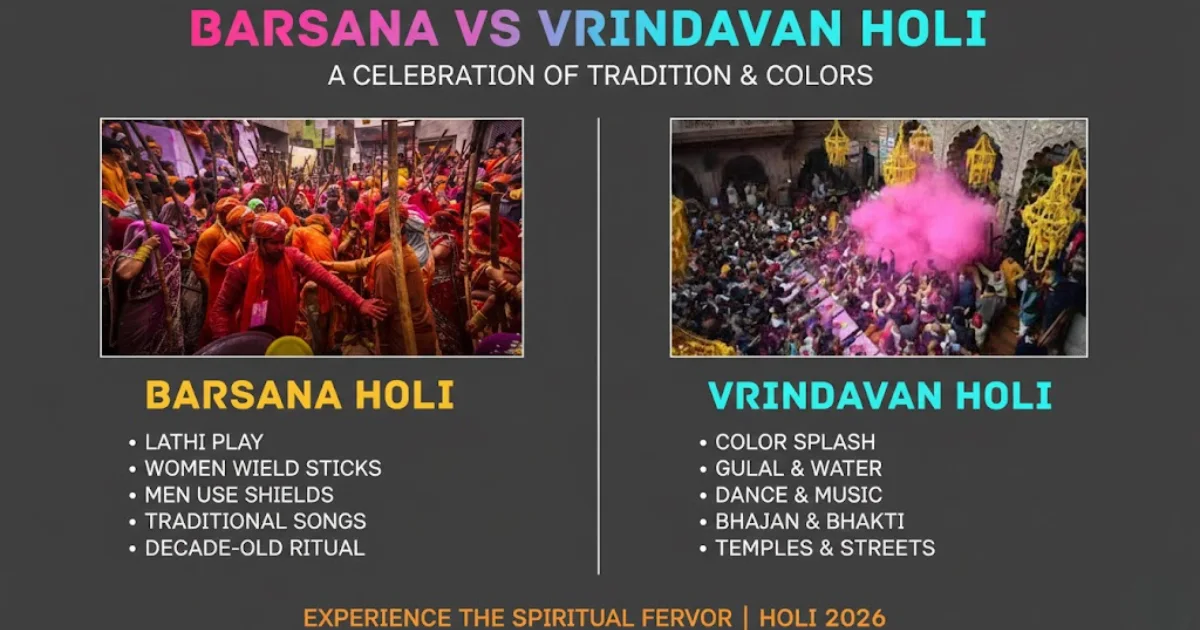
Holi in Mathura and Vrindavan is never just about colours. Anyone who has spent even a few days in Braj during this season understands that quickly. Here, Holi unfolds slowly, village by village, temple by temple, following an old rhythm that does not rush for visitors or cameras.
Highlights
ToggleOne common mistake travellers make is thinking that Barsana Holi and Vrindavan Holi are similar celebrations happening at two nearby places. In reality, they are very different experiences. The difference between Barsana Holi and Vrindavan Holi lies not only in rituals, but in mood, crowd behaviour, participation level, and even the way time feels during the festival.
If you are planning Holi 2026, understanding this difference will decide whether your experience feels overwhelming or deeply fulfilling.
Book Now Your Mathura Vrindavan Tour Package.
Why Holi Feels So Different Across Braj Bhoomi
Braj Bhoomi does not celebrate Holi as a single event. It celebrates Holi as a sequence. Each village adds its own meaning to the festival, shaped by local tradition and Krishna leela.
Barsana and Vrindavan sit close to each other on the map, but spiritually and culturally, their Holi celebrations move in different directions.
Barsana represents playful resistance, community energy, and raw village participation.
Vrindavan reflects devotion, restraint, and temple-led celebration.
This contrast forms the foundation of the difference between Barsana Holi and Vrindavan Holi.
Barsana Holi – Where Holi Is Physical and Community-Led
Barsana is known as the village of Radha Rani. Holi here is not symbolic. It is lived, enacted, and physically performed. This is where Lathmar Holi takes place, and it remains one of the most intense Holi celebrations anywhere in India.
The tradition comes from the Radha-Krishna leela, where Krishna and his friends from Nandgaon came to tease Radha and her companions. Instead of retreating, the women chased them away with sticks. Over time, this playful exchange became a ritual.
Even today, the structure remains unchanged.
- Women lead the celebration
- Men arrive from Nandgaon carrying shields
- Sticks are raised as part of ritual, not aggression
- Crowds gather tightly in narrow village spaces
- Movement slows once ceremonies begin
Barsana Holi is not a casual experience. Once you are inside the celebration, leaving or repositioning becomes difficult. This is why planning matters.
For many first-time visitors, this is where the difference between Barsana Holi and Vrindavan Holi becomes clear. Barsana Holi is loud, crowded, and physically demanding. It demands patience, awareness, and respect for local customs.
Without preparation, Barsana Holi can feel chaotic. With the right timing and guidance, it feels powerful and unforgettable.
Vrindavan Holi – Where Holi Is Devotional and Temple-Centered
Vrindavan tells a quieter story.
This is where Krishna spent his childhood, and Holi here reflects that softer devotion. Celebrations are centred around temples, bhajans, and ritual discipline rather than open-street play.
The most recognised event is Phoolon Wali Holi at Banke Bihari Temple. Instead of colours, flower petals are showered on devotees. Instead of noise, there is singing. Instead of chaos, there is control.
- Darshan timings are short
- Entry is regulated by temple authorities
- Photography is restricted
- The atmosphere is emotional, not aggressive
Vrindavan Holi is about witnessing rather than participating. You stand, watch, feel, and absorb.
For families, senior citizens, and travellers seeking a calmer spiritual experience, Vrindavan Holi feels more approachable. This calm devotion is a key part of the difference between Barsana Holi and Vrindavan Holi.
Difference Between Barsana Holi and Vrindavan Holi in Real Terms
- Barsana Holi happens in village courtyards and streets
Vrindavan Holi happens inside temples - Barsana Holi is physically intense
Vrindavan Holi is emotionally intense - Barsana Holi requires crowd tolerance
Vrindavan Holi requires patience and timing - Barsana Holi is led by the community
Vrindavan Holi is led by temples - Barsana Holi is not suitable for unplanned visits
Vrindavan Holi allows structured darshan
Neither celebration is better than the other. They simply offer different ways of experiencing Braj.
Explore All Our Tour Packages.
Holi Dates 2026 in Braj – Understanding the Sequence
Dates matter deeply in Braj. Missing a day often means missing a ritual that will not repeat.
Here is a clear and practical Holi 2026 list to help you understand the flow and the difference between Barsana Holi and Vrindavan Holi.
- 23 January 2026
Basant Panchami Utsav – Banke Bihari Temple, Vrindavan - 24 February 2026
Phag Invitation – Nandgaon - 24 February 2026
Laddu Holi – Barsana Dham - 25 February 2026
Lathmar Holi – Barsana Dham - 26 February 2026
Lathmar Holi – Nandgaon - 27 February 2026
Phoolon Wali Holi – Vrindavan
Janmabhoomi Huranga – Mathura - 1 March 2026
Chhadimar Holi – Gokul - 4 March 2026
Main Rangwali Holi – Mathura and Vrindavan - 5 March 2026
Dauji Huranga – Baldev
To experience both Barsana and Vrindavan Holi properly, it is best to plan your stay between 24 February and 4 March 2026.
Crowd Reality – What Experience Teaches You
This is the part many online guides skip.
Barsana Holi crowds are dense and slow-moving. Once rituals begin, exits are limited. Phone signals weaken. Heat and pressure build quickly. Early arrival is not optional, it is necessary.
Vrindavan Holi crowds are heavy but controlled. Temple authorities manage entry strictly. Darshan may stop without announcement. Morning hours are noticeably calmer than afternoons.
This crowd behaviour is another important difference between Barsana Holi and Vrindavan Holi that travellers should factor into their planning.
Many visitors rely on local planning support from Mathura Vrindavan Tourism to manage timings, transport, and exits during peak days.
Which Holi Should You Choose
Choose Barsana Holi if you:
- Want to witness rare village rituals
- Are comfortable in dense crowds
- Do not mind physical intensity
Choose Vrindavan Holi if you:
- Prefer temple environments
- Are travelling with family or elders
- Seek devotion over physical play
Experiencing both offers the most complete understanding of the difference between Barsana Holi and Vrindavan Holi.
Why Mathura Vrindavan Tourism Fits This Journey
A long Holi journey fails when movement feels forced.
Mathura Vrindavan Tourism focuses on realistic pacing. Not daily pressure. Not constant travel. As a planning support partner, the idea is simple. Let Braj decide the rhythm. Travellers just follow it.
That approach suits a Mathura Vrindavan Holi festival package far better than rigid schedules.
Contact Mathura Vrindavan Tourism Today:
Call Us: +91 7300620809
WhatsApp Us: +91 7300620809
Visit Our Website: Mathura Vrindavan Tourism
Email: mathuravrindavantourism.com@gmail.com
Frequently Asked Questions (FAQs)
Barsana Holi is village-based and physically intense, while Vrindavan Holi is temple-centered and devotional.
Yes, but only with proper planning and early arrival due to crowd density.
Yes, especially Phoolon Wali Holi during morning hours.
Yes, if dates and locations are planned carefully.
Vrindavan Holi is more devotional in nature.
Barsana Holi is louder and physically intense.
Yes, dates are based on the Hindu Panchang.
Old cotton clothes, full sleeves, and comfortable footwear.
Temple photography is restricted. Village areas allow limited safe zones.
Local planners like Mathura Vrindavan Tourism understand timing, crowd flow, and temple rules.
Conclusion
The difference between Barsana Holi and Vrindavan Holi is not about choosing one over the other. It is about understanding what each represents within Braj culture. One celebrates divine play through energy and ritual. The other expresses devotion through restraint and song.
When you approach Holi in Braj with patience and respect, the experience stops feeling overwhelming and starts feeling meaningful. That is when Holi in Mathura and Vrindavan becomes something you do not just attend, but quietly carry back with you.