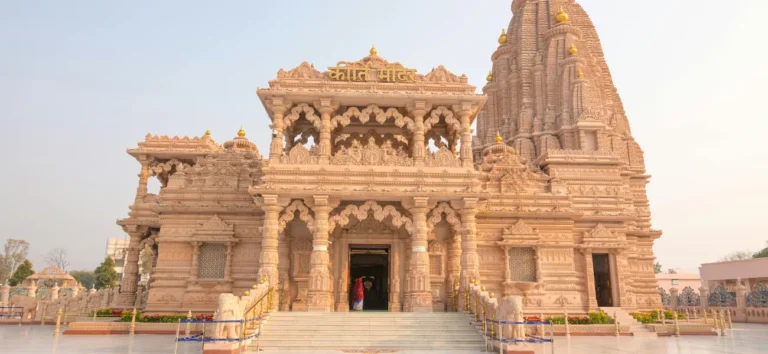
Mirabai Temple in Vrindavan is a quiet shrine near Nidhivan and Radha Damodar Temple – the historic spot where the 16th-century poet-saint Mirabai lived and worshipped Lord Krishna. Built in 1842 by Thakur Ram Narain Bhatti of Bikaner. Enshrines the sacred Shaligram Shila of Mira’s devotion. Timings: 7:30 AM-12:00 PM and 5:00-8:00 PM. Free entry. Accessible only on foot through narrow lanes. Experience My India Vrindavan tours from ₹1,999 per person. Call +91-7302265809.
Why Mirabai Temple Is One of Vrindavan’s Most Intimate Shrines
Vrindavan is a city of more than 5,000 temples – most of them large, crowded and architecturally grand. The Mirabai Temple is none of these things. It is a quiet, intimate shrine tucked away in a narrow lane in Vrindavan’s old quarter, near Nidhivan and the Radha Damodar Temple. It marks the historic spot where the 16th-century Rajput poet-saint Mirabai lived and worshipped Lord Krishna after leaving her royal life in Chittorgarh.
For pilgrims who know Mira’s story – her complete, consuming love for Lord Krishna that made her renounce royalty and walk to Vrindavan – this shrine carries a weight of devotional history that the grand modern temples cannot replicate. She sang here. She worshipped here. The Shaligram Shila that tradition holds was miraculously given to her is enshrined here to this day.
I am Gurudutt, founder of Experience My India, born and raised in Braj Bhoomi and guiding pilgrims since 2018. I have taken more than 50,000 pilgrims through Vrindavan – and the Mirabai Temple is among the sites that leave the deepest impression on visitors who know what they are standing in. In this guide you will find the complete 2026 visitor’s guide – history, timings, location and how to include it in your Vrindavan itinerary. Call +91-7302265809. Tours from ₹1,999 per person.
Mirabai Temple Vrindavan – Quick Overview
| Detail | Information |
| Common name | Mirabai Temple (also: Meera Bai Mandir, Meerabai Mandir) |
| Location | Near Radha Damodar Temple and Nidhivan, Vrindavan, Uttar Pradesh 281003 |
| Who it commemorates | Mirabai – 16th-century Rajput poet-saint and devotee of Lord Krishna |
| Historical event | Marks the spot where Mirabai lived and worshipped after arriving in Vrindavan around 1524 |
| Current structure | Built in 1842 by Thakur Ram Narain Bhatti, a nobleman from Bikaner |
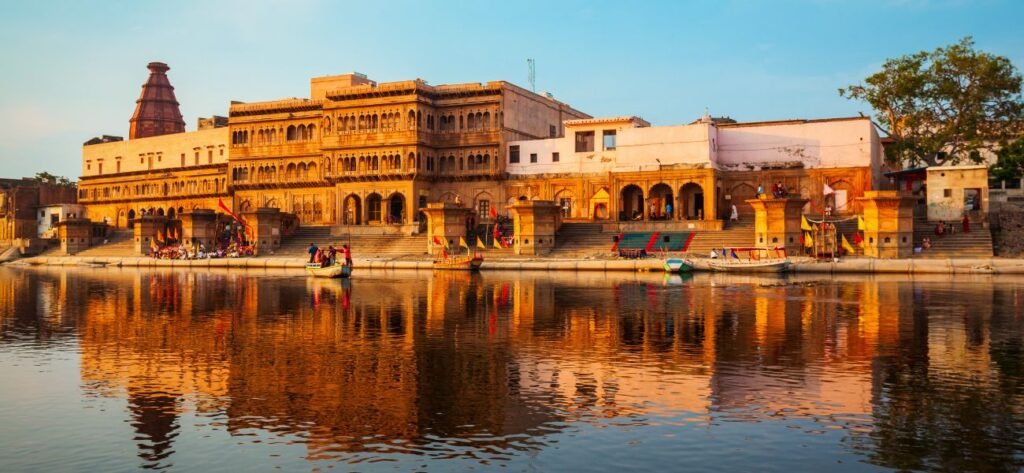
| Architecture | Simple, peaceful blue-and-white Rajasthani courtyard |
| Primary relic | Sacred Shaligram Shila associated with Mirabai’s devotion |
| Morning timings | 7:30 AM – 12:00 PM |
| Evening timings | 5:00 PM – 8:00 PM |
| Entry fee | Free |
| Access | On foot only – vehicular access restricted in the narrow old lanes |
| Nearest landmarks | Nidhivan · Radha Damodar Temple |
| EMI tour inclusion | Vrindavan tours · from ₹1,999 · +91-7302265809 |
Experience My India includes Mirabai Temple in extended Vrindavan heritage temple walks.
History of Mirabai Temple Vrindavan
Mirabai – Who She Was
Mirabai (also written: Meerabai, Mira Bai) was a 16th-century Rajput princess born into the royal family of Merta, Rajasthan. From childhood, she was deeply devoted to Lord Krishna – treating the deity in her home as her husband and companion. Her devotion to Krishna was so total and so unconventional for her station that it brought her into direct conflict with the royal household she married into in Chittorgarh.
Her bhajans – devotional songs composed in Braj Bhasha and Rajasthani, addressed directly to Lord Krishna – remain among the most beloved in the entire Vaishnava devotional tradition. Lines from her compositions are sung across India to this day. She is considered one of the four principal poet-saints of the Bhakti Movement, alongside Kabir, Tukaram and Surdas.
Mirabai’s Arrival in Vrindavan
Mirabai arrived in Vrindavan around 1524 – leaving behind her royal life in Chittorgarh to immerse herself in the sacred landscape directly associated with Lord Krishna’s life. Vrindavan, as the place where Krishna performed the Raas Leela and spent his adolescence, was for Mira the closest she could come to the living presence of her Lord.
The spot marked by the Mirabai Temple in Vrindavan is where she lived during her time in the city – worshipping in the same old temple quarter that houses Radha Damodar Temple and Nidhivan. For a pilgrim walking through these narrow lanes today, the physical proximity of all three sites is itself historically significant: Mira lived and worshipped in the same quarter where some of Vrindavan’s most ancient devotional traditions were being established in the same century.
The Current Temple Structure – Built 1842
The current temple structure was built in 1842 by Thakur Ram Narain Bhatti – a nobleman from Bikaner, Rajasthan. The Rajasthani connection is reflected in the temple’s architecture: a simple, peaceful blue-and-white Rajasthani courtyard style, modest and intimate in scale compared to Vrindavan’s more imposing 16th-century red sandstone temples.
The Bikaner nobleman’s decision to build a permanent shrine here in 1842 reflects the long Rajasthani devotional connection to Mirabai’s memory – Mira herself was from the Rajput heartland of Rajasthan and her story remained central to Rajasthani devotional culture for centuries after her life.
Experience My India explains the full Mirabai narrative before every temple visit. Call +91-7302265809. View Our 2 Days Mathura Vrindavan Tour Package
The Sacred Shaligram Shila – The Miraculous Relic
The Shaligram Shila enshrined at the Mirabai Temple Vrindavan is the primary sacred object of the shrine – and the legend surrounding it is among the most distinctive in Vrindavan’s temple lore.
According to tradition, Mirabai’s royal family – troubled by her unconventional devotion and her rejection of conventional royal life – attempted to harm her with poison. When the vessel containing the poison was brought to her, tradition holds that she found a sacred Shaligram Shila inside the vessel instead – a divine stone manifestation of Lord Vishnu (and by extension, Lord Krishna), which replaced the poison as a mark of divine protection and grace.
This Shaligram Shila – an emblem of Mira’s unshakeable faith – is preserved inside the shrine to this day. For pilgrims who visit the Mirabai Temple Vrindavan, the darshan of the Shaligram Shila is not the sight of a historical artifact but the encounter with the physical evidence of a saint’s divine protection.
| Shaligram Shila Detail | Information |
| What is a Shaligram Shila | A natural sacred stone (ammonite fossil from the Gandaki River in Nepal) worshipped as a form of Lord Vishnu |
| Legend associated | Found inside the poison vessel sent to harm Mirabai – considered divine protection |
| Current location | Enshrined at Mirabai Temple Vrindavan |
| Significance | Primary relic of the temple – the living evidence of Mirabai’s faith |
Experience My India explains the Shaligram Shila legend to every group before visiting. Call +91-7302265809. View Our Same Day Gokul Vrindavan Tour
Mirabai Temple Vrindavan Timings 2026
| Session | Timing | Notes |
| Morning session | 7:30 AM – 12:00 PM | Opens for darshan; quietest between 7:30-9:00 AM |
| Midday closure | 12:00 PM – 5:00 PM | Traditional midday temple rest |
| Evening session | 5:00 PM – 8:00 PM | Pre-dusk to evening darshan |
| Entry fee | Free | No ticket, no donation required |
| Weekly closure | None – open all days |
Best darshan window: 7:30-9:00 AM – the most peaceful and least crowded time. The narrow lanes around the temple area are quietest in the morning. By 10:00-11:00 AM, other Vrindavan pilgrims begin moving through this part of the old city.
Experience My India sequences the Mirabai Temple visit for the 7:30-9:00 AM window on all extended Vrindavan heritage temple walks. Call +91-7302265809.
Book Your Mathura Vrindavan Tour Package
Location and How to Reach Mirabai Temple Vrindavan
Address: Near Radha Damodar Temple and Nidhivan, Vrindavan, Uttar Pradesh 281003
The Mirabai Temple is in Vrindavan’s old city quarter – the same narrow-lane area that contains Nidhivan, Radha Damodar Temple and Seva Kunj. It is accessible only on foot.
| Access Detail | Information |
| Vehicular access | Not possible – the lanes are too narrow for cars or e-rickshaws |
| Walking route | Follow the Nidhivan road into the old city lanes; the temple is in the alleys off this road |
| Nearest landmarks | Nidhivan (adjacent) · Radha Damodar Temple (adjacent) |
| From Banke Bihari Temple | 0.5-1 km walk through the old city lanes |
| From Keshi Ghat | 0.5-1 km walk |
| From Vrindavan town centre | Walking or e-rickshaw to Nidhivan area, then on foot |
Walking the narrow lanes: The old city quarter near Nidhivan is one of the most devotionally atmospheric parts of Vrindavan – narrow flagstone lanes, ancient buildings, temple music from multiple directions. Walking this area in the morning between 7:30-10:00 AM is one of the distinctive experiences of Vrindavan. Experience My India always parks vehicles at a distance and walks groups through these lanes. Call +91-7302265809.
Places to Visit Near Mirabai Temple Vrindavan
| Place | Distance from Mirabai Temple | Travel Time | Significance |
| Nidhivan | Adjacent | 2-5 minutes walk | Sacred grove of eternal Raas Leela; closes before dark |
| Radha Damodar Temple | Adjacent | 3-5 minutes walk | Est. 1542 CE; Srila Prabhupada’s bhajan kutir preserved here |
| Seva Kunj | 0.2-0.3 km | 3-5 minutes walk | Sacred garden adjacent to Nidhivan; closes before dark |
| Banke Bihari Temple | 0.5-1 km | 8-12 minutes walk | Most visited Vrindavan temple; Summer 7:45 AM-12 PM |
| Radha Vallabh Temple | 0.5-1 km | 8-12 minutes walk | 16th century; open sewa; samaj gayan 6:30 PM |
| Radha Raman Temple | 1-1.5 km | 12-20 minutes walk | Est. 1542; Shringar Aarti 8:00-9:00 AM |
| Keshi Ghat | 0.5-1 km | 8-15 minutes walk | Yamuna Aarti 6:30 PM daily |
Recommended old city quarter morning walk: 7:30 AM – Mirabai Temple darshan (opening) 8:00 AM – Radha Damodar Temple 8:30 AM – Nidhivan (morning session) 9:30 AM – Banke Bihari Temple (before the 10:30-11:00 AM crowd) 10:30 AM – Radha Raman Temple
Experience My India includes this complete old city morning circuit in all extended Vrindavan day tours. Call +91-7302265809. View Our 3 Days Mathura Vrindavan Tour Package
Best Time to Visit Mirabai Temple
| Period | Temperature | Conditions | Verdict |
| October – March | 8°C-25°C | Best – narrow lane walking comfortable; crisp morning air | ✅ Recommended |
| Mirabai Jayanti (varies) | Seasonal | Celebration of Mirabai’s birth – special programmes at the temple | ✅ With advance planning |
| March – April | 25°C-38°C | Warming; 7:30-10:00 AM window still comfortable | ✅ Morning session only |
| Summer (May – July) | 38°C-46°C | Narrow lanes retain heat; 7:30-9:00 AM only | ⚠️ Very early session only |
| Monsoon (Aug – Sep) | 30°C-38°C | Lane stones may be slippery; lush Vrindavan | ✅ With caution |
October to March is the most recommended season – the narrow flagstone lanes of old Vrindavan are cool and comfortable in the morning, the 7:30 AM opening catches the best light through the lane buildings and the walk from Nidhivan to Mirabai Temple to Radha Damodar is one of the most pleasant heritage walks in Braj. Experience My India plans Vrindavan old city walks for this season. Call +91-7302265809.
What Nobody Tells You About Mirabai Temple Vrindavan
After guiding more than 50,000 pilgrims through Vrindavan since 2018, here is what I – Gurudutt, founder of Experience My India – share privately before every visit to Mirabai Temple:
Most Vrindavan itineraries – including many guided tours – skip the Mirabai Temple entirely. It does not appear on the standard “top 5 Vrindavan temples” list that most guides follow. The temple’s quiet, tucked-away character and its distance from the main Banke Bihari-ISKCON-Prem Mandir circuit means most pilgrims complete a Vrindavan visit without ever knowing it exists. Experience My India includes it specifically for pilgrims who want the complete Vrindavan devotional landscape.
The temple’s blue-and-white Rajasthani courtyard is architecturally distinct from every other major Vrindavan temple. All of Vrindavan’s famous 16th-century temples (Govind Devji, Madan Mohan, Radha Raman) are built in red sandstone in the Mughal-influenced Braj temple style. Mirabai Temple’s simple blue-and-white Rajasthani courtyard, built in 1842, reflects a completely different architectural tradition – the same visual tradition as Rajasthani havelis and palace interiors. This makes it visually distinctive even before you know the history.
The narrow lanes leading to Mirabai Temple from the Nidhivan direction are among the most intact sections of old Vrindavan. These lanes have barely changed in character over centuries – walking them is one of the few genuinely old-city experiences left in Vrindavan, which has changed significantly in its outer areas. Experience My India always walks the Nidhivan → Mirabai Temple → Radha Damodar route on foot for this reason.
The Radha Damodar Temple adjacent to Mirabai Temple contains Srila Prabhupada’s bhajan kutir (personal room), preserved exactly as he left it before founding ISKCON and travelling to the West. Most pilgrims visiting Mirabai Temple walk past Radha Damodar without realising this. Experience My India always includes both sites in a single 30-minute walk. Call +91-7302265809.
Know Before You Visit
- Timings: Morning 7:30 AM-12:00 PM · Evening 5:00-8:00 PM · Free entry
- Access: On foot only – no vehicles in the narrow old city lanes
- Address: Near Radha Damodar Temple and Nidhivan, Vrindavan, UP 281003
- Nearest landmarks: Nidhivan (adjacent) and Radha Damodar Temple (adjacent)
- Best window: 7:30-9:00 AM morning – quietest and most peaceful
- Best season: October to March for comfortable lane walking
- Architecture: Simple blue-and-white Rajasthani courtyard – built 1842 by Thakur Ram Narain Bhatti of Bikaner
- Primary relic: Sacred Shaligram Shila enshrined – tradition holds it was found in the poison vessel sent to harm Mira
- Combine with: Nidhivan + Radha Damodar + Banke Bihari in the same morning walk
- Dress code: Modest attire; remove footwear at the temple entrance
- Experience My India includes Mirabai Temple in extended Vrindavan heritage walks. Call +91-7302265809.
FAQ – Mirabai Temple Vrindavan
Mirabai Temple (Meerabai Mandir) Vrindavan timings: Morning session 7:30 AM to 12:00 PM; Evening session 5:00 PM to 8:00 PM. The temple follows traditional midday closure (12:00-5:00 PM). Entry is free. The best darshan window is 7:30-9:00 AM – quietest and most peaceful, before other pilgrims move through the old city quarter. The address is near Radha Damodar Temple and Nidhivan, Vrindavan, UP 281003. Experience My India times all visits for the morning window – call +91-7302265809.
The least crowded time in Vrindavan – across all temples – is the opening hour of the morning session on weekdays. For the Mirabai Temple area (old city near Nidhivan), 7:30-9:00 AM on a Tuesday to Thursday is the quietest window. For Banke Bihari Temple (7:45 AM summer / 8:45 AM winter opening), arriving at the exact opening minute is the least crowded time. All major Vrindavan temples are most crowded between 10:00 AM-12:00 PM and on weekends. Experience My India plans visits for the quietest windows – call +91-7302265809.
Mirabai Temple (Meerabai Mandir) is located near Radha Damodar Temple and Nidhivan in the old city quarter of Vrindavan, Uttar Pradesh 281003. It is accessible only on foot through the narrow winding alleys off the Nidhivan road – vehicular access is not possible in these old lanes. The nearest major temples are Nidhivan (adjacent) and Radha Damodar Temple (adjacent). From Banke Bihari Temple, it is approximately 0.5-1 km on foot through the old city lanes. Experience My India walks all groups to the temple – call +91-7302265809.
Mirabai Temple Vrindavan marks the historic spot where the 16th-century Rajput poet-saint Mirabai lived and worshipped after arriving in Vrindavan around 1524 – leaving her royal life in Chittorgarh to immerse herself in devotion to Lord Krishna. The Shaligram Shila enshrined here is traditionally associated with her miraculous divine protection from poison. The current temple structure was built in 1842 by Thakur Ram Narain Bhatti, a nobleman from Bikaner, in a simple blue-and-white Rajasthani courtyard style. Experience My India – call +91-7302265809.
The Shaligram Shila at Mirabai Temple Vrindavan is a sacred stone enshrined as the primary relic of the shrine. According to tradition, when Mirabai’s royal family attempted to harm her with poison, she found a sacred Shaligram Shila inside the vessel instead – considered a manifestation of Lord Vishnu’s divine protection. The Shaligram Shila has remained enshrined at this spot in Vrindavan since Mirabai’s time. It is free to see during open hours. Experience My India explains the full narrative – call +91-7302265809.
The current Mirabai Temple structure was built in 1842 by Thakur Ram Narain Bhatti – a nobleman from Bikaner, Rajasthan. The Rajasthani origin of the builder is reflected in the temple’s architectural character: a simple blue-and-white Rajasthani courtyard style, visually distinct from the red sandstone Braj temple architecture of Vrindavan’s older 16th-century temples. The temple marks the spot associated with Mirabai’s time in Vrindavan after she arrived around 1524. Experience My India – call +91-7302265809.
Yes – Mirabai Temple is approximately 0.5-1 km from Banke Bihari Temple, both in the old city quarter of Vrindavan. However, the two are connected only by the narrow winding footpaths of the old city lanes – not by a direct road. The natural sequence for visiting both: Mirabai Temple (7:30 AM opening) → Radha Damodar Temple → Nidhivan → walk to Banke Bihari Temple (7:45 AM summer / 8:45 AM winter opening). Experience My India walks all groups through this sequence – call +91-7302265809.
Mirabai Temple Vrindavan is special for three reasons: (1) it marks the actual historical spot where the poet-saint Mirabai lived and worshipped in Vrindavan after arriving around 1524 – making it one of the few sites in Vrindavan directly connected to a historical saint’s physical presence; (2) it enshrines the Shaligram Shila associated with her miraculous divine protection from poison; (3) its simple 1842 blue-and-white Rajasthani courtyard is architecturally unlike any other major Vrindavan temple. Experience My India – call +91-7302265809.
Yes – the most natural combination is the old city heritage morning walk: Mirabai Temple (7:30 AM opening) → Radha Damodar Temple (adjacent) → Nidhivan (adjacent) → Seva Kunj (adjacent) → Banke Bihari Temple (0.5-1 km walk, 7:45 AM summer / 8:45 AM winter opening) → Radha Vallabh Temple → Radha Raman Temple (Shringar Aarti 8:00-9:00 AM). The entire circuit covers 5-6 temples in the old city quarter in a 2.5-3 hour morning walk. Experience My India plans this walk for all extended Vrindavan tours – call +91-7302265809.
Entry to Mirabai Temple Vrindavan is completely free – no ticket, no donation required at the entrance. The temple is open during the morning session (7:30 AM-12:00 PM) and evening session (5:00 PM-8:00 PM). The Shaligram Shila and the temple courtyard are both accessible during open hours at no charge. Experience My India includes Mirabai Temple in all Vrindavan heritage temple visits – call +91-7302265809.
Mirabai Temple is adjacent to Nidhivan – in the same narrow-lane cluster of the old city quarter. From the Nidhivan entrance or exit, follow the winding flagstone lanes for 2-5 minutes and you will reach the Mirabai Temple. The Radha Damodar Temple is also in this same immediate cluster. The entire area (Nidhivan + Mirabai Temple + Radha Damodar) is within a 200-300 metre radius in the old city lanes. Vehicular access is not possible – this is an entirely pedestrian area. Experience My India – call +91-7302265809.
Yes. Experience My India includes the Mirabai Temple in extended Vrindavan heritage tours – paired with Radha Damodar Temple (adjacent) and Nidhivan (adjacent) in a single old city morning walk. The visit is timed for the 7:30 AM opening, the Shaligram Shila narrative is explained before entry and the walk continues to Banke Bihari and Radha Raman in the same morning circuit. Vrindavan 1-day tour from ₹1,999 per person. WhatsApp +91-7302265809 – Vrindavan itinerary in 30 minutes.
Recommended products
-
02 Days Mathura Vrindavan Tour
-
03 Days Mathura Vrindavan Tour
Original price was: ₹9,000.00.₹8,000.00Current price is: ₹8,000.00. -
04 Days Agra Mathura Vrindavan Tour
-
5 days Mathura Vrindavan Tour Package
Original price was: ₹7,500.00.₹7,000.00Current price is: ₹7,000.00.

🙏 Ready to Visit Mirabai Temple Vrindavan with Experience My India?
WhatsApp us – Vrindavan itinerary within 30 minutes. Old city morning walk planned (Mirabai Temple → Radha Damodar → Nidhivan → Banke Bihari), Shaligram Shila narrative explained and complete Vrindavan circuit scheduled for the day. Tours from ₹1,999 per person.
WhatsApp +91-7302265809 – Book Now
Jai Shri Krishna 🙏