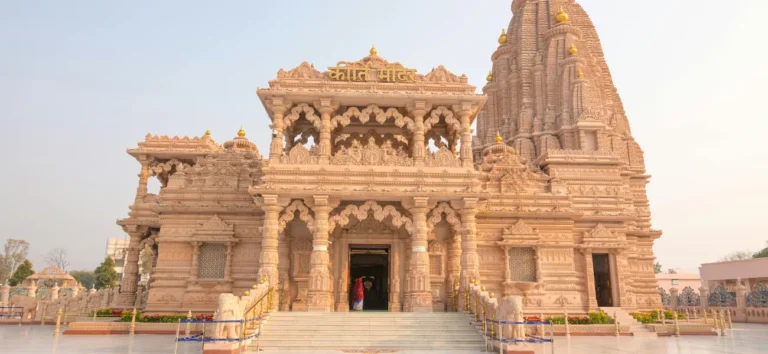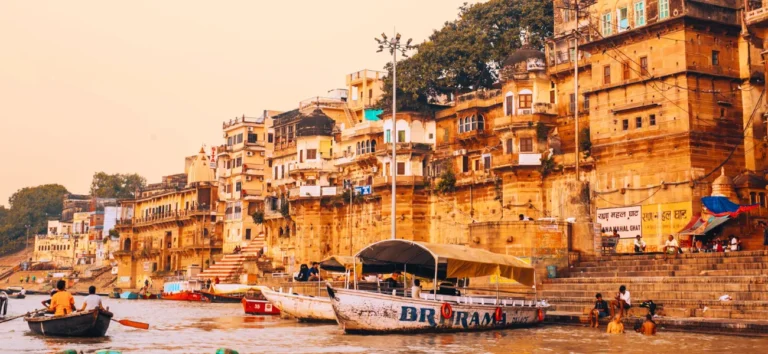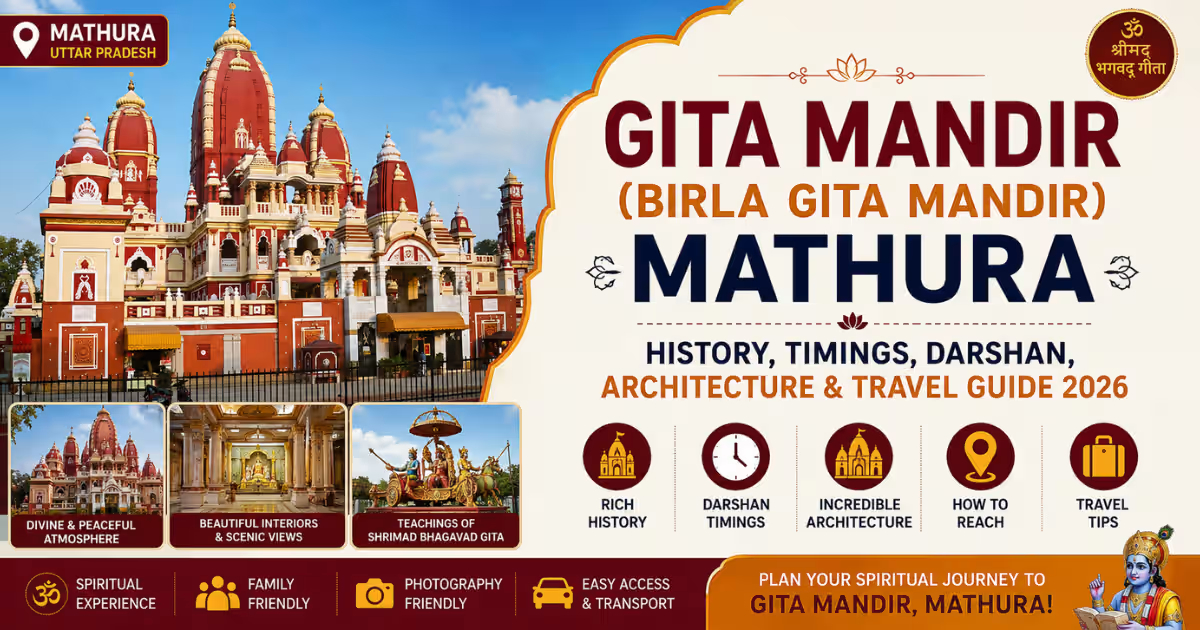
Gita Mandir (Birla Gita Mandir) in Mathura was built in 1946 by Jugal Kishore Birla. It is located on Mathura-Vrindavan Road, approximately 4-7 km from Mathura Junction. Summer timings: 5:00 AM-12:00 PM and 3:30-9:00 PM. Winter timings: 6:00 AM-12:00 PM and 4:00-8:30 PM. Entry is free. The 18-metre Gita Stambh (red sandstone pillar inscribed with all 700 Bhagavad Gita shlokas) is its most distinctive feature. Experience My India includes Gita Mandir in Mathura tour circuits. Call +91-7302265809.
Why Gita Mandir Mathura Deserves a Place in Every Mathura Pilgrimage
In Mathura – a city of more than 2,000 temples, most associated with Lord Krishna’s birth and childhood – Gita Mandir (Birla Gita Mandir) occupies a distinctive and considered position. Unlike Mathura’s ancient temples that are primarily sites of darshan and devotional practice, Gita Mandir is equally a site of scriptural study – built around a single, extraordinary architectural decision: to inscribe all 700 shlokas of the Bhagavad Gita on an 18-metre red sandstone pillar (the Gita Stambh) so that Krishna’s teachings are literally written into the sacred geography of his birthplace.
The Birla family’s choice to build this temple in Mathura in 1946 – and to centre it on the Gita rather than the standard devotional idol – made it one of the most philosophically intentional temples in all of Braj. It serves pilgrims who want not just darshan but also a moment of sustained engagement with Lord Krishna’s teachings in the city where he was born.
I am Gurudutt, founder of Experience My India, born and raised in Braj Bhoomi and guiding pilgrims since 2018. I have included Gita Mandir in the Mathura circuit for more than 50,000 pilgrims – typically between the Dwarkadhish visit and the Krishna Janmabhoomi queue, in the 9:30-11:00 AM window. In this guide you will find the complete 2026 visiting guide for Gita Mandir Mathura – history, architecture, timings, deities, location, how to reach and its place in the broader Mathura temple circuit. Call +91-7302265809 to plan with Experience My India. Tours from ₹1,999 per person.
Gita Mandir Mathura – Quick Overview
| Detail | Information |
| Full name | Shri Gita Mandir · also known as Birla Gita Mandir |
| Location | Mathura-Vrindavan Road, Mathura, Uttar Pradesh |
| Distance from Mathura Junction | Approximately 4-7 km (depending on route) |
| Distance from Vrindavan | Approximately 8-10 km |
| Built | 1946 CE |
| Built by | Jugal Kishore Birla (Birla industrialist family) |
| Purpose | To install the Bhagavad Gita – all 700 shlokas – in the sacred geography of Krishna’s birthplace |
| Primary deities | Lakshmi-Narayan (main sanctum) + Radha-Krishna + Ram-Sita |
| Most distinctive feature | Gita Stambh – 18-metre red sandstone pillar inscribed with all 700 Bhagavad Gita shlokas |
| Entry fee | Free – for all visitors |
| Summer timings | 5:00 AM – 12:00 PM · 3:30 PM – 9:00 PM |
| Winter timings | 6:00 AM – 12:00 PM · 4:00 PM – 8:30 PM |
| Photography | Generally permitted in the gardens and exterior; check at gate for interior |
| Atmosphere | Quiet, contemplative gardens; less crowded than Dwarkadhish or Janmabhoomi |
| Best incorporated into | Mathura temple circuit Day 1 – 9:30-11:00 AM between Dwarkadhish and Janmabhoomi visits |
| EMI tour inclusion | Mathura 1-day or 2-day circuit · from ₹1,999 · +91-7302265809 |
Gita Mandir Mathura History
The Birla Family’s Philanthropic Temple Programme
Gita Mandir in Mathura is one of several temples built by the Birla industrialist family across India – a network of philanthropic temple projects initiated in the 20th century. The Birla family’s temple-building programme was distinctive for selecting historically and spiritually significant cities and constructing temples that combined traditional devotional architecture with contemporary craftsmanship and educational intent.
| Historical Detail | Information |
| Built | 1946 CE |
| Builder | Jugal Kishore Birla – member of the prominent Birla industrialist family |
| Family’s other major temples | Lakshmi Narayan Temple New Delhi (1939), Birla Mandir Hyderabad (1976), Birla Mandir Jaipur (1988) and others |
| Location chosen | Mathura – specifically because it is the birthplace of Lord Krishna, whose primary teaching is the Bhagavad Gita |
| Theological intent | To situate the Bhagavad Gita – the philosophical dialogue between Krishna and Arjuna – in the city of Krishna’s birth |
The Significance of 1946 CE
The year 1946 – when Gita Mandir was inaugurated – was a period of significant historical activity in India, one year before independence. The Birla family had close associations with the independence movement and several of their temple projects from this era reflect the desire to establish distinctly Indian philosophical and spiritual landmarks as the nation approached self-determination.
The Gita Stambh – The Core Concept
The founding conceptual decision at Gita Mandir was to inscribe all 700 shlokas of the Bhagavad Gita on a single red sandstone pillar – the Gita Stambh – so that the complete philosophical teaching of Lord Krishna would be physically present at the site of his birth. This was not a standard feature of contemporary temple architecture; it was a deliberate and original contribution of Birla Gita Mandir to the Mathura sacred landscape.
Experience My India explains the full context of the Gita Stambh to every tour group visiting the temple. Call +91-7302265809. View Our 3 Days Mathura Vrindavan Tour Package
Gita Mandir Mathura Timings and Darshan 2026
Daily Timings
| Season | Morning Opens | Morning Closes | Evening Opens | Evening Closes |
| Summer (April-October) | 5:00 AM | 12:00 PM | 3:30 PM | 9:00 PM |
| Winter (November-March) | 6:00 AM | 12:00 PM | 4:00 PM | 8:30 PM |
Aarti Timings
The temple observes standard Vaishnava Aarti timings. The following are the principal Aarti sessions:
| Aarti | Approximate Time | Notes |
| Mangala Aarti | 5:00-5:30 AM (summer) / 6:00-6:30 AM (winter) | First Aarti of the day – Lord’s awakening |
| Shringar Darshan | 8:00-9:00 AM | Deity dressed for the day |
| Rajbhog Aarti | 11:30 AM | Midday food offering – before temple closes at noon |
| Sandhya Aarti | 6:00-7:00 PM (summer) / 5:30-6:30 PM (winter) | Evening Aarti |
| Shayan Aarti | 8:30-9:00 PM (summer) / 8:00-8:30 PM (winter) | Final Aarti – Lord’s rest |
Note: Gita Mandir’s Aarti timings are not as publicly documented as those at Dwarkadhish or Banke Bihari. The approximate timings above follow standard Vaishnava practice for a Lakshmi-Narayan temple. Confirm at the temple on your visit morning. Experience My India confirms the current day’s Aarti schedule before every Mathura tour. Call +91-7302265809.
Best Darshan Windows
| Visit Goal | Best Window | Reason |
| Least crowded general darshan | 9:30-11:00 AM weekday | After Dwarkadhish morning rush; before Janmabhoomi crowd |
| Gita Stambh reading / study | 9:00-11:00 AM | Good morning light for reading the inscribed shlokas |
| Garden visit + photography | 8:00-10:00 AM (summer) | Light ideal for the red sandstone Stambh |
| Evening Aarti atmosphere | 6:00-7:30 PM (summer) | After Vishram Ghat Yamuna Aarti (7:00 PM), combine both |
Gita Mandir Architecture – The Gita Stambh
The Gita Stambh (Pillar of the Gita)
The most architecturally and philosophically significant element of Gita Mandir is the Gita Stambh – an 18-metre (approximately 59-foot) pillar of red sandstone on which all 700 shlokas of the Bhagavad Gita have been inscribed in Sanskrit.
| Detail | Information |
| Name | Gita Stambh – “Pillar of the Gita” |
| Height | 18 metres (approximately 59 feet) |
| Material | Red sandstone – the same material used in Mathura’s most historically significant architectural tradition |
| Inscription | All 700 shlokas of the Bhagavad Gita in Sanskrit |
| Position | Prominently placed within the temple complex grounds |
| Significance | Creates a physical presence of Krishna’s complete philosophical teaching at his birthplace – possibly the only place in the world where the entire Bhagavad Gita is inscribed on a single structure at the site of Krishna’s birth |
Temple Architecture
| Architectural Element | Description |
| Style | North Indian (Nagara) temple style with Birla-period refinements |
| Primary material | White marble (main temple) + red sandstone (Gita Stambh) |
| Main sanctum | Lakshmi-Narayan deities – tall, well-lit sanctum |
| Wall paintings | Paintings depicting Lord Krishna and Arjuna on the chariot from the Kurukshetra battlefield – the visual narrative of the Gita |
| Gardens | Well-maintained, quiet green grounds with the Gita Stambh as the visual centrepiece |
| Atmosphere | Calmer and more contemplative than the high-density temple areas of the Mathura old city (Vishram Ghat, Dwarkadhish, Janmabhoomi) |
The Deities – Who Is Worshipped at Gita Mandir?
| Deity | Position in Temple | Tradition |
| Lakshmi-Narayan | Main sanctum – primary deities | Vaishnavism – Lord Vishnu with his consort Lakshmi |
| Radha-Krishna | Secondary shrine | Braj Vaishnava tradition – Lord Krishna with Radha |
| Ram-Sita | Secondary shrine | Vaishnava – Lord Ram with Sita from the Ramayana tradition |
Why Lakshmi-Narayan as the primary deity? The Birla family’s temple programme typically centres on Lakshmi-Narayan rather than the more specific forms of Krishna associated with the Braj tradition (such as Banke Bihari or Radha-Krishna). This reflects the Birla family’s broader Vaishnava orientation – Narayan as the cosmic form of Lord Vishnu, with Lakshmi as his consort. The Gita connection is to Krishna as the divine teacher of the Bhagavad Gita – an identification with the cosmic Vishnu-Narayan, not the pastoral childhood Krishna of Vrindavan.
Experience My India explains this theological context to pilgrims who may be more familiar with Krishna’s Vrindavan forms. Call +91-7302265809.
Book Your Mathura Vrindavan Tour Package
Gita Mandir Mathura Location and Address
| Location Detail | Information |
| Address | Shri Gita Mandir (Birla Gita Mandir), Mathura-Vrindavan Road, Mathura, Uttar Pradesh |
| Road | Mathura-Vrindavan Road – the main highway connecting Mathura and Vrindavan |
| Position on the road | On the Mathura-Vrindavan Road between Mathura city centre and Vrindavan – well-signposted from both directions |
| Distance from Mathura Junction (MTJ) | Approximately 4-7 km (via city centre roads or directly via Mathura-Vrindavan Road) |
| Distance from Vrindavan | Approximately 8-10 km |
| Distance from Dwarkadhish Temple | 3-4 km (from the Vishram Ghat / Dwarkadhish area of Mathura) |
| Distance from Krishna Janmabhoomi | 3-4 km |
| Google Maps search | “Gita Mandir Mathura” or “Birla Gita Mandir Mathura” |
| Parking | Available on-site – one of the easier Mathura temples to park at (unlike the inner city temples) |
Location advantage: Because Gita Mandir is on the Mathura-Vrindavan Road, it is the natural first or last stop when travelling between Mathura city and Vrindavan. Pilgrims visiting both cities in one day can include Gita Mandir in the Mathura-Vrindavan transition naturally. Experience My India routinely uses it as the Mathura circuit’s final stop before the Vrindavan temple sequence begins. Call +91-7302265809.
How to Reach Gita Mandir Mathura
| From | Distance | Mode | Time | Fare |
| Mathura Junction (MTJ) | 4-7 km | Auto-rickshaw | 15-25 minutes | ₹60-₹120 |
| Dwarkadhish Temple / Vishram Ghat | 3-4 km | Auto-rickshaw or cab | 12-20 minutes | ₹50-₹100 |
| Krishna Janmabhoomi | 3-4 km | Auto-rickshaw or cab | 12-20 minutes | ₹50-₹100 |
| Vrindavan (Banke Bihari area) | 8-10 km | Cab | 20-35 minutes | ₹250-₹400 per cab |
| Delhi (by car) | 150 km | Car via Yamuna Expressway | 3-4 hours | – |
Within Mathura: Gita Mandir is on the Mathura-Vrindavan Road – well-signposted and accessible by auto-rickshaw from Mathura Junction or any point in the city centre. Unlike the inner-city temples (Dwarkadhish, Janmabhoomi, Vishram Ghat) which require navigating Mathura’s narrow lanes, Gita Mandir is on a main road and can be reached directly by auto-rickshaw without lane restrictions.
As part of the Mathura circuit: Experience My India sequences Gita Mandir as the final Mathura stop before departing for Vrindavan – 9:30-11:00 AM after the Dwarkadhish Shringar Aarti and before the Janmabhoomi queue. This minimises backtracking as the temple is directionally aligned toward Vrindavan. Call +91-7302265809.
Places to Visit Near Gita Mandir Mathura
| Place | Distance | Travel Time | Significance |
| Krishna Janmabhoomi | 3-4 km | 12-20 minutes | Lord Krishna’s birthplace – the Garbha Griha prison cell |
| Dwarkadhish Temple | 3-4 km | 12-20 minutes | 1814 CE; Mangala Aarti 6:30 AM; Pushtimarg tradition |
| Vishram Ghat | 4 km | 15-25 minutes | Where Krishna rested; Yamuna Aarti 7 PM (summer) |
| Kans Quila | 4-5 km | 15-25 minutes | Site of King Kansa’s fort; Yamuna terrace view |
| Mathura Museum | 4 km | 15-25 minutes | Archaeological museum – Mathura school of sculpture |
| Vrindavan (Banke Bihari Temple) | 8-10 km | 20-35 minutes | Most visited temple in Vrindavan |
| Govind Devji Temple, Vrindavan | 8 km | 20-30 minutes | 1590 CE – finest Mughal-era Braj temple |
| Prem Mandir, Vrindavan | 9-11 km | 25-40 minutes | Fountain show 7:00/7:30 PM |
Recommended Mathura full-day sequence (including Gita Mandir): 6:30 AM – Dwarkadhish Mangala Aarti 8:00-9:00 AM – Dwarkadhish Shringar Aarti + Vishram Ghat 9:30-11:00 AM – Gita Mandir (Gita Stambh + full darshan + gardens) 11:00 AM-12:30 PM – Krishna Janmabhoomi (deposit electronics before queue) 1:00 PM – Lunch 7:00 PM – Vishram Ghat Yamuna Aarti (return evening)
Experience My India uses this sequence on every Mathura day tour. Call +91-7302265809. View Same Day Mathura Vrindavan Tour
Best Time to Visit Gita Mandir Mathura
| Season | Months | Temperature | Conditions | Verdict |
| Best season | October – February | 8°C-25°C | Cool; comfortable for outdoor Gita Stambh reading and garden sitting | ✅ Recommended |
| Spring | March – April | 20°C-35°C | Pleasant; not too hot for the gardens | ✅ Good |
| Summer | May – July | 38°C-46°C | Very hot; outdoor Gita Stambh reading uncomfortable after 9:00 AM | ⚠️ 6:00-9:00 AM only |
| Monsoon | August – September | 28°C-38°C | Occasional rain; gardens green and pleasant | ✅ Good |
| Janmashtami | August 17, 2026 | 28°C-34°C | Mathura receives 5 lakh+ pilgrims; Gita Mandir less crowded than Janmabhoomi | ✅ With planning |
Best time of day: The 8:00-11:00 AM window is consistently best for Gita Mandir – after the temple opens, before the day’s heat builds (in summer), with good light for reading the Gita Stambh inscriptions. This also fits naturally into the Mathura morning circuit after Dwarkadhish.
Gita Mandir in the Mathura Temple Circuit
| Circuit | Where Gita Mandir Fits | Duration at Temple |
| Mathura 1-day | Between Dwarkadhish (8:00 AM) and Janmabhoomi (11:00 AM) – 9:30-11:00 AM slot | 45-60 minutes |
| Mathura-Vrindavan 2-day | Day 1 (Mathura) – as above, in the 9:30-11:00 AM slot | 45-60 minutes |
| 3-day Braj circuit | Day 2 (Mathura + Gokul) – included in the Mathura morning circuit | 45-60 minutes |
Time recommendation: Experience My India allocates 45-60 minutes at Gita Mandir – 15 minutes for the main sanctum darshan (Lakshmi-Narayan, Radha-Krishna, Ram-Sita), 20 minutes for the Gita Stambh (reading shlokas, understanding the structure, photographs) and 15 minutes for the garden walk and exterior paintings. This is sufficient for most pilgrims; scholars of the Gita often want longer.
Experience My India plans Gita Mandir as a natural Mathura circuit stop. Call +91-7302265809. View Our 2 Days Mathura Vrindavan Tour Package
What Nobody Tells You About Gita Mandir Mathura
After including Gita Mandir in Mathura tours for more than 50,000 pilgrims since 2018, here is what I – Gurudutt, founder of Experience My India – share privately before every visit:
Gita Mandir is one of the calmest and most navigable sites in the entire Mathura circuit – precisely because most visitors underestimate it. While thousands queue at Dwarkadhish and Janmabhoomi, Gita Mandir’s gardens are typically quiet enough to walk without crowd pressure. The Gita Stambh can be approached directly and read without waiting. This is valuable in a city where virtually every other sacred site involves crowd management.
The Gita Stambh’s 700 shloka inscription is not merely decorative – it is an act of scriptural preservation. The red sandstone pillar was carved with all 700 Bhagavad Gita shlokas to ensure that Krishna’s teachings would remain physically present at his birthplace regardless of what happened to printed texts. At 18 metres, it is tall enough that reading the entire inscription requires a circuit walk around the base – and each face of the pillar carries a different section of the Gita.
The combination of three divine pairs at Gita Mandir (Lakshmi-Narayan, Radha-Krishna, Ram-Sita) is theologically deliberate. The Birla temple programme typically installs multiple shrine representations to be inclusive of all mainstream Hindu devotional traditions. For pilgrims devoted to Ram (following an Ayodhya-Mathura route), the Ram-Sita shrine at Gita Mandir provides a devotional continuity that the other Mathura temples (focused entirely on Krishna) do not.
Gita Mandir’s parking is one of the most manageable in all of Mathura. Unlike Dwarkadhish (where vehicles must park 500-800 metres away and navigate lanes on foot) or Janmabhoomi (where all electronics and bags must be left at external storage), Gita Mandir has on-site parking and no electronics ban. This makes it the most practical site in the Mathura circuit for visitors who are managing bags, wheelchairs or elderly family members.
The paintings inside Gita Mandir depicting Krishna and Arjuna on the Kurukshetra chariot are among the most visually detailed modern Gita narrative artworks in any Mathura temple. Most Mathura temples focus on the childhood and adolescence lila of Krishna (Bal Krishna, Raas Leela, Govardhan). Gita Mandir’s interior focuses on the Mahabharata context – Krishna as the charioteer and teacher. This gives the temple a distinct visual identity within the Mathura landscape.
Experience My India plans all Mathura circuit visits around these realities. WhatsApp +91-7302265809.
Know Before You Visit Gita Mandir Mathura
- Entry is completely free – no ticket, no donation required
- Summer timings: 5:00 AM-12:00 PM and 3:30-9:00 PM · Winter timings: 6:00 AM-12:00 PM and 4:00-8:30 PM
- No electronics ban (unlike Krishna Janmabhoomi) – phones and cameras permitted for garden and exterior
- The Gita Stambh (18 metres, red sandstone, all 700 Gita shlokas) is the centrepiece – plan 20 minutes for it
- Best darshan window: 9:30-11:00 AM (weekday) – fits naturally between Dwarkadhish and Janmabhoomi
- Dress code: shoulders and knees covered; traditional attire for temple entry
- On-site parking available – easier access than inner-city Mathura temples
- Located on Mathura-Vrindavan Road – 4-7 km from Mathura Junction; 8-10 km from Vrindavan
- Best season: October to February – comfortable for garden walking and Gita Stambh reading
- Experience My India includes Gita Mandir in all Mathura temple circuit tours. Call +91-7302265809.
Frequently Asked Questions – Gita Mandir (Birla Gita Mandir) Mathura
Gita Mandir Mathura – officially Shri Gita Mandir, also known as Birla Gita Mandir – was built in 1946 CE by Jugal Kishore Birla of the prominent Birla industrialist family. It was constructed in Mathura specifically because the city is the birthplace of Lord Krishna, who delivered the Bhagavad Gita to Arjuna on the Kurukshetra battlefield. The temple’s founding purpose was to install all 700 Bhagavad Gita shlokas in the sacred geography of their source. The Gita Stambh – an 18-metre red sandstone pillar – carries this complete inscription. Experience My India explains this history before every visit – call +91-7302265809.
Birla Mandir in Mathura (Gita Mandir) was inaugurated in 1946 by Jugal Kishore Birla – part of the wider Birla family temple-building programme that included the Lakshmi Narayan Temple in New Delhi (1939), Birla Mandir Hyderabad (1976) and others. The Mathura temple was specifically designed around the Gita Stambh – an 18-metre red sandstone pillar inscribed with all 700 Bhagavad Gita shlokas. The main deities are Lakshmi-Narayan, with secondary shrines for Radha-Krishna and Ram-Sita. Entry is free. Experience My India includes this in Mathura tours – call +91-7302265809.
The most famous temples in Mathura are: (1) Shri Krishna Janmabhoomi – the birthplace of Lord Krishna; the Garbha Griha (prison cell of King Kansa) is the most sacred single point in Mathura (no electronics allowed); (2) Dwarkadhish Temple (Est. 1814; Mangala Aarti 6:30 AM; Pushtimarg tradition); (3) Vishram Ghat – where Krishna rested after defeating Kansa; Yamuna Aarti daily. Gita Mandir (Birla Gita Mandir) is famous for its unique Gita Stambh and is included in all Experience My India Mathura tours – call +91-7302265809.
Shri Gita Mandir (Birla Gita Mandir), Mathura-Vrindavan Road, Mathura, Uttar Pradesh. The temple is on the main Mathura-Vrindavan Road – the highway connecting Mathura city to Vrindavan – approximately 4-7 km from Mathura Junction railway station. By auto-rickshaw from Mathura Junction: 15-25 minutes, approximately ₹60-₹120. Google Maps: search “Gita Mandir Mathura” or “Birla Gita Mandir Mathura.” On-site parking is available. Experience My India includes transport coordination – call +91-7302265809.
Gita Mandir Mathura timings: Summer (April-October) – 5:00 AM to 12:00 PM and 3:30 PM to 9:00 PM. Winter (November-March) – 6:00 AM to 12:00 PM and 4:00 PM to 8:30 PM. Entry is completely free. The temple closes from 12:00 PM to 3:30/4:00 PM for the afternoon rest period. Best darshan window: 9:30-11:00 AM weekday – quiet, good light for the Gita Stambh. Experience My India confirms the current timing on every Mathura tour morning – call +91-7302265809.
Yes – Gita Mandir (Birla Gita Mandir) Mathura is completely free to enter. No ticket, no donation and no paid priority access exists. The temple gardens, the Gita Stambh, all three sanctums (Lakshmi-Narayan, Radha-Krishna, Ram-Sita) and the Mahabharata narrative paintings are all accessible at no charge. Photography in the gardens and exterior areas is generally permitted; confirm at the entrance for interior photography. Experience My India includes the temple in Mathura tours at no site charge – call +91-7302265809.
The Gita Stambh (literally “Pillar of the Gita”) is an 18-metre red sandstone pillar at Birla Gita Mandir in Mathura on which all 700 shlokas of the Bhagavad Gita have been inscribed in Sanskrit. It is the temple’s most architecturally and philosophically distinctive feature – created to ensure that Lord Krishna’s complete teaching in the Bhagavad Gita is physically present at his birthplace in Mathura. The Stambh stands at the centre of the temple complex’s garden area. Experience My India explains its significance on every tour – call +91-7302265809.
Gita Mandir (Birla Gita Mandir) Mathura is approximately 8-10 km from the Banke Bihari Temple area in Vrindavan. Travel time by cab: 20-35 minutes depending on traffic. The temple is on the Mathura-Vrindavan Road, which is the direct road between the two cities – making it a natural intermediate stop on the Mathura-to-Vrindavan journey. Experience My India sequences Gita Mandir as the final Mathura stop before departing for Vrindavan – call +91-7302265809.
Yes – Gita Mandir fits naturally into a 1-day Mathura trip from Delhi. The standard Experience My India Mathura 1-day sequence: Dwarkadhish Mangala Aarti at 6:30 AM → Shringar Aarti at 8:00 AM → Vishram Ghat → Gita Mandir 9:30-11:00 AM → Krishna Janmabhoomi 11:00 AM → lunch → evening Vishram Ghat Yamuna Aarti at 7:00 PM. Delhi to Mathura is 150 km / 3-4 hours via Yamuna Expressway. Experience My India’s Mathura 1-day tour: ₹1,999 per person – call +91-7302265809.
Gita Mandir Mathura was built by Jugal Kishore Birla of the Birla industrialist family and was inaugurated in 1946 CE. The Birla family also built the Lakshmi Narayan Temple in New Delhi (1939), Birla Mandir Hyderabad (1976), Birla Mandir Jaipur (1988) and several other major temples across India. The Mathura temple was built to install the complete Bhagavad Gita – all 700 shlokas on the Gita Stambh – at the birthplace of Lord Krishna. Experience My India explains this context on every visit – call +91-7302265809.
The Birla family’s temple-building programme (spanning the 1930s through 1990s) produced a series of architecturally significant temples in major Indian cities – each featuring high-quality marble and sandstone craftsmanship and typically housing multiple shrine representations to serve diverse Vaishnava traditions. Birla temples are noted for their clean, well-maintained spaces, free entry and the deliberate choice of philosophically significant locations (Mathura for the Gita; Delhi, the capital, for the Lakshmi Narayan Temple). Experience My India includes the Mathura Birla temple in all circuit tours – call +91-7302265809.
Yes. Experience My India includes Gita Mandir (Birla Gita Mandir) in all Mathura temple circuit tours – correctly timed in the 9:30-11:00 AM window between the Dwarkadhish Shringar Aarti and the Krishna Janmabhoomi visit. Mathura 1-day guided tour from ₹1,999 per person (AC car + guide); 2-day Mathura Vrindavan tour from ₹3,999 per person (hotel included). WhatsApp +91-7302265809 – personalised Mathura itinerary with Gita Mandir in 30 minutes.
Recommended products
-
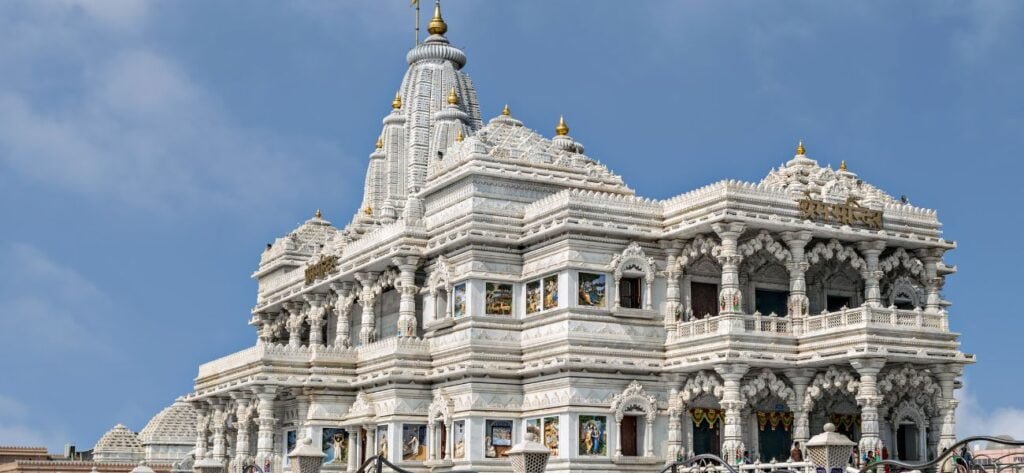
02 Days Mathura Vrindavan Tour
-
03 Days Mathura Vrindavan Tour
Original price was: ₹9,000.00.₹8,000.00Current price is: ₹8,000.00. -
04 Days Agra Mathura Vrindavan Tour
-
5 Days Braj 84 Kosh Yatra
🙏 Ready to Visit Gita Mandir Mathura with Experience My India?
WhatsApp us and receive your personalised Mathura itinerary within 30 minutes – Gita Mandir correctly placed in the 9:30-11:00 AM window, Gita Stambh context explained and all Mathura temple Aarti timings confirmed for your visit date. Tours from ₹1,999 per person.
WhatsApp +91-7302265809 – Book Now
Jai Shri Krishna 🙏