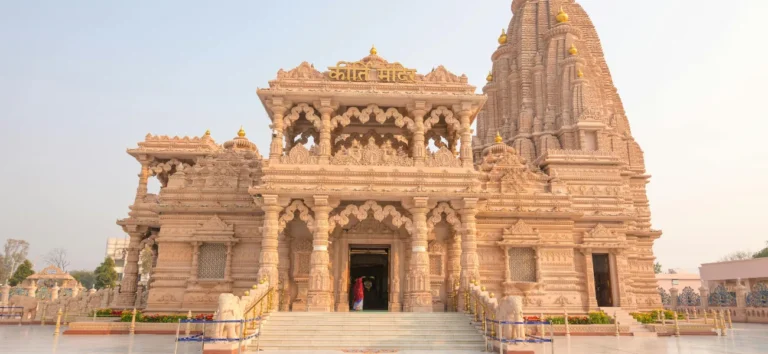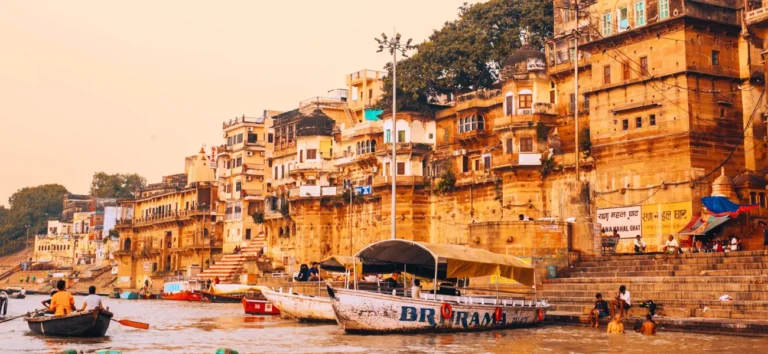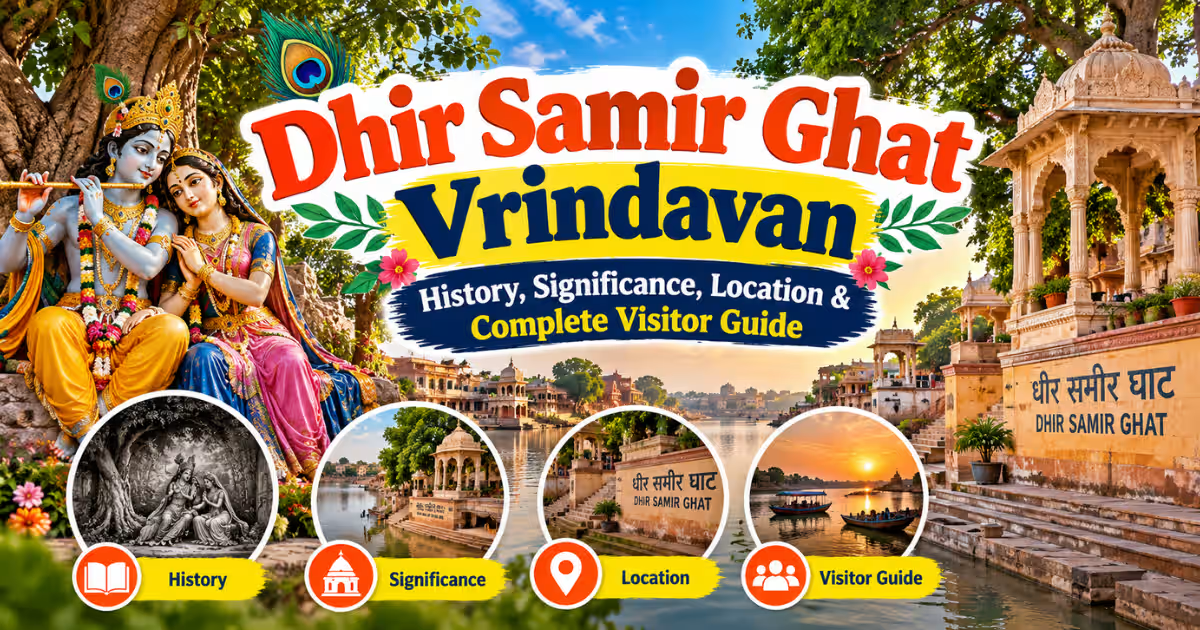
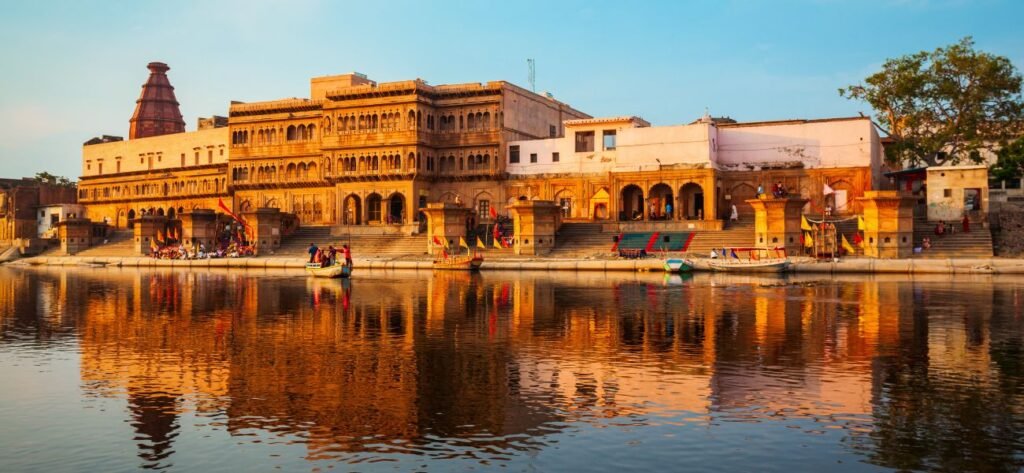
Dhir Samir Ghat (also Dheer Sameer Ghat) is a quiet, spiritually significant Yamuna riverbank ghat in old Vrindavan, located in the Vanshivat Muhalla near Keshi Ghat and Vanshi Vat – PIN 281121. It is the site immortalised in the opening verse of Jayadeva’s 12th-century Gita Govinda (“Dhira-samire yamuna-tire vasati vane vana-mali”), the site of Radha’s mana-bhanjana (dissolution of loving anger) and the location of the pushpa samadhi of Gauridas Pandit (16th-century companion of Chaitanya Mahaprabhu) and the Shyam Ray Temple. Entry is free. Experience My India includes it in the Vrindavan Parikrama circuit. See our Mathura Vrindavan tour Package or message WhatsApp +91 7302265809.
Vrindavan’s Quietest and Most Poetically Celebrated Ghat
Vrindavan has 84 ghats along the Yamuna River – each associated with a specific divine pastime of Lord Krishna. Most visitors know Keshi Ghat (the most famous) and walk no further. But a short walk northeast, tucked within the Vanshivat Muhalla of old Vrindavan, lies Dhir Samir Ghat – arguably the most poetically and theologically celebrated Yamuna bank in all of Braj.
Its name appears in the opening verse of the Gita Govinda – the 12th-century Sanskrit masterpiece by Jayadeva that shaped the devotional imagination of generations of Vaishnav poets, musicians and saints. It is where the Braj tradition holds that Radha’s mana (loving anger) was dissolved by Krishna. It is where Gauridas Pandit – a direct companion of Chaitanya Mahaprabhu – established his samadhi. And it maintains, in 2026, the rare quality of genuine quietness – something that most of Vrindavan’s more visited sites have long since lost.
I am Gurudutt, born and raised in Braj Bhoomi and founder of Experience My India. Since 2018, our team has guided over 50,000 pilgrims through Vrindavan. Dhir Samir Ghat is a site I include for every pilgrim who wants to go beyond the standard circuit. For the complete Vrindavan site guide, see the Vrindavan tour guide from Experience My India. The 3 Days Mathura Vrindavan Tour includes Dhir Samir Ghat on the Day 2 Parikrama Marg circuit. Call +91-7302265809.
Quick Facts – Dhir Samir Ghat at a Glance
| Attribute | Details |
| Full name | Dhir Samir Ghat (also: Dheer Sameer Ghat, Dhira Samira Ghat) |
| Location | Vanshivat Muhalla, old Vrindavan, Uttar Pradesh – PIN 281121 |
| On Yamuna’s bank? | Yes – Yamuna riverbank ghat |
| On Parikrama Marg? | Adjacent; in the Vanshivat Muhalla zone |
| Nearest major ghat | Keshi Ghat (short walk) |
| Nearest sacred grove | Vanshi Vat (adjacent) |
| Central landmark | Dheer Sameer Kunj Ashram |
| Literary connection | Gita Govinda by Jayadeva (12th century CE) |
| Sacred significance | Mana-Bhanjana Sthala – where Radha’s mana was dissolved |
| Saint’s samadhi | Gauridas Pandit (16th century; companion of Chaitanya Mahaprabhu) |
| Temple on site | Shyam Ray Temple – deity reportedly recovered from the Yamuna |
| Entry fee | Free |
| Character | Quiet, meditative, preferred by sadhus and serious pilgrims |
| Best time | Sunrise or late afternoon/sunset |
For all Vrindavan and Mathura sacred site timings, see the Mathura Vrindavan temple timings guide. Experience My India includes Dhir Samir Ghat in the extended Vrindavan Parikrama Marg circuit. The 5 Days Mathura Vrindavan Tour gives ample time for both the standard and the lesser-visited Vrindavan ghats. WhatsApp +91-7302265809.
Location & How to Reach Dhir Samir Ghat
Address: Vanshivat Muhalla, near Vanshi Vat and Keshi Ghat, Vrindavan, Uttar Pradesh – PIN 281121
| Starting Point | Distance | Walking Time | Notes |
| Keshi Ghat | Very short | 5-10 min walk | Walk northeast along the Parikrama Marg |
| Vanshi Vat | Adjacent | 2-5 min walk | Both are in the Vanshivat Muhalla zone |
| Banke Bihari Temple | 1-1.5 km | 15-20 min | Through inner Vrindavan lanes |
| ISKCON Vrindavan | 2.5-3 km | 30-40 min walk / 10 min auto | – |
| Mathura Junction (railway) | 15 km | 30-40 min by cab | Auto-rickshaw or pre-booked cab |
Navigation tip: From Keshi Ghat, walk northeast along the Yamuna bank or the Parikrama Marg. Ask for “Dheer Sameer Kunj Ashram” – this is the central landmark; the ghat is immediately adjacent. All parikrama walkers and local pilgrims know this name.
Vehicle access: The narrow lanes of the Vanshivat Muhalla do not accommodate cars. Auto-rickshaws can reach the nearest access point; the final 200-400 metres are always on foot. This is standard for all old Vrindavan ghats in this zone.
For NCR-based pilgrims, the Noida to Vrindavan distance guide covers the Yamuna Expressway approach to Vrindavan. Experience My India arranges the complete Vrindavan inner-city walking circuit from any hotel. The 2 Days Mathura Vrindavan Tour includes the Vanshivat Muhalla ghat circuit on Day 2 afternoon. Call +91-7302265809.
The Name – What “Dhira Samira” Means
The name of this ghat is both a description and a spiritual indicator:
| Sanskrit Word | Meaning | Context |
| Dhira | Calm, slow, gentle, steady | Describing the quality of the breeze at this spot |
| Samira | Wind, breeze | The Yamuna riverside wind |
| Dhira Samira | “Gentle breeze” or “calm wind” | The characteristic atmosphere of this specific Yamuna bank |
The name is not merely descriptive – it is theological. The Braj tradition holds that when Lord Krishna played his flute on the Yamuna bank at this spot, the winds that normally blow along the river slowed to a soft, gentle whisper – as if the wind itself did not want to create any sound that might disturb or overpower the flute’s melody. The breeze became a devotee, slowing itself to listen. The place acquired the name Dhira Samira – the place of the gentle wind.
This theological reading of the name is the reason it appears in the Gita Govinda’s opening verse – the poet Jayadeva was not describing a coincidental geographical feature but invoking a specific spiritual quality of this specific place on the Yamuna bank.
Experience My India explains the Sanskrit etymology of Braj site names to every group during the Vrindavan Parikrama Marg circuit. The top 25 places to visit in Mathura Vrindavan covers the broader Vrindavan and Mathura circuit. WhatsApp +91-7302265809.
The Gita Govinda Connection – Jayadeva’s Immortal Verse
Of all the associations of Dhir Samir Ghat, the most celebrated – and the one that gives the site its global literary significance – is its appearance in the Gita Govinda.
What Is the Gita Govinda?
The Gita Govinda (“Song of the Cowherd”) is a Sanskrit lyric poem composed by the poet Jayadeva in 12th-century Bengal. It depicts the love of Radha and Krishna in 12 chapters, 24 songs and 72 slokas – using the Yamuna bank settings of Vrindavan as its recurring landscape.
The Gita Govinda is considered one of the greatest works of Sanskrit literature and holds a unique liturgical status: its verses are recited and sung daily in the Jagannath Temple at Puri, Odisha and at the Guruvayur Temple in Kerala, among other major Vaishnav shrines. The poem’s influence on classical Indian dance (Odissi, Bharatanatyam, Manipuri), music and visual art is immeasurable.
The Verse from Dhir Samir Ghat
The opening line of one of the Gita Govinda’s most celebrated verses specifically names this location:
“Dhira-samire yamuna-tire vasati vane vana-mali…”
| Phrase | Translation |
| Dhira-samire | In the gentle breeze |
| Yamuna-tire | On the banks of the Yamuna |
| Vasati vane | Dwelling in the forest |
| Vana-mali | Krishna adorned with forest flower garlands |
The verse describes Krishna – adorned with forest flowers – waiting in the gentle breeze on the Yamuna bank for Radha. Every word of this opening places the reader at Dhir Samir Ghat specifically: the gentle breeze (dhira-samira), the Yamuna bank (yamuna-tire), the forest (vane).
This is why pilgrims and scholars of Braj devotional literature specifically seek out this ghat. When Jayadeva wrote this verse 900 years ago, he was describing a real place on the Yamuna – and that place is still there.
Experience My India explains the Gita Govinda verse in full at Dhir Samir Ghat for every interested group. The 8 Days Braj 84 Kosh Yatra includes multiple sessions in the Vrindavan ghat zone with full textual context. Call +91-7302265809.
The Mana-Bhanjana Sthala – Where Radha’s Loving Anger Was Dissolved
Among the many theological associations of Dhir Samir Ghat, one carries particular devotional weight in the Braj Vaishnav tradition: it is a Mana-Bhanjana Sthala.
What Is Mana?
| Term | Meaning | Devotional Context |
| Mana | Loving anger, jealous pride, a beloved’s righteous pique | Radha’s mana arises from Krishna’s dalliances with other gopis; it is not ordinary anger but a form of deep love |
| Bhanjana | Dissolution, breaking, resolving | The loving resolution of mana |
| Mana-Bhanjana | The dissolution of Radha’s loving anger | A specific divine pastime in Braj theology |
| Mana-Bhanjana Sthala | The sacred site where this event occurred | Dhir Samir Ghat |
The Significance
In the Radha-Krishna theology of Braj, Radha’s mana – her loving displeasure – is not a negative emotion but one of the most aesthetically refined states in the tradition of divine love (bhakti). When Radha becomes displeased with Krishna and withdraws, the entire landscape of Braj is affected. The resolution of that mana – when Krishna pacifies Radha through his devotion, his flute and his presence – is one of the most celebrated series of pastimes in Braj devotional literature.
At Dhir Samir Ghat, in the gentle breeze along the Yamuna, the tradition holds that this resolution occurred – Krishna’s presence in the dhira-samira atmosphere of this specific spot was what finally dissolved Radha’s mana.
The Gita Govinda itself is, in part, a narrative of this mana and its resolution – which is why Jayadeva chose this specific Yamuna bank as the setting.
For pilgrims interested in the Barsana outer circuit associated with Radha, see the Prem Sarovar Barsana guide. Experience My India explains the mana-bhanjana concept at the site. The 3 Days Mathura Vrindavan Tour from Ahmedabad and from Bangalore include the Vrindavan ghat circuit. WhatsApp +91-7302265809.
The Legend – Why the Wind Became Gentle
Beyond the textual and theological dimensions, Dhir Samir Ghat carries a specific local legend that explains both its name and its atmosphere:
When Lord Krishna played his flute on the banks of the Yamuna at this spot, the sound was of such divine quality that all of nature became devotees. The birds stopped singing. The Yamuna’s current slowed in its course. And the winds – which normally blow briskly along the open river – consciously slowed themselves to a gentle whisper.
The winds did not want to drown a single note of the flute. They became dhira (gentle, steady) and samira (a soft breeze) specifically at this location, specifically while the flute played.
This is why the Braj tradition holds that this specific stretch of the Yamuna bank retains the quality of dhira-samira even today – a subtle, calm atmosphere that pilgrims and meditators consistently notice as different from the surrounding areas.
Experience My India guides explain this legend at the site – and invite pilgrims to sit quietly for a few minutes and observe whether they notice the quality of the air at Dhir Samir Ghat. The Same Day Mathura Vrindavan Tour from Experience My India includes a brief stop at Dhir Samir on request. Call +91-7302265809.
Gauridas Pandit – The 16th-Century Saint’s Connection
Within the Dheer Sameer Kunj Ashram premises stands the pushpa samadhi of Gauridas Pandit – one of the most distinguished 16th-century Vaishnav saints of Bengal.
Who Was Gauridas Pandit?
| Detail | Information |
| Period | 16th century CE |
| Tradition | Gaudiya Vaishnavism; direct companion and associate of Chaitanya Mahaprabhu |
| Location of his main life | Ambika Kalna, Bengal (main place of practice); Vrindavan pilgrimage and seva |
| Relationship with Chaitanya | A close associate of Chaitanya Mahaprabhu’s Puri and Bengal circle |
| His samadhi here | Pushpa samadhi (a memorial filled with flowers, not the physical body) at Dhir Samir Ghat |
| Legacy | His tradition and the Shyam Ray deity he established continue in active worship |
Pushpa Samadhi vs Samadhi
It is important for pilgrims to understand the distinction:
| Type | Meaning |
| Samadhi | Memorial where the saint’s body is interred (standard for major saints) |
| Pushpa Samadhi | A memorial filled with flowers, established at a site associated with the saint’s practice – not the physical remains |
Gauridas Pandit’s pushpa samadhi at Dhir Samir Ghat marks a place associated with his devotional practice and his connection to the Yamuna bank. His primary samadhi is at Ambika Kalna, Bengal.
The top 10 places to visit in Mathura covers the broader Mathura-Vrindavan heritage context. The 4 Days Agra Mathura Vrindavan Tour gives enough time for the heritage ghat zone. WhatsApp +91-7302265809.
The Shyam Ray Temple – Deity from the Yamuna
Within the Dheer Sameer Kunj Ashram compound stands the Shyam Ray Temple – housing one of Vrindavan’s most distinctive deity origins.
| Detail | Information |
| Deity name | Shyam Ray (a name of Lord Krishna – “the dark beautiful one”) |
| Temple location | Within Dheer Sameer Kunj Ashram, Dhir Samir Ghat |
| How the deity arrived | According to tradition, Gauridas Pandit retrieved the deity directly from the Yamuna River |
| Significance of water recovery | A deity found within a sacred river is considered a self-manifested (svayambhu-type) form – not carved by human hands |
| Character | Small temple; intimate darshan; not on tourist circuits |
| Active worship | Yes – daily seva by the ashram |
The theological significance of a Yamuna-recovered deity: In the Vaishnav tradition, a deity found within a sacred body of water – as with the Banke Bihari deity revealed from Nidhivan, the Radha Raman deity manifested from a shaligram or the Dauji deity recovered from Sankarshan Kund – carries a specific spiritual status. It is understood as the deity choosing to reveal itself rather than being created. The Shyam Ray deity’s Yamuna origin gives it this sacred status within Gauridas Pandit’s tradition.
Experience My India includes the Shyam Ray Temple darshan for every Dhir Samir Ghat visit. The 3 Days Agra Mathura Vrindavan Tour gives time for the full ghat and temple heritage zone. Call +91-7302265809.
Dheer Sameer Kunj Ashram
The Dheer Sameer Kunj Ashram is the central institutional landmark of the Dhir Samir Ghat complex.
| Detail | Information |
| Type | Active Gaudiya Vaishnav ashram |
| Location | Directly at Dhir Samir Ghat, Vanshivat Muhalla, Vrindavan |
| What it houses | Pushpa samadhi of Gauridas Pandit; Shyam Ray Temple; ashram residential quarters |
| Daily programme | Regular bhajan, puja and kirtan – ask the ashram keeper for current schedule |
| Visitors welcome? | Yes – respectful visitors are always welcome in Vrindavan ashrams |
| Photography | Ask the ashram before photographing inside |
| Dress | Modest – covered shoulders and legs; remove footwear |
The ashram is small and traditional in character – it does not have a visitor centre or ticket booth. Simply enter respectfully, observe the practices in silence, take darshan at the Shyam Ray Temple and pay respects at the pushpa samadhi. The atmosphere is genuine ashram life, not a tourist attraction. Experience My India prepares every group for this context before visiting. WhatsApp +91-7302265809.
Visitor Guide – Best Time, Sunrise & Sunset
| Time | Experience | Crowd | Verdict |
| Sunrise (5:30-7:30 AM) | Yamuna mist; first light; birdsong; silence | None | ✅ Best – the most authentic Dhir Samir experience |
| Morning (8-11 AM) | Good light; active ashram | Very low | ✅ Excellent – temple worship in progress |
| Midday (12-3 PM) | Quiet; ashram resting | Very low | ⚠️ Peaceful but limited activity |
| Late afternoon (4-6 PM) | Gentle light; evening preparations | Low | ✅ Good – pairs with Keshi Ghat sunset Aarti |
| Sunset (6-7 PM) | Yamuna turns golden; evening kirtan from nearby temples | Very low | ✅ One of the most beautiful moments at this ghat |
Sunrise at Dhir Samir Ghat: The most consistent recommendation from pilgrims and sadhus who visit regularly is to arrive before sunrise. The combination of river mist, early morning light, the gentleness of the Yamuna at this hour and the literal dhira-samira quality of the morning air creates an experience that cannot be replicated later in the day.
For the complete Vrindavan sunrise and evening circuit plan, see the top 25 places to visit in Mathura Vrindavan. Experience My India sequences Dhir Samir Ghat in the early morning or late afternoon depending on the group’s program. The 5 Days Mathura Vrindavan Tour from Jaipur gives enough time for sunrise at Dhir Samir. Call +91-7302265809.
Where to Place Dhir Samir in the Vrindavan Circuit
Experience My India’s recommended sequence for including Dhir Samir Ghat in the Vrindavan Parikrama Marg morning circuit:
| Stop | Site | Distance / Time from Previous | Notes |
| 1 | Radha Damodar Temple | Starting point | 1542 CE; Jiva Goswami; samadhi |
| 2 | Radha Raman Temple | 200-300 m | 1542 CE; svayambhu deity |
| 3 | Seva Kunj | 300-400 m | Sacred grove; visit before 5 PM |
| 4 | Vanshi Vat | 200-300 m | The kadamba tree of Krishna’s flute |
| 5 | Dhir Samir Ghat | Adjacent (100-200 m) | Ghat + Shyam Ray Temple + samadhi |
| 6 | Keshi Ghat | 5-10 min walk | Evening Aarti at sunset |
This sequence is built into the Vrindavan Parikrama Marg circuit in the 2 Days Mathura Vrindavan Tour and the 3 Days Mathura Vrindavan Tour from Experience My India. Dhir Samir Ghat and Vanshi Vat together add approximately 30-45 minutes to the standard Keshi Ghat visit. WhatsApp +91-7302265809.
Ground Truth – What Nobody Tells You About Dhir Samir Ghat
After guiding 50,000+ pilgrims through Vrindavan since 2018, here is what Experience My India knows:
Dhir Samir Ghat is genuinely quiet – not because it is unknown, but because those who know it prefer not to publicise it. The sadhus and bhaktas who visit Dhir Samir Ghat regularly do not want it to become like Keshi Ghat – crowded, loud and commercial. It remains meditative precisely because it has stayed under the mainstream tourist radar. This guide exists to help the right kind of pilgrim find it – not to fill it with tour buses.
The Gita Govinda verse “Dhira-samire yamuna-tire” is sung in the Jagannath Temple, Puri and at Guruvayur, Kerala, every day. Most pilgrims who visit Dhir Samir Ghat have heard this verse sung in classical dance or devotional music without knowing they were hearing the name of a physical place on the Yamuna bank. Standing here while knowing this transforms the visit entirely.
Vanshi Vat – the kadamba tree associated with Krishna’s flute playing – is immediately adjacent to Dhir Samir Ghat. Most visitors who come specifically for Dhir Samir Ghat walk past Vanshi Vat without realising its separate significance. Experience My India always covers both in the same visit.
The Shyam Ray Temple inside the ashram is one of the few active temple deities in Vrindavan specifically associated with Gauridas Pandit’s tradition. Most temple deities in Vrindavan are from the Goswami traditions (Radha Raman, Radha Damodar, Govind Devi). The Shyam Ray Temple represents the Bengali Gaudiya Vaishnav line through Gauridas Pandit – a different but equally important devotional lineage.
Know Before You Visit – Dhir Samir Ghat Vrindavan
- Location: Vanshivat Muhalla, near Keshi Ghat and Vanshi Vat, Vrindavan – PIN 281121
- Ask for: “Dheer Sameer Kunj Ashram” – all local parikrama walkers know this name
- Entry: Free – ghat, ashram and temple all free
- Vehicle access: No cars; e-rickshaw to nearest Parikrama Marg point + 200-400 m walk
- Best time: Sunrise or late afternoon
- Time needed: 30-45 minutes (ghat + ashram + temple darshan)
- Dress: Modest; remove footwear at ashram and temple entrance
- Photography inside ashram: Ask the ashram keeper before photographing
- Combine with: Vanshi Vat (adjacent) + Keshi Ghat (5-10 min walk) for one complete session
- Gita Govinda: If possible, read the “Dhira-samire yamuna-tire” verse before visiting – it changes the experience
- Experience My India includes Dhir Samir Ghat in the Vrindavan Parikrama circuit. WhatsApp +91-7302265809.
Frequently Asked Questions
Dhir Samir Ghat (also spelled Dheer Sameer Ghat) is a quiet Yamuna riverbank ghat in old Vrindavan, located in the Vanshivat Muhalla near Keshi Ghat and Vanshi Vat – PIN 281121. It is most famous as the site named in the opening verse of Jayadeva’s 12th-century Gita Govinda (“Dhira-samire yamuna-tire vasati vane vana-mali”), which describes Krishna waiting in the gentle breeze on the Yamuna bank for Radha. The site also contains the Dheer Sameer Kunj Ashram, the pushpa samadhi of Gauridas Pandit and the Shyam Ray Temple. Entry is free. Experience My India includes it in the Parikrama Marg circuit. Call +91-7302265809.
Dhira Samira (also Dhir Samir) is a Sanskrit compound meaning “gentle breeze” or “calm wind” – dhira meaning slow, gentle or steady and samira meaning wind or breeze. The name refers to the specific quality of the Yamuna riverside wind at this location. According to Braj tradition, when Lord Krishna played his flute at this spot, the normally vigorous Yamuna winds slowed themselves to a gentle whisper so as not to drown out a single note of the flute. The place acquired the name Dhira Samira – the place of the gentle wind. Jayadeva used this name in the Gita Govinda’s opening verse. Experience My India explains this etymology at the site. WhatsApp +91-7302265809.
The famous verse from Jayadeva’s 12th-century Gita Govinda opens with “Dhira-samire yamuna-tire vasati vane vana-mali” – meaning: “In the gentle breeze, on the banks of the Yamuna, dwelling in the forest, stands the wearer of forest flower garlands (Krishna).” Every word specifically describes Dhir Samir Ghat: the gentle breeze (dhira-samira), the Yamuna bank (yamuna-tire), the forest setting (vane) and Krishna adorned with forest flowers (vana-mali). The Gita Govinda is recited daily in major Vaishnav temples including the Jagannath Temple at Puri. Standing at Dhir Samir Ghat while knowing this verse transforms the experience. Experience My India. Call +91-7302265809.
Mana-Bhanjana Sthala means “the sacred site of the dissolution of mana.” Mana in Braj devotional theology refers to Radha’s loving anger – a refined emotional state arising from Krishna’s association with other gopis, considered a form of intense love rather than ordinary anger. Bhanjana means the dissolution or resolution of this state. Dhir Samir Ghat is considered by the Braj Vaishnav tradition as the specific place on the Yamuna bank where Krishna, through his devotion and the atmosphere of the gentle breeze, dissolved Radha’s mana – a central narrative in the Gita Govinda. Experience My India explains this at the site. WhatsApp +91-7302265809.
Gauridas Pandit was a 16th-century Gaudiya Vaishnav saint and a close associate of Chaitanya Mahaprabhu – the devotional reformer who initiated the renaissance of Vrindavan pilgrimage in the 16th century. Gauridas Pandit’s tradition and devotional practice were connected to the Dhir Samir Ghat area of Vrindavan and a pushpa samadhi (a flower memorial, not the physical remains) is maintained at the Dheer Sameer Kunj Ashram on the ghat premises. His primary samadhi is at Ambika Kalna, Bengal. He also reportedly recovered the Shyam Ray deity from the Yamuna River, which is now enshrined in the Shyam Ray Temple at the ashram. Experience My India. Call +91-7302265809.
The Shyam Ray Temple within the Dheer Sameer Kunj Ashram at Dhir Samir Ghat houses a deity of Lord Shyam Ray (a name of Krishna meaning “the dark beautiful one”) that, according to tradition, was recovered from the Yamuna River by Gauridas Pandit in the 16th century. A deity found within a sacred river is considered spiritually significant – understood as self-manifested rather than carved, similar to other Yamuna-recovered deities in the Braj tradition. The temple is small and intimate, performs active daily seva and is free to visit for respectful pilgrims. Experience My India includes Shyam Ray Temple darshan in every Dhir Samir Ghat visit. WhatsApp +91-7302265809.
The best times to visit Dhir Samir Ghat are at sunrise (approximately 5:30 to 7:30 AM) and in the late afternoon before sunset (4:00 to 6:30 PM). The sunrise visit offers the most authentic experience of the ghat’s characteristic gentle atmosphere – river mist, birdsong and the quality of stillness that gave the site its name. The late afternoon visit pairs naturally with the sunset at Keshi Ghat (a short walk away) and its evening Yamuna Aarti. Both time windows have very low crowds. Experience My India plans sunrise visits for dedicated pilgrims. Call +91-7302265809.
From Keshi Ghat, walk northeast along the Yamuna bank or the Parikrama Marg for 5 to 10 minutes into the Vanshivat Muhalla area. Ask any local pilgrim or parikrama walker for “Dheer Sameer Kunj Ashram” – this is the central landmark and everyone in the Parikrama Marg zone knows it. No vehicles can reach the ghat directly – take an auto-rickshaw or e-rickshaw to the nearest Parikrama Marg access point in the Vanshivat Muhalla and walk the final 200 to 400 metres. GPS search “Dheer Sameer Ghat Vrindavan” or “Dheer Sameer Kunj Ashram” on Google Maps. Experience My India navigates to this site on all Parikrama Marg circuits. WhatsApp +91-7302265809.
Recommended products
-
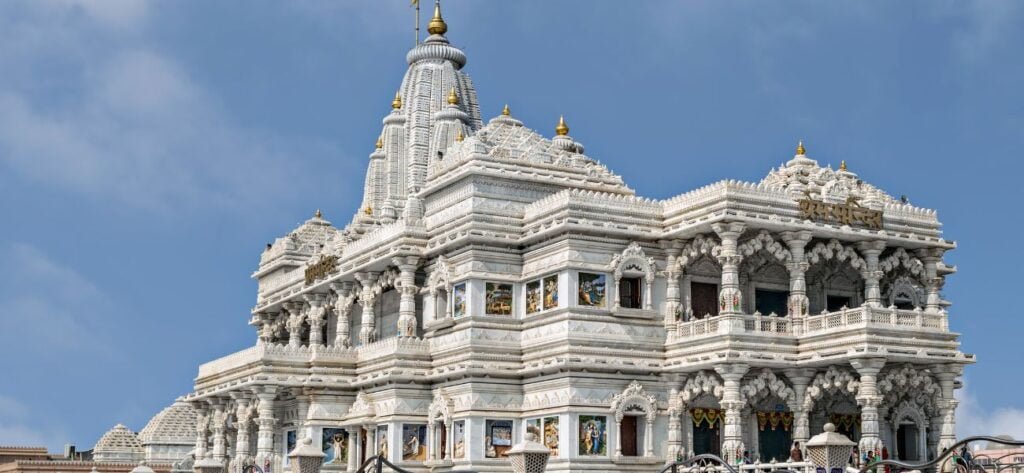
02 Days Mathura Vrindavan Tour
-
03 Days Mathura Vrindavan Tour
Original price was: ₹9,000.00.₹8,000.00Current price is: ₹8,000.00. -
04 Days Agra Mathura Vrindavan Tour
-
5 Days Braj 84 Kosh Yatra
Ready to Visit Dhir Samir Ghat with Experience My India?
WhatsApp us and receive your complete Vrindavan Parikrama Marg circuit plan – Vanshi Vat (Krishna’s flute grove), Dhir Samir Ghat (sunrise), Shyam Ray Temple, Keshi Ghat evening Aarti – with a Braj-born guide who explains the Gita Govinda verse at the spot where it was set.
Vrindavan Packages from ₹1,999 per person · Dhir Samir Ghat included on request
WhatsApp +91-7302265809 – Book Now
Jai Shri Krishna 🙏