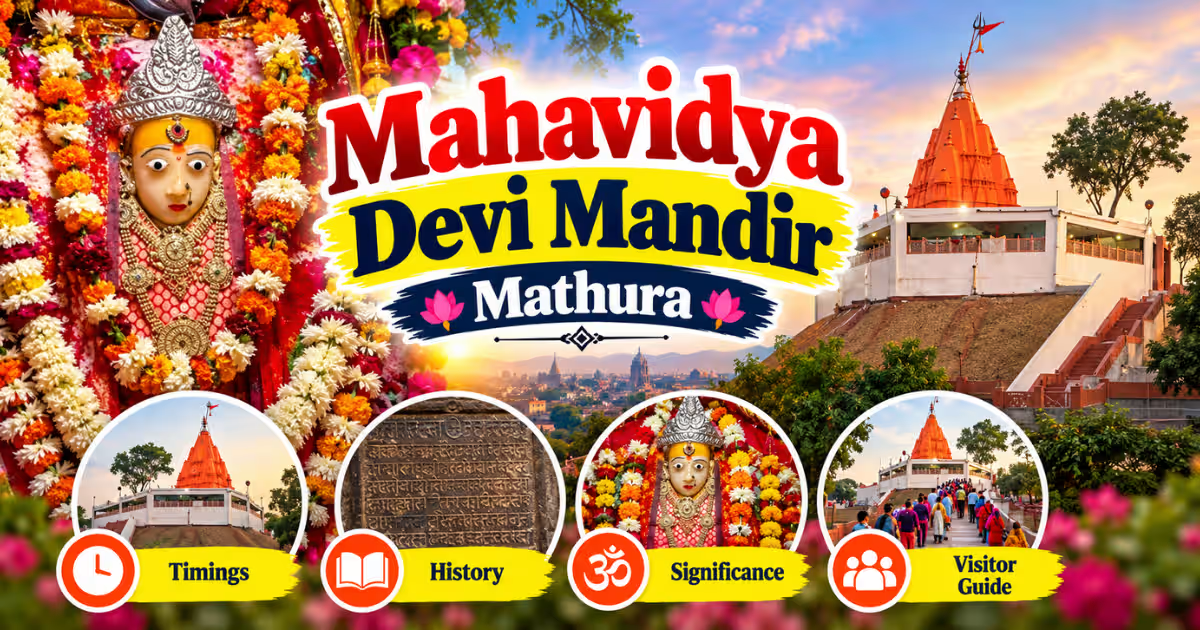
Mahavidya Devi Mandir is an ancient Shakti temple in Mathura dedicated to Goddess Mahavidya (also worshipped as Ambika Devi – a form of Goddess Parvati). Located on Mahavidya Road near the Ramleela Ground on a raised hillock overlooking the sacred Mahavidya Kund, it is revered as the Kuldevi (family deity) of Nand Baba (Lord Krishna’s foster father) and the guardian goddess of Mathura’s Chaturvedi community. Timings: 6 AM-1 PM and 4 PM-9 PM daily. Entry is free. Experience My India includes it in the Mathura heritage circuit. See our Mathura Vrindavan tour Package or message WhatsApp +91 7302265809.
Mathura’s Ancient Shakti Shrine – Older Than the City’s Famous Vaishnav Circuit
When pilgrims think of Mathura, they think of Krishna Janmabhoomi, Dwarkadhish Temple and Vishram Ghat. But Mathura’s sacred geography predates the Vaishnav circuit by millennia – and at its centre is the Mahavidya Devi Mandir, an ancient Shakti shrine whose roots reach back to the Bhagavata Purana and the era of the Pandavas.
Mahavidya Devi Mandir stands on a raised hillock on Mahavidya Road, near the Ramleela Ground, overlooking the Mahavidya Kund. It is dedicated to Goddess Mahavidya – also worshipped here as Ambika Devi, a form of Goddess Parvati – and it is the Kuldevi (family goddess) of Nand Baba, Lord Krishna’s foster father. It is where Vasudeva and Devaki prayed before Krishna’s birth. It is where the Pandavas prayed during their vanavas. And it is where the area’s grand Ramleela performers come every Dussehra to receive the Goddess’s blessings.
This is not a minor or obscure temple. It is one of Mathura’s most ancient and most theologically layered sacred sites – and one of the least visited by pilgrims focused exclusively on the Vaishnav circuit.
I am Gurudutt, born and raised in Braj Bhoomi and founder of Experience My India. Since 2018, our team has guided over 50,000 pilgrims through Mathura – including this temple, which I include for every pilgrim who wants to go beyond the standard circuit. For the complete Mathura sightseeing guide, see the top 10 places to visit in Mathura. The 3 Days Mathura Vrindavan Tour from Experience My India includes Mahavidya Devi Mandir in the Mathura heritage circuit. Call +91-7302265809.
Quick Facts at a Glance
| Attribute | Details |
| Full name | Mahavidya Devi Mandir (also: Ambika Devi Mandir) |
| Deity | Goddess Mahavidya / Ambika Devi (form of Goddess Parvati / Shakti) |
| Location | Mahavidya Road, near Ramleela Ground, Mathura, Uttar Pradesh |
| Geographical feature | Raised hillock overlooking Mahavidya Kund |
| Morning timings | 6:00 AM – 1:00 PM (midday bhog pause 11:30 AM) |
| Evening timings | 4:00 PM – 9:00 PM (includes evening aarti) |
| Entry fee | Free |
| Historical area name | Ambikavan – once a dense sacred forest |
| Scriptural reference | Bhagavata Purana (Ambikavan; Nand Baba and serpent liberation) |
| Kuldevi of | Nand Baba (Krishna’s foster father); Mathura’s Chaturvedi community |
| Temple architecture | Nagar style; present structure from late 18th century (Maratha Peshwas) |
| Later restoration | 1907 by Tantrik saint Sheelchandra |
| Special tradition | Ramleela actors seek blessing here on Dussehra (Vijayadashami) |
| Navratri | Major festival at this temple |
For all Mathura temple timings in one place, see the Mathura Vrindavan temple timings guide. The 2 Days Mathura Vrindavan Tour from Experience My India includes the Mathura heritage circuit. WhatsApp +91-7302265809.
Location & How to Reach
Address: Mahavidya Road, near Ramleela Ground, Mathura, Uttar Pradesh
| Starting Point | Distance | Travel Time | Notes |
| Mathura Junction (railway) | 2-3 km | 10-15 min by auto | Auto-rickshaw: “Mahavidya Devi Mandir” |
| Krishna Janmabhoomi | 1-1.5 km | 10 min walk / 5 min auto | Within Mathura old city |
| Vishram Ghat | 1-2 km | 10-15 min walk | Through Mathura old city lanes |
| Dwarkadhish Temple | 1 km | 10 min walk | Adjacent zone |
| Vrindavan | 15 km | 25-30 min by cab | – |
| Delhi (Yamuna Expy) | 165 km | 2.5-3 hrs | Yamuna Expressway → Mathura |
Navigation: Search “Mahavidya Devi Mandir Mathura” on Google Maps. The temple is on a raised hillock on Mahavidya Road – visible from the road. Auto-rickshaws in Mathura know this temple by name.
For NCR-based pilgrims, the Noida to Vrindavan distance guide covers the Yamuna Expressway approach to Mathura. Experience My India includes Mahavidya Devi Mandir in the Mathura old-city heritage circuit. The 5 Days Mathura Vrindavan Tour gives ample time for this temple and the full Mathura circuit. Call +91-7302265809.
Temple Timings – Mahavidya Devi Mandir
| Session | Opening | Closing | Notes |
| Morning darshan | 6:00 AM | 1:00 PM | Brief pause at 11:30 AM for midday bhog (food offering to the deity) |
| Evening darshan | 4:00 PM | 9:00 PM | Evening aarti included; most devotionally active session |
| Navratri | Extended | Extended | Timings expand during Navratri; check locally |
Best time to visit: The evening session (4-9 PM) is the most atmospherically rich – the aarti in the elevated hillock setting, overlooking the Mahavidya Kund, is particularly evocative. Morning visits (6-11:30 AM) are quieter and more meditative.
Note on midday bhog: The approximately 11:30 AM pause for midday bhog is brief – the temple typically reopens within 15-30 minutes for darshan before the 1 PM morning session close. Plan your arrival to avoid this window if you have limited time.
For the complete Mathura sightseeing sequence that can incorporate Mahavidya Devi Mandir with other temples, see the top 25 places to visit in Mathura Vrindavan. Experience My India includes Mahavidya in the morning Mathura heritage circuit. The Same Day Mathura Vrindavan Tour can include this temple on request. WhatsApp +91-7302265809.
The Goddess – Who Is Mahavidya / Ambika Devi?
| Name | Significance |
| Mahavidya | “The Great Knowledge” – Maha (great) + Vidya (knowledge, learning, power); a specific form of Goddess Shakti associated with supreme divine knowledge |
| Ambika Devi | “The Mother” – the benevolent, nurturing form of Goddess Parvati; the mother aspect of Shakti |
| Parvati | The primary form; the divine consort of Lord Shiva |
| As Kuldevi | In the Braj tradition, the Goddess here is specifically the Kuldevi of Nand Baba’s family and the Chaturvedi community – a community protectress who guards the lineage |
The term “Mahavidya” also refers to the group of ten tantric goddess forms (Dasha Mahavidyas) – Kali, Tara, Tripura Sundari, etc. – but in this specific Mathura temple, the name refers to the individual Shakti deity of this site, worshipped primarily as Ambika Devi / Parvati.
Who visits and for what: Women primarily visit Mahavidya Devi Mandir to pray for marital bliss, family wellbeing, husband’s health and longevity and wish fulfilment. The temple is also visited by women seeking blessings for fertility and children. The Goddess is particularly associated with family protection and lineage continuity – which is consistent with her Kuldevi status.
Experience My India provides full context on the Goddess’s forms and the temple’s specific prayer traditions. The Gayatri Tapobhumi guide covers another Mathura site connected to the Shakti tradition. Call +91-7302265809.
Historical & Mythological Significance
The Ambikavan – The Sacred Forest of the Goddess
The area now known as Mahavidya Road was, in ancient times, a dense sacred forest called Ambikavan – the “Forest of Ambika (the Mother Goddess).”
| Detail | Information |
| Ancient name | Ambikavan (Ambika = Mother Goddess; Van = Forest) |
| Scriptural reference | Bhagavata Purana – specifically references this forest in association with a Yadu clan pilgrimage |
| Character | A sacred forest dedicated to the Goddess; a place of tapasya and pilgrimage |
| Current form | The dense forest is gone; the hillock remains; the sacred geography preserved in the temple complex |
The Bhagavata Purana’s reference to Ambikavan as a pilgrimage site of the Yadu clan places this location within the oldest layers of Braj sacred geography – predating the Krishna-Vrindavan pastoral era. This is one of the sites that establishes Mathura’s sacred identity as a Shakti pilgrimage location independent of – and prior to – its identity as Krishna’s birthplace.
For the complete Mathura sacred geography including this ancient dimension, see the top 10 places to visit in Mathura. Experience My India explains the Ambikavan historical layer to every group visiting this temple. The 3 Days Mathura Vrindavan Tour from Ahmedabad includes the Mathura heritage circuit. WhatsApp +91-7302265809.
Kuldevi of Nand Baba – The Family Goddess of Krishna’s Foster Father
The most significant devotional connection of Mahavidya Devi Mandir in the Braj tradition is this: Goddess Mahavidya/Ambika is the Kuldevi – the family goddess – of Nand Baba, Lord Krishna’s beloved foster father.
| Connection | Detail |
| Who is Nand Baba? | The chief of the Gokul cowherd community (Gopas); the man who raised Lord Krishna as his own son |
| What is Kuldevi? | The family’s protective goddess – worshipped at major life events (birth, marriage, death); the deity who guards the lineage across generations |
| Why this matters | Lord Krishna’s childhood was spent in a family that worshipped the Goddess Mahavidya/Ambika as their Kuldevi – the Vaishnav and Shakti traditions interweave here |
| Chaturvedi community | Goddess Mahavidya is also the traditional Kuldevi of the Chaturvedi (Brahmin) community native to Mathura – many of whom are hereditary priests at Mathura’s ancient temples |
The Kuldevi connection makes Mahavidya Devi Mandir one of the most important temples in Mathura for devotees tracing their family’s Braj roots – particularly those of the Chaturvedi, Tiwari and related communities.
For pilgrims visiting the Gokul tourist places guide – which covers the sites associated with Nand Baba and Krishna’s childhood – the Mahavidya Devi Mandir represents the Kuldevi dimension of that same family. Experience My India connects both sites in the outer Braj circuit. The 3 Days Mathura Vrindavan Tour from Bangalore includes the outer circuit. Call +91-7302265809.
The Ambikavan Legend – Nand Baba and the Serpent Liberation
The Bhagavata Purana records a specific, dramatic event that occurred at Ambikavan – directly naming this location:
During a pilgrimage to the Ambikavan forest to worship the Goddess, Nand Baba was caught and swallowed by a massive python. As the cowherd community watched in horror, Lord Krishna arrived. He touched the serpent with his foot.
The touch of Krishna’s foot instantly liberated the python from an ancient curse – it was not an ordinary serpent at all, but a divine being named Sudarshana, a Vidyadhara (a class of celestial beings) who had been cursed to take the form of a python. Krishna’s touch restored Sudarshana to his original celestial form. He bowed in gratitude and ascended to his heavenly abode.
| Element | Detail |
| Who was the python? | Sudarshana – a Vidyadhara cursed to take serpent form |
| The curse | Placed by celestial sages for some transgression |
| The liberation | Lord Krishna touched the serpent with his foot – the lightest of divine touches freed the being from its curse |
| Theological reading | Even the Goddess’s sacred forest was visited by Krishna’s grace – the intersection of Shakti and Vaishnav traditions |
| What happened to Sudarshana | Restored to divine Vidyadhara form; bowed to Krishna; returned to celestial realm |
This event is recorded in Bhagavata Purana, Canto 10, in the chapters covering Krishna’s early childhood pastimes – giving it canonical Puranic authority.
Experience My India explains this Ambikavan narrative in full at the temple. The 5 Days Mathura Vrindavan Tour includes the complete Mathura heritage circuit with all Puranic narratives. WhatsApp +91-7302265809.
Vasudeva and Devaki’s Prayers Before Krishna’s Birth
According to local tradition preserved at the temple, Vasudeva and Devaki – Lord Krishna’s biological parents, imprisoned by Kansa in Mathura’s prison – prayed to Goddess Mahavidya before Krishna’s birth.
| Detail | Information |
| Who prayed? | Vasudeva (Krishna’s father) and Devaki (Krishna’s mother) |
| When? | Before the birth of Lord Krishna; during their imprisonment by Kansa |
| Purpose | Prayer for divine protection; for the child who would liberate them and defeat Kansa |
| Significance | The Goddess Mahavidya received the prayers that preceded the most celebrated birth in the Braj tradition |
This connection places Mahavidya Devi Mandir at the very beginning of the Krishna narrative – the temple where the prayers of his parents were heard before he was born in the Mathura prison. For pilgrims visiting Krishna Janmabhoomi (the birthplace), this temple provides the devotional prologue to that sacred site.
The top 25 places to visit in Mathura Vrindavan covers the complete Mathura sacred sites including Janmabhoomi. Experience My India sequences the Mahavidya Devi Mandir visit before Krishna Janmabhoomi for pilgrims who want the full narrative arc. Call +91-7302265809.
The Pandava Connection
The site’s sacred history predates even the Krishna era – local tradition holds that the Pandavas – the five brothers of the Mahabharata – stopped at this hillock during their vanavas (forest exile) and offered prayers to Goddess Shakti.
| Detail | Information |
| Who came? | The five Pandavas (Yudhishthira, Bhima, Arjuna, Nakula, Sahadeva) |
| When? | During their 12-year forest exile (vanavas) as recorded in the Mahabharata |
| Purpose | Offering prayers to Goddess Shakti for strength, protection and eventual victory |
| The hillock’s role | The raised position of the site made it a natural location for Shakti worship during the long journey through forests and sacred sites |
This Pandava connection places Mahavidya Devi Mandir within the Mahabharata pilgrimage tradition – a layer of Braj sacred history that significantly predates the Vaishnav devotional era of the medieval period. Mathura and the Braj region appear repeatedly in the Mahabharata, not only in the context of Krishna’s birth but as an ancient sacred geography that both the Pandavas and the Yadavas venerated.
Experience My India explains the Pandava layer of Mathura’s sacred geography for every group. The 8 Days Braj 84 Kosh Yatra covers the complete sacred geography of Braj with full historical context. WhatsApp +91-7302265809.
Krishna’s Mundan at Mahavidya
Local lore at the temple preserves one more striking association: Lord Krishna’s childhood mundan (head-shaving ritual / Chudakarana Samskara) is said to have been performed at this sacred spot.
| Detail | Information |
| Mundan (Chudakarana) | One of the 16 Hindu samskaras (life-passage rituals); the child’s first head-shaving, typically performed between age 1 and 3 |
| Why here? | As the Kuldevi of Nand Baba’s family, the temple was the natural location for performing major family samskaras |
| Significance | Lord Krishna’s hair shaved at his Kuldevi’s shrine – connecting the most beloved childhood Krishna narratives to the Shakti tradition |
This tradition explains why many Mathura-area families still bring their children for mundan at Mahavidya Devi Mandir – following the same tradition attributed to Nand Baba for the infant Krishna. The temple thus serves as an active site of family samskara practice, not just a historical pilgrimage.
The Gokul tourist places guide covers the Gokul sites associated with Krishna’s childhood including Nand Bhavan. Experience My India includes Mahavidya Devi Mandir in the Nand Baba family circuit. The 4 Days Agra Mathura Vrindavan Tour covers the complete Mathura-Gokul circuit. Call +91-7302265809.
Maratha Restoration – The Peshwas & Sheelchandra
The current temple structure at Mahavidya Devi Mandir dates to the late 18th century – built and restored by the Maratha Peshwas.
| Phase | Who | When | What |
| Original site | Prehistoric/Puranic | Ancient (Ambikavan era) | The sacred hillock and Mahavidya Kund |
| Maratha restoration | Maratha Peshwas | Late 18th century CE | Present Nagar-style temple structure constructed/restored |
| Later restoration | Tantrik saint Sheelchandra | 1907 CE | Significant restoration and religious reactivation |
Why the Marathas? The Maratha Peshwas – particularly during the 18th century – were significant patrons of Hindu pilgrimage site restoration across North India, from Varanasi to Mathura to Vrindavan. The Maratha patronage of the Mahavidya Devi Mandir is part of this wider programme of Hindu sacred site revival after the disruptions of the Mughal era.
Sheelchandra’s restoration in 1907 represents a specifically Tantrik religious tradition maintaining the temple’s Shakti character – consistent with the Mahavidya identification, which has strong Tantric associations in the wider tradition.
The Delhi to Govardhan distance guide covers the Govardhan outer circuit – another Braj site with Maratha patronage in its heritage. Experience My India provides historical context at every heritage site. The 3 Days Agra Mathura Vrindavan Tour covers the Mathura heritage circuit. WhatsApp +91-7302265809.
Dussehra & Ramleela Tradition
One of the most distinctive and living traditions associated with Mahavidya Devi Mandir is its role in Mathura’s annual Ramleela and Dussehra festival:
| Detail | Information |
| The tradition | The actors portraying Lord Rama and Lakshmana in the city’s grand Ramleela specifically visit this temple on Vijayadashami (Dussehra) |
| Purpose | To seek Goddess Mahavidya’s blessings before performing the Ravan Vadh (the slaying of Ravana) |
| Significance | The Goddess’s blessing is sought for the performance of dharmic victory – consistent with her Shakti identity as the source of divine power for righteous action |
| When | Vijayadashami (Dussehra) – the 10th day of Navratri; dates vary annually |
| Why this temple? | As the city’s ancient Shakti guardian, the Goddess’s blessing for the enactment of Rama’s victory is theologically natural |
This living tradition – continuing today – makes the Mahavidya Devi Mandir one of Mathura’s most culturally active temples beyond the standard pilgrimage calendar. The Dussehra blessing ceremony is a genuinely distinctive community practice that connects the Shakti tradition to the Ram tradition in the specific Mathura cultural context.
Experience My India advises groups visiting during Navratri and Dussehra season to include the Mahavidya Devi Mandir visit specifically. The Prem Sarovar Barsana guide covers the Barsana outer circuit for pilgrims staying multiple days. Call +91-7302265809.
Mahavidya Kund
The Mahavidya Kund – the sacred water body overlooked by the hillock on which the temple stands – is an integral part of the sacred complex.
| Detail | Information |
| What it is | A sacred pond (kund) associated with the Goddess |
| Location | Below the hillock on which the temple stands |
| Significance | Part of the ancient Ambikavan sacred geography; integral to the pilgrimage tradition of this site |
| Ritual use | Devotees take a ritual dip or perform ritual worship at the kund before ascending to the temple |
| Current state | Present; maintained as part of the temple complex |
The elevated position of the temple above the kund creates a classic sacred topography – the Goddess on the hill, the sacred water at its base – that is found at many ancient Shakti temples across India. This layout reflects the original Ambikavan sacred geography, preserved in the current site plan.
Experience My India explains the kund’s significance and the sacred topography of the site to every group. The Vrindavan tour guide covers the Vrindavan kunds in the complementary Vaishnav circuit. WhatsApp +91-7302265809.
Navratri at Mahavidya Devi Mandir
Navratri – the nine-night Goddess festival observed twice annually (Chaitra Navratri in spring and Shardiya Navratri in autumn) – is the most significant festival at Mahavidya Devi Mandir.
| Detail | Information |
| Chaitra Navratri | March-April; spring Navratri |
| Shardiya Navratri | September-October; the more widely celebrated autumn Navratri |
| Temple character during Navratri | Extended timings; major crowds; special puja and aarti schedules; cultural programmes |
| Devotee profile | Large number of local women; families performing Kuldevi worship; pilgrims from outside Mathura |
| Special practices | Devi Mahatmya recitation; Kanya Puja (worship of young girls as the Goddess); akhanda jyoti (continuous lamp) |
| Vijayadashami | Dussehra on the 10th day – the Ramleela blessing tradition described above |
Experience My India advises Navratri-period visitors to arrive early and allow extra time at Mahavidya Devi Mandir. The 5 Days Mathura Vrindavan Tour from Jaipur gives Rajasthan-origin pilgrims ample time for the complete Mathura circuit during Navratri. Call +91-7302265809.
Ground Truth – What Nobody Tells You About Mahavidya Devi Mandir
After guiding 50,000+ pilgrims through Mathura since 2018, here is what Experience My India knows:
Mahavidya Devi Mandir is one of Mathura’s oldest and most theologically layered temples – and one of the least featured on standard pilgrimage itineraries. The Mathura circuit most travel guides give – Janmabhoomi, Dwarkadhish, Vishram Ghat – omits the Shakti dimension of Mathura’s sacred geography entirely. The Mahavidya Devi Mandir is where that dimension lives. Experience My India always includes it for pilgrims who want the complete Mathura.
The Kuldevi connection is the most personally relevant aspect for many Mathura-region pilgrims. Families from the Chaturvedi, Tiwari and related communities who have roots in Mathura often find that Mahavidya Devi is their own family’s Kuldevi. The temple is not just a historical site for these families – it is the Goddess of their lineage.
The Ambikavan narrative in the Bhagavata Purana (Nand Baba and the serpent Sudarshana) is canonical scripture – not local legend. The event is recorded in Bhagavata Purana, Canto 10. It is the same scriptural authority as the Govardhan lift narrative or the Kaliya subduing. The Mahavidya Devi Mandir is therefore a scripturally attested Puranic pilgrimage site.
The midday bhog pause at 11:30 AM is brief – 15-30 minutes – but many visitors arrive at 11:45 AM and assume the temple is closed. If you arrive and find the sanctum briefly closed for bhog, wait – it reopens shortly.
Know Before You Visit – Mahavidya Devi Mandir
- Address: Mahavidya Road, near Ramleela Ground, Mathura, UP
- Morning timings: 6:00 AM – 1:00 PM (brief bhog pause 11:30 AM)
- Evening timings: 4:00 PM – 9:00 PM (aarti included)
- Entry: Free
- Best time: Evening session (4-9 PM) for aarti in the hillock setting; morning (6-11 AM) for quiet darshan
- Getting there: Auto-rickshaw from Mathura city; ask for “Mahavidya Devi Mandir” or “Mahavidya Road”
- Navratri: Extended timings; major crowds; arrive early
- Dussehra: Ramleela blessing ceremony – distinctive living tradition
- Combined with: Krishna Janmabhoomi, Dwarkadhish Temple, Vishram Ghat (all within 1-2 km)
- Women’s prayers: Specifically revered for marital bliss, family wellbeing, husband’s health
- Experience My India includes this temple in the Mathura heritage circuit. WhatsApp +91-7302265809.
Frequently Asked Questions
Mahavidya Devi Mandir is an ancient Shakti temple in Mathura dedicated to Goddess Mahavidya, also worshipped as Ambika Devi – a form of Goddess Parvati. Located on Mahavidya Road near the Ramleela Ground on a raised hillock overlooking the Mahavidya Kund, it is one of Mathura’s oldest and most historically layered sacred sites. It is the Kuldevi (family goddess) of Nand Baba (Lord Krishna’s foster father) and of Mathura’s Chaturvedi community. The area was originally a dense sacred forest called Ambikavan, referenced in the Bhagavata Purana. Entry is free. Experience My India. Call +91-7302265809.
Mahavidya Devi Mandir is open in two daily sessions: morning from 6:00 AM to 1:00 PM (with a brief closure at approximately 11:30 AM for the midday bhog offering to the deity) and evening from 4:00 PM to 9:00 PM including the evening aarti. During Navratri (both Chaitra in spring and Shardiya in autumn), the timings are typically extended. The evening session (4 to 9 PM) is the most devotionally active, with the aarti in the hillock setting particularly atmospheric. Entry is free. Experience My India. WhatsApp +91-7302265809.
Kuldevi means the family’s protective goddess – worshipped at major life events to seek the deity’s blessing for the entire lineage. Goddess Mahavidya/Ambika is the Kuldevi of Nand Baba’s family – the cowherd community of Gokul of which Nand Baba was chief and within which Lord Krishna was raised. This is why Lord Krishna’s childhood mundan (head-shaving ritual) is traditionally said to have been performed at this temple and why the Ambikavan pilgrimage in the Bhagavata Purana involves Nand Baba specifically. Mahavidya Devi is also the Kuldevi of Mathura’s native Chaturvedi Brahmin community. Experience My India. Call +91-7302265809.
According to the Bhagavata Purana (Canto 10), during a pilgrimage to the Ambikavan forest – the ancient name of the area now known as Mahavidya Road – Nand Baba (Lord Krishna’s foster father) was caught and swallowed by a large python. Lord Krishna arrived and touched the serpent with his foot. The divine touch instantly liberated the python from an ancient curse – it was not an ordinary serpent but a celestial Vidyadhara being named Sudarshana who had been cursed to take serpent form. Sudarshana was restored to his divine form, bowed in gratitude to Krishna and ascended to the heavens. This event is recorded in canonical scripture. Experience My India. WhatsApp +91-7302265809.
By a specific Mathura local custom, the performers enacting the roles of Lord Rama and Lakshmana in the city’s grand annual Ramleela come to Mahavidya Devi Mandir on Vijayadashami (Dussehra – the 10th day of Navratri) to seek the Goddess’s blessings before performing the Ravan Vadh (the enactment of Ravana’s defeat). This living tradition connects the Shakti temple to both the Vaishnav pilgrimage culture and the Ram devotional tradition of Mathura in a single annual ceremony. It is one of the most distinctive cultural practices associated with any specific Mathura temple. Experience My India. Call +91-7302265809.
The present Nagar-style temple structure at Mahavidya Devi Mandir was constructed and restored by the Maratha Peshwas in the late 18th century CE – part of the Maratha patronage of Hindu sacred site restoration across North India after the disruptions of the Mughal era. The site itself is far older, rooted in the Puranic tradition of Ambikavan. In 1907, Tantrik saint Sheelchandra carried out a significant further restoration, maintaining the temple’s Shakti and Tantrik religious character. The hillock, the Mahavidya Kund and the sacred geography are original; the temple structure is 18th century. Experience My India. WhatsApp +91-7302265809.
Yes – both are within Mathura’s old city, approximately 1 to 1.5 km apart. A single Mathura day can comfortably include: Mahavidya Devi Mandir (morning darshan 7-9 AM), then Krishna Janmabhoomi (9 AM-12 PM), then Dwarkadhish Temple and Vishram Ghat. The experience of visiting Mahavidya Devi Mandir – where Vasudeva and Devaki are said to have prayed before Krishna’s birth – before Krishna Janmabhoomi creates a meaningful narrative arc. Experience My India sequences the Mathura old-city circuit this way for every guided visit. Call +91-7302265809.
Women visit Mahavidya Devi Mandir primarily to pray for marital bliss, husband’s health and longevity, family wellbeing and wish fulfilment. The Goddess Mahavidya/Ambika Devi, in her role as the family’s Kuldevi and as a form of Parvati (the supreme model of devoted wifehood in the Shakti tradition), is considered particularly responsive to these prayers. The temple is also visited for fertility blessings and for the protection of children. Families bring children for mundan (first head-shaving ritual) here, following the tradition attributed to Nand Baba for the infant Krishna. Experience My India. WhatsApp +91-7302265809.
Recommended products
-
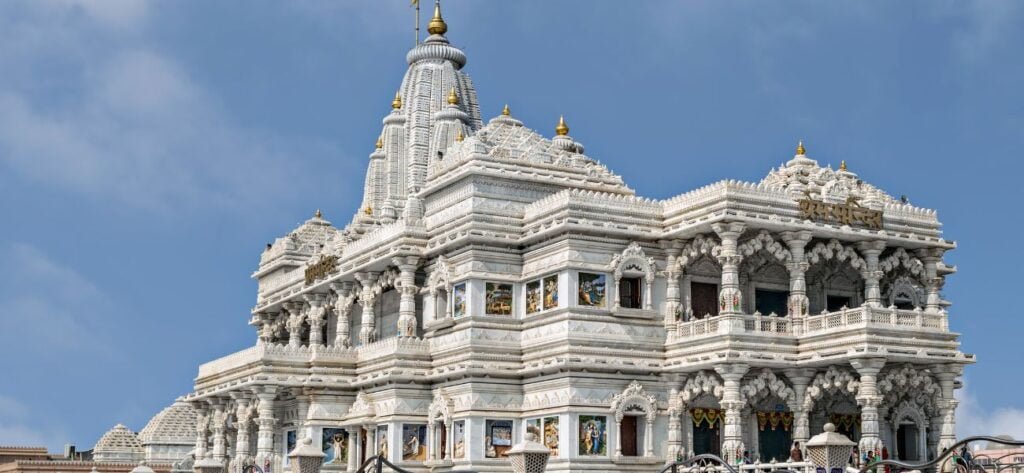
02 Days Mathura Vrindavan Tour
-
03 Days Mathura Vrindavan Tour
Original price was: ₹9,000.00.₹8,000.00Current price is: ₹8,000.00. -
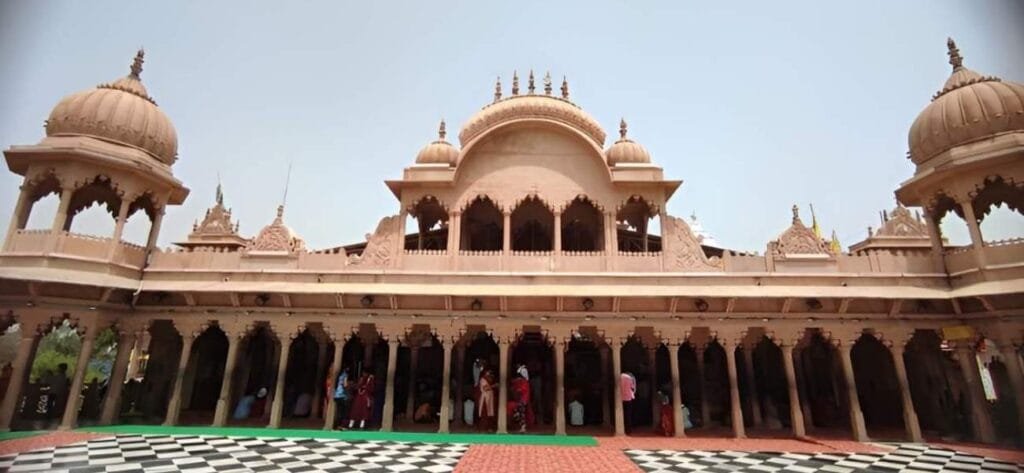
04 Days Agra Mathura Vrindavan Tour
-
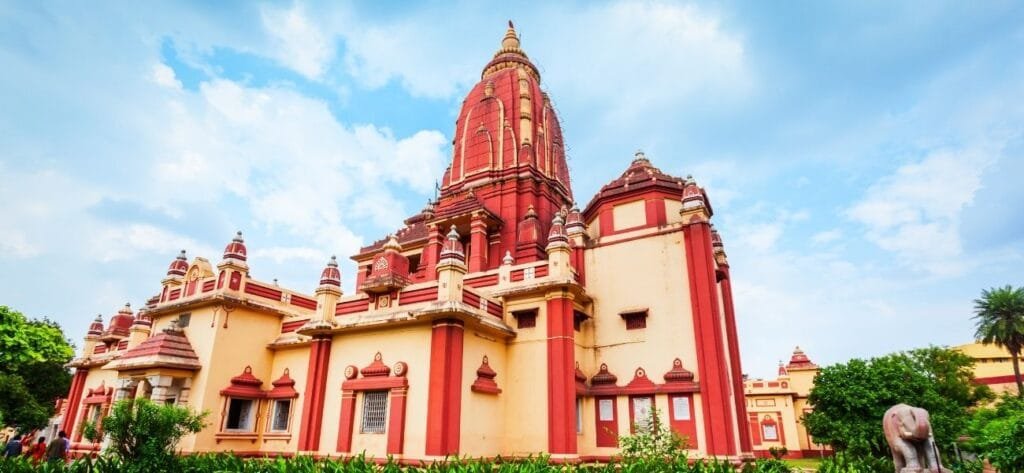
5 Days Braj 84 Kosh Yatra
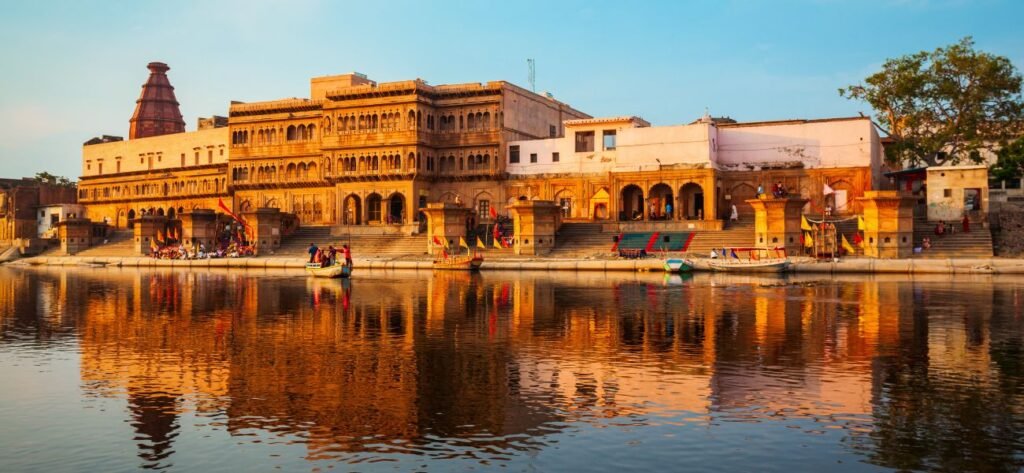
Ready to Visit Mahavidya Devi Mandir with Experience My India?
WhatsApp us and receive your complete Mathura heritage circuit plan – Mahavidya Devi Mandir (morning), Krishna Janmabhoomi, Dwarkadhish Temple and Vishram Ghat Aarti – all sequenced correctly with a Braj-born guide who explains the Ambikavan scripture and the Kuldevi tradition at the site.
Mathura Packages from ₹1,999 per person · Mahavidya Devi Mandir included on request
WhatsApp +91-7302265809 – Book Now
Jai Shri Ram 🙏