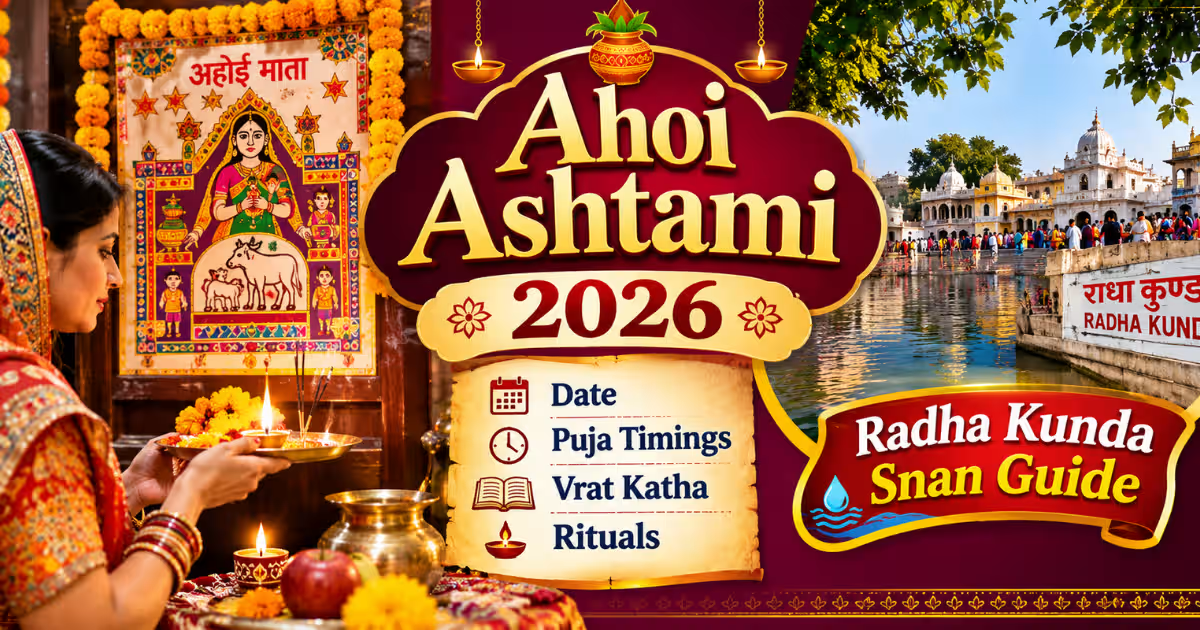
Ahoi Ashtami 2026 date: Sunday, 1 November 2026. The festival falls on the eighth day (Ashtami) of Krishna Paksha (waning moon) in Kartik month. Puja muhurat (New Delhi reference): 5:36 PM to 6:54 PM. Star sighting time: approximately 6:00 PM. Moonrise: approximately 11:40 PM. Ashtami Tithi begins 2:51 PM on 1 November; ends 1:10 PM on 2 November. Mothers observe a strict waterless fast (Nirjala Vrat) from dawn until stars appear. The Braj epicentre: thousands of couples gather at Radha Kunda, Govardhan for a midnight sacred dip. Experience My India. See our Mathura Vrindavan tour Package or message WhatsApp +91 7302265809.
Highlights
ToggleA Mother’s Waterless Fast – And the Sacred Pool That Answers Her Prayer
Ahoi Ashtami is one of North India’s most observed and most personally felt festivals – a day when mothers fast from dawn to the appearance of the first stars, praying for the health, longevity and wellbeing of their children. It is observed with a severity (Nirjala Vrat – no water all day) that reflects the depth of the maternal prayer it carries.
The Braj region – Mathura, Vrindavan and Govardhan – is the spiritual epicentre of this festival. At Radha Kunda in Govardhan, at exactly midnight on Ahoi Ashtami, thousands of couples gather to take a sacred dip in the holy pool. For couples seeking to conceive, this midnight bath is believed to carry a blessing that no other ritual in the entire year provides.
I am Gurudutt, born and raised in Braj Bhoomi and founder of Experience My India. Since 2018, our team has guided over 50,000 pilgrims through the Braj circuit – including many who arrive specifically for the Radha Kunda midnight snan on Ahoi Ashtami. For the complete Govardhan and Radha Kunda circuit, see the Delhi to Govardhan distance guide. The 3 Days Mathura Vrindavan Tour from Experience My India can be planned around the Ahoi Ashtami Radha Kunda snan. Call +91-7302265809.
Ahoi Ashtami 2026 Date & Timings
| Detail | Information |
| Festival name | Ahoi Ashtami (also: Ahoi Mata Vrat, Ahoi Asthami) |
| 2026 date | Sunday, 1 November 2026 |
| Day | Sunday |
| Tithi | Ashtami (8th day) of Krishna Paksha (waning moon), Kartik month |
| Ashtami Tithi begins | 2:51 PM on 1 November 2026 |
| Ashtami Tithi ends | 1:10 PM on 2 November 2026 |
| Fast duration | Dawn (sunrise) to star sighting (6 PM) – Nirjala Vrat (no water) |
Ahoi Ashtami 2026 Muhurat Table
All timings are New Delhi / North India reference. Adjust 5-20 minutes for your city based on local sunset.
| Time | Event |
| Puja Muhurat begins | 5:36 PM |
| Puja Muhurat ends | 6:54 PM |
| Duration | 1 hour 18 minutes |
| Star sighting (approx) | 6:00 PM |
| Moonrise (approx) | 11:40 PM |
Which timing to use: Perform puja during the 5:36-6:54 PM window. The fast is broken after offering Arghya (water offering) to the visible evening stars – typically visible from approximately 6:00 PM. Mothers who wish to also offer to the moon may wait until moonrise at approximately 11:40 PM, though the star-based breaking of the fast is the more common practice.
For the complete Mathura-Vrindavan festival calendar and temple timings, see the Mathura Vrindavan temple timings guide. Experience My India plans the Radha Kunda midnight snan for couples departing NCR on the evening of 1 November 2026. The 2 Days Mathura Vrindavan Tour is available around this date. WhatsApp +91-7302265809.
What Is Ahoi Ashtami? – Significance & Overview
Ahoi Ashtami is a North Indian Hindu fasting festival observed primarily by mothers for the longevity, health and wellbeing of their children.
| Attribute | Details |
| When | Ashtami (8th day) of Krishna Paksha, Kartik month – 8 days before Diwali |
| Who observes it | Mothers; in contemporary practice, also couples seeking children or fertility blessings |
| Type of fast | Nirjala Vrat – strictly waterless from dawn to star sighting |
| Presiding deity | Goddess Ahoi Mata (an incarnation of Goddess Parvati; specifically her aspect as the divine protector of offspring) |
| Where observed | Predominantly North India: UP, Haryana, Punjab, Rajasthan, Bihar, MP, Delhi NCR |
| Braj connection | Radha Kunda (Govardhan) midnight snan – the sacred epicentre of Ahoi Ashtami |
| Modern scope | Originally for sons; now observed for the wellbeing of all children – sons and daughters equally |
| Timing in the Kartik calendar | 8 days before Diwali (Kartik Amavasya); part of the pre-Diwali festival sequence |
Why 8 days before Diwali: Ahoi Ashtami falls on the eighth day (Ashtami) of the waning moon in Kartik – exactly 8 days before the Amavasya (new moon) of Diwali. This places it within the pre-Diwali spiritual intensification period of Kartik month, when sacred water bodies, fast observances and Yamuna-bank rituals are considered especially powerful.
For the top 25 places to visit in Mathura Vrindavan covering the complete Braj festival circuit, see the dedicated guide. The 5 Days Mathura Vrindavan Tour from Experience My India can be planned to include both Ahoi Ashtami (1 Nov) and Govardhan Puja-Diwali (6-11 Nov). Call +91-7302265809.
The Legend – Ahoi Mata Vrat Katha
The Ahoi Ashtami Vrat Katha (the sacred story read during the evening puja) is one of the most well-known folk narratives in North Indian domestic religious life.
The Story
In a village, there lived a kind-hearted woman with seven sons. In the weeks before Diwali – the period when homes are traditionally cleaned, plastered and decorated – she went into the forest to gather soil (mitti) for renovating and decorating her home.
While digging the earth with a spade, she accidentally struck and killed a porcupine’s cub (syau in Hindi) that was sleeping in a burrow beneath the soil. She realised what she had done, but the harm was already done – the young creature was dead.
The curse: The grieving mother porcupine turned to the woman and cursed her: “As my child has been taken from me, so too shall your children be taken from you.”
The consequence: Over the course of the following year, the woman’s sons began to disappear or die, one by one. By the end of the year, all seven were gone.
The counsel: Devastated, the woman sought guidance from the village elders. They advised her to pray to Goddess Ahoi Mata – an incarnation of Goddess Parvati specifically associated with the protection of offspring. They told her to observe a rigorous waterless fast on Kartik Krishna Ashtami, express deep repentance for the accidental killing and pray with complete sincerity.
The resolution: On the next Kartik Krishna Ashtami, the woman kept the Nirjala Vrat with total dedication – no water, no food, from dawn to the appearance of the stars. She prayed deeply and expressed genuine remorse for the accidental harm. Goddess Ahoi Mata, moved by her devotion and the sincerity of her repentance, blessed her – reversing the curse and bringing all seven sons safely back to life.
The Teaching
| Teaching | Detail |
| Unintentional harm has consequences | Even an accidental sin – the killing of a living creature without ill intent – carries karmic weight |
| Repentance through devotion works | Sincere prayer, fasting and repentance can reverse karmic consequences |
| Goddess Ahoi Mata’s mercy | The Goddess is specifically associated with protection of offspring and maternal welfare; she responds to sincere maternal prayer |
| The porcupine connection | The porcupine (syau) and her image remain central to Ahoi Ashtami’s puja iconography |
Experience My India explains the Katha in full to groups visiting Radha Kunda on Ahoi Ashtami. The Gokul tourist places guide covers the outer Braj circuit for pilgrims extending the Govardhan visit. The 3 Days Mathura Vrindavan Tour from Ahmedabad and from Bangalore include the Govardhan outer circuit. Call +91-7302265809.
Spiritual Significance – A Mother’s Prayer
| Dimension | Significance |
| For children’s longevity | The fast’s primary purpose – mothers pray for the long life, health and protection of their children |
| Universal scope (modern) | Originally focused on sons; now observed by mothers for all children – sons and daughters both |
| Fertility blessings | Women seeking to conceive or who have experienced pregnancy loss, observe this fast specifically to invoke Ahoi Mata’s blessings for maternal success |
| Govardhan / Radha Kunda | Couples who cannot conceive make a pilgrimage to Radha Kunda for the midnight snan – one of the most specific fertility-associated pilgrimage acts in the Braj tradition |
| Repentance | The Katha establishes that the fast carries a dimension of repentance for any unintentional harm caused to living beings – it is not only a maternal fast but a fast of karmic cleansing |
| Kartik month context | Ahoi Ashtami falls within Kartik month – the most sacred Vaishnav month when fasting, bathing and lamp-lighting carry maximum spiritual fruit |
For pilgrims combining the Ahoi Ashtami Radha Kunda snan with the broader Govardhan Parikrama circuit, the Vrindavan tour guide covers the Braj pilgrimage context. The 8 Days Braj 84 Kosh Yatra covers the complete Braj circuit including Govardhan. WhatsApp +91-7302265809.
The Vrat Rituals – Step by Step
The Ahoi Ashtami observance follows a specific sequence:
| Step | Ritual | Timing |
| 1. Morning Sankalp (Vow) | Mother takes a formal vow at dawn to observe Nirjala Vrat (waterless fast) for her children’s wellbeing | Dawn (approximately 6:00 AM) |
| 2. Nirjala Vrat | Complete waterless fast – no food, no water from dawn until stars appear | Dawn to 6:00 PM |
| 3. Evening puja setup | Draw or place an image of Ahoi Mata on the wall – depicting the Goddess with her seven sons and a porcupine (syau); arrange a Kalash (pot) filled with water | 5:00-5:30 PM |
| 4. Offerings | Present Halwa, Puri and Puas (traditional sweet fried bread) as offerings alongside the Kalash | 5:30 PM |
| 5. Ahoi Mata Vrat Katha | The Katha (sacred story) is read aloud – by the mother or an elder in the family | 5:36-6:54 PM (muhurat window) |
| 6. Arghya to stars | After the Katha, the mother offers Arghya (water) from the Kalash to the evening stars (visible from 6 PM) | 6:00 PM (star sighting time) |
| 7. Breaking the fast | The mother drinks water from the hands of her children – the physical moment that breaks the day’s waterless fast | 6:00-6:30 PM |
| 8. Moon Arghya (optional) | Some women wait for moonrise (11:40 PM) to additionally offer water to the moon before fully completing the day | 11:40 PM |
| 9. Syau Mala | The silver pendant necklace (Syau Mala) is worn and two new silver beads added for each child – a living record of the family | Annual tradition |
The Syau Mala – The Silver Pendant Tradition
One of the most distinctive material traditions of Ahoi Ashtami is the Syau Mala – a silver necklace with pendant beads that carries the record of a mother’s family.
| Detail | Information |
| Name | Syau Mala (Syau = porcupine, connected to the Katha; Mala = necklace/garland) |
| Material | Silver |
| What it is | A necklace with a pendant; two new silver beads are added every year – one for each child born |
| Purpose | A living material record of the family’s children; worn specifically on Ahoi Ashtami and other sacred occasions |
| The adding of beads | Two silver beads per child per year; the necklace grows as the family grows |
| Devotional dimension | Each bead represents a living child for whom prayers are offered; the necklace is simultaneously jewellery and a devotional object |
| Who wears it | The observing mother |
The Syau Mala is one of the most personally meaningful objects in North Indian domestic religion – a material theology worn close to the heart. Experience My India mentions this tradition to every group visiting Radha Kunda for Ahoi Ashtami, particularly for couples who have come with the intention of praying for children. The 5 Days Mathura Vrindavan Tour from Jaipur is popular for Rajasthan-based families for Kartik-month Braj pilgrimages. Call +91-7302265809.
Where Is Ahoi Ashtami Celebrated? – Regional Observances
| Region | Observation |
| Uttar Pradesh | Widely observed; Braj region is the spiritual epicentre |
| Haryana | Major observance; community-level puja gatherings |
| Punjab | Observed across Hindu households; family-centred |
| Rajasthan | Widely observed; traditional puja with Syau Mala tradition strong |
| Bihar | Observed with regional variations |
| Madhya Pradesh | Observed in cities and towns |
| Delhi NCR | Major observance; many families travel to Radha Kunda for the midnight snan |
| Sacred epicentre | Braj region – specifically Radha Kunda at Govardhan; the midnight snan is the singular Ahoi Ashtami pilgrimage act |
For pilgrims approaching from Delhi, the Noida to Vrindavan distance guide covers the Yamuna Expressway approach to Mathura, from which Govardhan (and Radha Kunda) is approximately 22 km further. Experience My India coordinates Ahoi Ashtami Radha Kunda snan for NCR-based families annually. The 2 Days Mathura Vrindavan Tour can be timed for 1-2 November 2026. WhatsApp +91-7302265809.
Radha Kunda Snan – The Sacred Midnight Bath
The Radha Kunda midnight snan on Ahoi Ashtami is the most spiritually significant pilgrimage act associated with this festival – and the one that makes the Braj region the absolute epicentre of Ahoi Ashtami observance.
What Is Radha Kunda?
| Detail | Information |
| Location | Govardhan, Mathura district, Uttar Pradesh – part of the Govardhan Parikrama circuit |
| Distance from Mathura | 22 km |
| What it is | The most sacred kund (sacred pool) in all of Braj; specifically associated with Radharani’s divine pastimes; considered by the Vaishnav tradition to be the most sacred body of water in the universe |
| Adjacent kund | Shyam Kund (Krishna’s kund) – directly adjacent to Radha Kunda |
| Who frequents it | Serious Vaishnav pilgrims throughout the year; massive gatherings on specific sacred dates |
The Ahoi Ashtami Midnight Snan
| Detail | Information |
| When | Midnight of Ahoi Ashtami – approximately midnight on 1-2 November 2026 |
| Who comes | Thousands of couples – particularly those seeking fertility blessings, those who have had difficulty conceiving or those who have suffered pregnancy loss |
| What is believed | A sacred bath in Radha Kunda specifically at midnight on Ahoi Ashtami is believed to help couples conceive; a blessing attributed to the specific combination of the Kartik sacred period, the Ahoi Ashtami tithi and the unparalleled sanctity of Radha Kunda |
| Scale | Thousands of pilgrims gather throughout the night; it is one of the most attended night-bathing events in the Braj annual calendar |
| Atmosphere | Lamps, diyas and the sound of prayers and bhajans throughout the night at the kund |
The Theological Basis
Radha Kunda is considered the most sacred body of water in Vaishnav theology – described as such in the Bhakti Rasamrita Sindhu of Rupa Goswami (16th century CE) and in multiple Puranic sources. Its sanctity is considered to surpass that of the Ganges itself in Vaishnav understanding.
The specific association of Ahoi Ashtami (a festival of maternal protection and fertility) with Radha Kunda (the kund of Radha – the embodiment of maternal, nurturing and all-encompassing divine love) is theologically coherent: the Goddess of unconditional love and the festival of maternal prayer converge at the same sacred water at midnight.
For the complete Radha Kunda and Govardhan circuit, see the Delhi to Govardhan distance guide and the top 25 places to visit in Mathura Vrindavan. Experience My India coordinates the Radha Kunda snan for every Ahoi Ashtami group. The 3 Days Mathura Vrindavan Tour timed for 1-3 November 2026 includes the midnight Radha Kunda visit. Call +91-7302265809.
How to Reach Radha Kunda for Ahoi Ashtami
| From | Distance | Travel Time | Notes |
| Mathura | 22 km | 40-50 min | Via Govardhan road |
| Vrindavan | 25-28 km | 45-55 min | Via Mathura or direct road |
| Delhi (via Yamuna Expy) | 160-175 km | 2.5-3 hrs | Yamuna Expy → Mathura → Govardhan |
| Noida / Gurgaon | 150-165 km | 2.5 hrs | Same Yamuna Expy corridor |
| Govardhan town | 3-4 km | 10-15 min | Adjacent; on Govardhan Parikrama circuit |
For the midnight snan: Most NCR-based families depart at 9-10 PM to arrive at Radha Kunda by midnight. Experience My India arranges vehicles that pick up from Mathura/Vrindavan hotels for the Radha Kunda midnight snan and return by 2-3 AM. Book transportation in advance – vehicle availability is limited on Ahoi Ashtami night.
Navigation: Search “Radha Kunda Govardhan” on Google Maps. The kund is well-pinned on the Govardhan Parikrama Marg. The Prem Sarovar Barsana guide covers the Barsana outer circuit for pilgrims extending beyond Govardhan. The Gayatri Tapobhumi guide covers another Mathura sacred site for a full-day Kartik pilgrimage. WhatsApp +91-7302265809.
Ground Truth – What Nobody Tells You About Ahoi Ashtami 2026
After coordinating Ahoi Ashtami Radha Kunda snan for pilgrims since 2018, here is what Experience My India knows:
Radha Kunda at midnight on Ahoi Ashtami is one of the most crowded nights of the Braj year. Thousands of couples and families arrive through the night. Parking and vehicle access near Radha Kunda is significantly restricted from approximately 10 PM onward. Plan to park further from the kund and walk the final 500 metres to 1 km. Experience My India pre-books vehicles and coordinates parking for all Ahoi Ashtami groups.
The correct Ahoi Ashtami puja is performed during the muhurat (5:36-6:54 PM) on 1 November – not on 2 November. The Ashtami Tithi runs from 2:51 PM on 1 November to 1:10 PM on 2 November, so there can be confusion about which evening to perform the puja. The answer is clear: the evening stars appear during the Ashtami phase on 1 November, so all rituals – Katha, Arghya, fast-breaking – are performed on the evening of 1 November 2026.
The waterless Nirjala Vrat is physically demanding – particularly in November 2026 when Ahoi Ashtami falls relatively early in autumn. The 1 November 2026 date means the fast is observed in pleasant weather (Mathura region approximately 22-28°C in early November) – more comfortable than when Ahoi Ashtami falls in peak October heat. Experience My India advises mothers observing the fast who are traveling to Radha Kunda to rest in the afternoon before the evening puja and the midnight snan.
The midnight snan at Radha Kunda is not merely a symbolic act – it is one of the most personally impactful experiences that couples dealing with infertility describe. Experience My India has guided many such couples to Radha Kunda on Ahoi Ashtami night. The combination of the prayers offered since dawn, the puja at dusk and the silent arrival at one of the most sacred kunds in Braj at midnight creates a devotional experience that pilgrims consistently describe as transformative. The katha and its theology – repentance, devotion and the Goddess’s mercy – are lived fully in this moment.
Know Before You Go – Ahoi Ashtami Visitor Guide
- Festival date 2026: Sunday, 1 November 2026
- Puja muhurat (New Delhi): 5:36 PM – 6:54 PM (duration 1 hr 18 min)
- Star sighting: 6:00 PM – fast broken after Arghya to stars
- Moonrise: 11:40 PM – optional moon Arghya for those waiting
- Radha Kunda midnight snan: Midnight 1-2 November 2026; thousands attend
- Crowd at Radha Kunda from 10 PM – arrive before or after the peak 11 PM-1 AM window
- Parking: Limited near Radha Kunda on Ahoi Ashtami night; plan to walk last 500m-1 km
- Who should come: Couples seeking fertility blessings; mothers observing the fast who wish to combine it with a Braj pilgrimage
- Distance from Delhi: 160-175 km via Yamuna Expressway + Mathura + Govardhan
- Experience My India: Coordinates midnight Radha Kunda snan transport for all Ahoi Ashtami groups. WhatsApp +91-7302265809.
Frequently Asked Questions
Ahoi Ashtami is a North Indian Hindu fasting festival observed by mothers for the health, longevity and wellbeing of their children. It falls on the Ashtami (8th day) of Krishna Paksha (waning moon) in the Kartik lunar month – 8 days before Diwali. In 2026, Ahoi Ashtami falls on Sunday, 1 November. The Ashtami Tithi begins at 2:51 PM on 1 November and ends at 1:10 PM on 2 November. Mothers observe a strict waterless Nirjala Vrat from dawn to the appearance of the evening stars (approximately 6:00 PM). Experience My India. Call +91-7302265809.
The Ahoi Ashtami 2026 puja muhurat (New Delhi reference) is 5:36 PM to 6:54 PM – a duration of 1 hour 18 minutes. The evening stars are visible from approximately 6:00 PM, at which time the mother offers Arghya (water offering) to the stars and breaks her fast by drinking water from her children’s hands. Moonrise is at approximately 11:40 PM for those who wish to additionally offer to the moon. Adjust timings by 5 to 20 minutes for your specific city based on local sunset. All puja rituals must be performed on the evening of 1 November 2026. Experience My India. WhatsApp +91-7302265809.
The Ahoi Ashtami Vrat Katha tells the story of a woman with seven sons who accidentally killed a porcupine’s cub while digging soil in the forest before Diwali. The mother porcupine cursed her, causing all seven of her sons to disappear over the following year. Devastated, she sought guidance from village elders who advised her to pray to Goddess Ahoi Mata – an incarnation of Parvati who protects offspring – with a strict waterless fast on Kartik Krishna Ashtami. She observed the fast with complete sincerity and repentance; Goddess Ahoi Mata reversed the curse and brought all seven sons back to life. The porcupine (syau) and the Goddess with her seven sons are depicted in the evening puja. Experience My India. Call +91-7302265809.
At midnight on Ahoi Ashtami, thousands of couples gather at Radha Kunda – the most sacred kund in the Braj region, located at Govardhan approximately 22 km from Mathura – to take a sacred midnight bath (snan). The Radha Kunda midnight snan on Ahoi Ashtami is specifically associated with fertility blessings: couples who have difficulty conceiving or who have experienced pregnancy loss make this pilgrimage, believing that bathing in Radha Kunda at midnight on this specific Kartik night invokes divine blessing for children. Radha Kunda is considered in Vaishnav theology to be the most sacred body of water in the universe. Experience My India. WhatsApp +91-7302265809.
Radha Kunda is located at Govardhan, Mathura district, Uttar Pradesh – on the Govardhan Parikrama Marg, approximately 22 km from Mathura city and 25 to 28 km from Vrindavan. From Delhi (via Yamuna Expressway): approximately 160 to 175 km, 2.5 to 3 hours. On Ahoi Ashtami night, parking near Radha Kunda is restricted from approximately 10 PM – plan to park further and walk 500 metres to 1 km. Most NCR-based families depart at 9 to 10 PM to arrive by midnight. GPS: search “Radha Kunda Govardhan” on Google Maps. Experience My India coordinates vehicles for the Radha Kunda midnight snan. Call +91-7302265809.
The Syau Mala is a silver necklace with pendant beads that is a traditional material symbol of Ahoi Ashtami observance. Syau refers to the porcupine from the Vrat Katha; mala means necklace or garland. The observing mother wears the Syau Mala and adds two new silver beads to it every year – one for each child born in the family. Over time, the necklace becomes a living material record of the family’s children and the years of maternal devotion. The necklace is worn specifically during Ahoi Ashtami and on sacred occasions. It is one of the most distinctive devotional objects in North Indian domestic religion. Experience My India. WhatsApp +91-7302265809.
Both Ahoi Ashtami and Karwa Chauth are North Indian Hindu fasting festivals observed in the Kartik month involving the moon – but they serve different purposes and have different observances. Karwa Chauth (this year approximately 17 days before Diwali) is observed by wives for their husbands’ longevity; the fast is broken after seeing the moon through a sieve. Ahoi Ashtami is observed by mothers for their children’s wellbeing; the fast is traditionally broken by offering water to the evening stars (not the moon, though some wait for moonrise). Ahoi Ashtami also has a specific fertility-pilgrimage dimension at Radha Kunda, Govardhan, which has no equivalent in Karwa Chauth. Experience My India. Call +91-7302265809.
Ahoi Ashtami is traditionally observed by mothers for their children’s wellbeing. In contemporary practice, married women who wish to conceive observe the fast specifically to invoke Goddess Ahoi Mata’s blessings for fertility – this is considered an entirely appropriate and widely observed variation of the vrat. The Radha Kunda midnight snan at Govardhan is specifically associated with couples seeking to conceive, making it the pilgrimage destination for this intention. Unmarried women do not typically observe this fast in tradition, but women who have experienced miscarriage or pregnancy difficulty may observe it as a prayer for future maternal success. Experience My India. WhatsApp +91-7302265809.
Ready to Observe Ahoi Ashtami in Braj with Experience My India?
WhatsApp us and receive your complete Ahoi Ashtami Braj plan – Govardhan Parikrama during the day, Radha Kunda midnight snan on the night of 1 November 2026 and the complete Govardhan-Mathura-Vrindavan Kartik pilgrimage circuit.
Ahoi Ashtami Braj Packages from ₹2,999 per person · Radha Kunda midnight snan included · All Kartik timings managed
WhatsApp +91-7302265809 – Book Now
Jai Shri Krishna 🙏