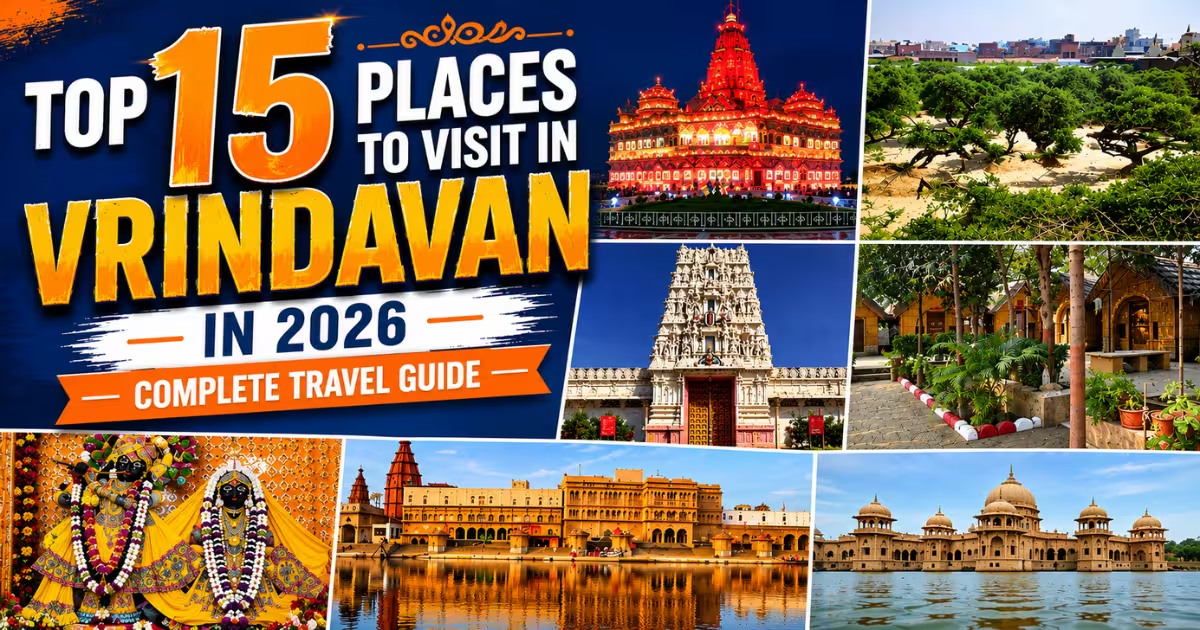
Vrindavan’s top 15 places to visit include Shri Banke Bihari Temple, Prem Mandir, ISKCON Krishna Balaram Mandir, Nidhivan, Keshi Ghat, and 10 more sacred sites — all coverable in 1–2 days. Entry to most temples is free. Guided Vrindavan pilgrimage tours with Experience My India start from ₹1,999 per person. To plan your visit, call or WhatsApp +91-7302265809 today. Jai Shri Krishna 🙏
Why Every Pilgrim Must Know These Places Before Arriving
Vrindavan is not simply a town — it is a 10.5 sq km sacred circuit in Uttar Pradesh’s Mathura district where every street, grove, and ghat carries a story from Lord Krishna’s life. Pilgrims arrive from across India and from over 40 countries each year, yet many leave having visited only 3–4 places because nobody gave them a clear, ground-level map of all 15 essential spots.
This guide changes that. My name is Gurudutt. I was born here in Braj Bhoomi and have been guiding pilgrims through these lanes since 2018. Over that time, Experience My India has personally accompanied 50,000+ devotees through Vrindavan’s temples, ghats, and sacred groves. What you are about to read is not copied from a travel aggregator — it is what I tell my own guests on day one.
By the end of this guide you will know exactly which 15 places to visit in Vrindavan, in what order, at what time, with what to expect at each — plus a full table of timings, distances, and a curated set of tour packages that take the planning off your plate entirely.
All 15 Places to Visit in Vrindavan — At a Glance
The table below lets you plan at a single glance. Distances are measured from Banke Bihari Temple, which is the natural anchor point of the town.
| No | Place | Type | Distance from Banke Bihari | Entry Fee | Must-See Highlight |
| 1 | Shri Banke Bihari Temple | Temple | 0 km (anchor) | Free | Oscillating curtain darshan |
| 2 | Prem Mandir | Temple | 1.5 km | Free | Nightly light & sound show (7:30 PM) |
| 3 | ISKCON Krishna Balaram Mandir | Temple | 1.8 km | Free | Samadhi of Srila Prabhupada |
| 4 | Nidhivan | Sacred Grove | 0.5 km | Free | Closed after sunset — no exceptions |
| 5 | Keshi Ghat | Ghat | 1.2 km | Free | Yamuna boat ride (₹50–₹100) |
| 6 | Radha Raman Temple | Temple | 0.9 km | Free | Self-manifested 16th-c. deity |
| 7 | Shri Rangji (Ranganatha) Temple | Temple | 2.2 km | Free | South Indian gopuram in North India |
| 8 | Madan Mohan Temple | Temple | 2.0 km | Free | Vrindavan’s oldest surviving temple |
| 9 | Seva Kunj | Sacred Grove | 0.6 km | Free | Radha Krishna’s alleged nightly rest |
| 10 | Radha Damodar Temple | Temple | 0.7 km | Free | Bhagavata Ratna stone |
| 11 | Gopeshwar Mahadev Temple | Temple | 0.4 km | Free | Shiva as a Gopi — unique iconography |
| 12 | Shahji Temple | Temple | 1.0 km | Free | 12 spiral marble columns |
| 13 | Pagal Baba Temple | Multi-story complex | 3.5 km | Free | 7-storey mechanical doll exhibitions |
| 14 | Jaipur Temple | Temple | 2.8 km | Free | Maharaja of Jaipur-funded stone carvings |
| 15 | Katyayani Peeth | Shakti Peeth | 4.0 km | Free | One of 51 Shakti Peethas in India |
Top 15 Places to Visit in Vrindavan — Explained
1. Shri Banke Bihari Temple
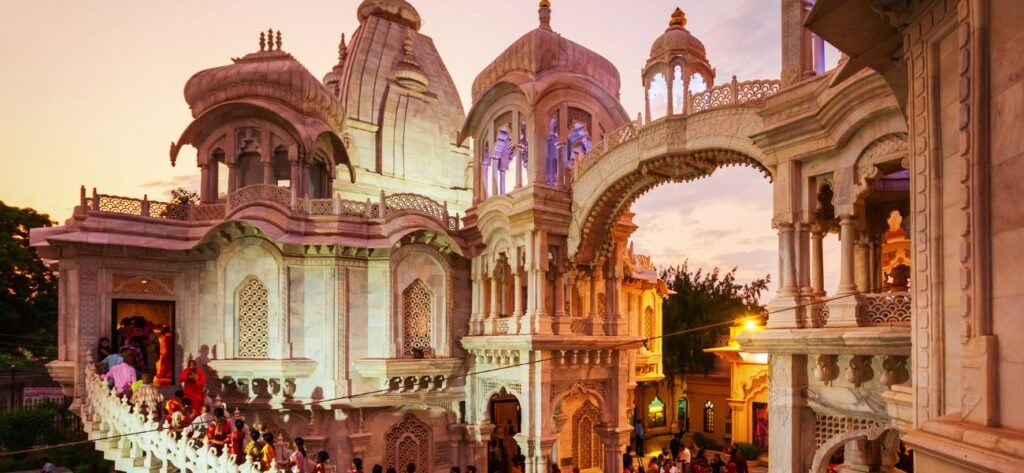
Built in 1864 by the disciples of saint Swami Haridas, Banke Bihari Temple is the spiritual and geographic heart of Vrindavan. The black wooden deity of Bihariji stands in the tribhanga (three-bend) pose — “Banke” means bent in three places; “Bihari” means the enjoyer of Braj. What sets this temple apart is the tradition of drawing the curtain every 30–60 seconds to protect devotees from the intensity of the Lord’s gaze. Unlike most temples, there is no Mangala Aarti here: the deity is believed to wake late.
Practical: Open 7:45 AM–12:00 PM and 5:30 PM–9:30 PM (summer timings differ by ~30 min). No photography inside the sanctum. Arrive on a weekday and plan 45 minutes minimum.
2. Prem Mandir
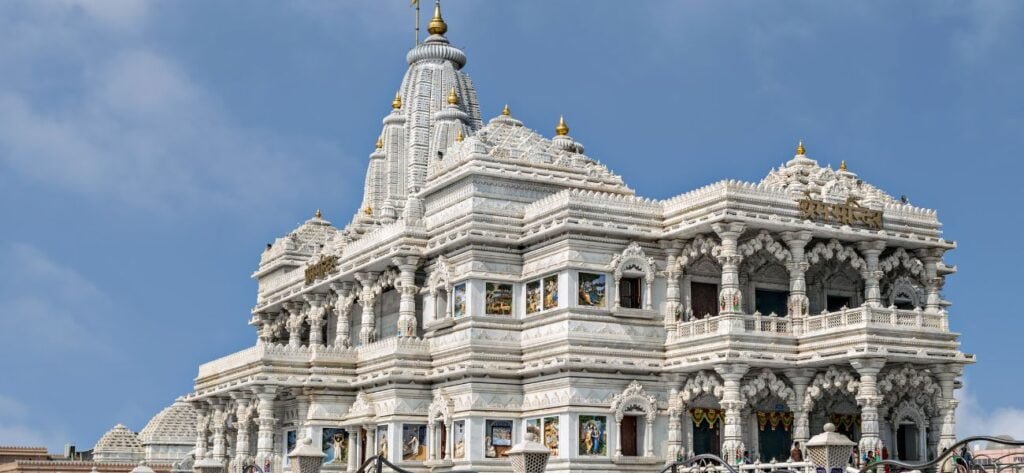
Inaugurated in 2012 by Jagadguru Kripalu Maharaj, Prem Mandir is built entirely from Italian white Rajnagar marble and cost over ₹100 crore to construct. Its outer walls carry 94 panels depicting Radha-Krishna and Ram-Sita pastimes. The sprawling 54-acre complex includes landscaped gardens and musical fountains.
Don’t miss: The nightly light and sound show at 7:30 PM when the entire structure is illuminated in changing colours. Allocate 1.5 hours. Wear footwear that is easy to remove — the marble forecourt covers a large area.
3. ISKCON Krishna Balaram Mandir
The International Society for Krishna Consciousness established this complex in 1975 on direct instruction from Srila A.C. Bhaktivedanta Swami Prabhupada, whose samadhi (memorial tomb) sits within the compound. The three shrines house Krishna-Balarama, Gaura-Nitai, and Radha-Shyamasundara. The community kitchen (prasadam hall) serves 5,000+ meals daily.
Practical: Open 4:30 AM–1:00 PM and 4:15 PM–8:45 PM. The bookstore stocks Bhagavad Gita in 27 languages. This is the most accessible temple for international visitors; English-speaking priests are available.
4. Nidhivan
Nidhivan is a dense 1-acre grove of intertwined tulsi (basil) trees within a walled enclosure, 500 metres from Banke Bihari Temple. Local belief holds that Krishna performs Raas Leela (the divine circle dance) here every night, which is why the grove is sealed shut after sunset — no residents, monkeys, or birds remain inside after dusk. Whether you accept the legend or not, the grove’s micro-environment is genuinely unusual: the trees grow in unusual spiral forms and the air noticeably cooler inside the walls.
Critical rule: You must exit by sunset. Temple authorities strictly enforce this. Photography is permitted in the outer courtyard only.
5. Keshi Ghat
Keshi Ghat is Vrindavan’s principal riverfront, named after the demon Keshi who was slain here by Krishna. It is the only point in Vrindavan where pilgrims can descend to the Yamuna River, take a ritual bath, and watch the evening Yamuna Aarti (7:00 PM, daily). Boat rides run throughout the day at ₹50–₹100 per person for a 20-minute circuit.
Honest note: The Yamuna at Vrindavan has high industrial pollution levels from upstream discharge. Most pilgrims choose to sprinkle water rather than immerse fully. The aarti and the ghat steps at dusk, however, are genuinely worth the visit.
6. Radha Raman Temple
Founded in 1542 by Gopal Bhatt Goswami, one of the Six Goswamis of Vrindavan appointed by Chaitanya Mahaprabhu, this temple is central to the Gaudiya Vaishnava tradition. The self-manifested deity of Radha Raman appeared from a Shaligrama (sacred stone) — the stone itself is still kept beside the idol, unique among Vrindavan temples. The architecture uses intricate sandstone carvings untouched by major restoration, giving it an authentically aged feel.
Timings: 7:00 AM–12:30 PM and 5:30 PM–8:30 PM. Closed on Thursdays for special internal seva.
7. Shri Rangji (Ranganatha) Temple
Built in 1851 by Seth Radha Krishna Das of Chennai, the Rangji Temple is the largest temple complex in the Vrindavan area, covering over 16 acres. What makes it architecturally remarkable is its fusion of Dravidian gopuram (towering gateway) with Rajput courtyard structures — a design combination found nowhere else in North India. The main deity is Ranganatha (Vishnu) reclining on the serpent Shesha.
Note: The temple celebrates its grandest festival in March–April (Brahmotsava), with a chariot procession through the town.
8. Madan Mohan Temple
Perched on a small hill above the Yamuna riverbank near Kali Dah, the Madan Mohan Temple is the oldest surviving temple in Vrindavan, built in the 16th century by Sanatana Goswami. The original deity was later taken to Karauli, Rajasthan for safety; the present pratinidhi (representative) deity is worshipped at the same spot. The hilltop position gives a clear view of the Yamuna and the Vrindavan skyline.
Visiting tip: Combine with Keshi Ghat, which is 800 metres away. The path between the two runs along the river and is one of the few quieter walks in Vrindavan.
9. Seva Kunj
Located immediately adjacent to Nidhivan, Seva Kunj is a sacred grove believed to be the spot where Radha and Krishna rest after their nightly Raas Leela. A small platform within the grove (the Rang Mahal) marks the traditional resting place. Peacocks move freely through the grove and are considered sacred residents. The atmosphere inside is noticeably tranquil compared to the surrounding lanes.
Open: Sunrise to sunset only. Women are not permitted to stay in the grove after sunset — this is a temple trust rule enforced by on-site staff.
10. Radha Damodar Temple
Founded in 1542 by Jiva Goswami, the Radha Damodar Temple is where Bhaktivedanta Swami Prabhupada (founder of ISKCON) lived and wrote for several years before travelling to the West. The temple houses the Bhagavata Ratna — a sacred stone with footprint impressions believed to be Krishna’s own. The samadhi shrines of Jiva Goswami and Rupa Goswami are within the compound.
Practical: This is a quieter temple, less crowded than Banke Bihari. Allocate 30–40 minutes. Located near Seva Kunj, making a natural two-site visit.
11. Gopeshwar Mahadev Temple
This is one of the oldest temples in Vrindavan, predating several of the major Vaishnava temples. It is dedicated to Lord Shiva worshipped in the form of a Gopi (a female cowherd devotee) — the only temple in the world with this specific iconography. Legend says Shiva was refused entry into Vrindavan for the Raas Leela as it was for Gopis only, so he took the form of a Gopi and was permitted inside.
Visiting tip: Monday evenings draw local Shaiva devotees in large numbers; any other time is quieter.
12. Shahji Temple
Built in 1876 by Shah Kundan Lal of Lucknow, the Shahji Temple is architecturally distinctive for its 12 spiral (barankhamba) marble columns, each carved from a single block, in the inner hall. The ceiling features Belgian glass mirrors imported during the colonial period. The main deity is Chote Radha Raman. Photography of the interior is permitted in most areas.
Note: Fewer pilgrims visit this temple, which makes darshan unhurried. Combined with Radha Raman Temple, 500 metres away.
13. Pagal Baba Temple
Officially named Bhagwan Shri Krishna Dham, this 7-storey multi-level complex was established by Pagal Baba, a saint known for his unconventional teaching methods. Each floor features life-size mechanical doll exhibitions depicting scenes from Hindu epics including the Ramayana and Mahabharata. An attached ashram hosts 200+ resident saints.
Practical: Located on the Mathura-Vrindavan road, 3.5 km from Banke Bihari. Accessible by e-rickshaw. Allocate 45 minutes for the full exhibition.
14. Jaipur Temple (Shri Govind Dev Ji Vrindavan)
Funded by the Maharaja of Jaipur, this temple uses finely detailed pink and red sandstone carvings that are among the most intricate in Vrindavan. The original Govind Dev Ji idol now resides in Jaipur’s City Palace — this temple houses the swaroop (representative form). The scale of the compound and the quality of the stone carving repay a slow, unhurried visit.
15. Katyayani Peeth
Located near Bhooteshwar road, Katyayani Peeth is one of the 51 Shakti Peethas of India — the sacred sites where the body parts of Goddess Sati are believed to have fallen. Vrindavan’s Peeth is associated with the hair ring (keshamadhya). While most visitors focus on the Vaishnava temples, pilgrims seeking the Goddess’s blessings — particularly for marriage-related wishes — make this a dedicated stop.
Tip: This is one of the least-crowded major sacred sites in Vrindavan. Best visited in the morning when the compound is peaceful.
Vrindavan Temple Timings & Entry Fees 2026
| Temple / Place | Morning Opening | Afternoon Closure | Evening Opening | Evening Closing | Entry Fee |
| Banke Bihari Temple | 7:45 AM | 12:00 PM | 5:30 PM | 9:30 PM | Free |
| Prem Mandir | 8:30 AM | 12:00 PM | 4:30 PM | 8:30 PM | Free |
| ISKCON Temple | 4:30 AM | 1:00 PM | 4:15 PM | 8:45 PM | Free |
| Radha Raman Temple | 7:00 AM | 12:30 PM | 5:30 PM | 8:30 PM | Free |
| Madan Mohan Temple | 6:00 AM | 12:00 PM | 4:00 PM | 8:00 PM | Free |
| Rangji Temple | 8:00 AM | 12:00 PM | 4:00 PM | 8:00 PM | Free |
| Nidhivan | Sunrise | — | — | Sunset (strictly) | Free |
| Keshi Ghat | 5:00 AM | — | — | 9:00 PM | Free (boat: ₹50–100) |
| Radha Damodar Temple | 7:00 AM | 12:00 PM | 5:00 PM | 8:30 PM | Free |
| Seva Kunj | Sunrise | — | — | Sunset | Free |
| Shahji Temple | 8:00 AM | 12:00 PM | 4:30 PM | 7:30 PM | Free |
| Katyayani Peeth | 6:00 AM | 12:00 PM | 4:00 PM | 8:00 PM | Free |
Timings may shift by 30–60 minutes during major festivals (Holi, Janmashtami, Kartik month). Call +91-7302265809 for confirmed current timings before you travel.
Best Time to Visit Vrindavan in 2026
| Season | Months | Weather | Crowd Level | Recommended For |
| Winter (Peak) | October – February | 8–22°C | High | First-time pilgrims, families |
| Spring Festival | March (Holi) | 18–28°C | Very High | Holi celebrations in Braj |
| Monsoon | July – September | 28–36°C + rain | Low | Budget travel, Janmashtami (Aug) |
| Summer | April – June | 35–45°C | Very Low | Not recommended for outdoor touring |
Specific festival dates for 2026:
- Holi (Braj Holi): Celebrations begin ~14 days before Holi day. In 2026 this falls in early-to-mid March.
- Janmashtami: Usually August — the town sees 2–3 lakh pilgrims in a single night.
- Kartik month (Oct–Nov): Daily parikrama (circumambulation) of Vrindavan draws 50,000+ daily visitors.
For most first-time visitors, October to February gives the most comfortable experience. If you specifically want the Holi or Janmashtami atmosphere, book accommodation at least 3 months in advance and contact Experience My India at +91-7302265809 for festival-specific packages.
Ground Truth — What Nobody Tells You About Vrindavan
Most travel blogs give you a clean list. Here is what I tell my pilgrims at Experience My India based on 8 years and 50,000+ visits:
1. The afternoon closure is non-negotiable for most temples. Between 12:00 PM and 4:30 PM, the majority of major temples are shut. Pilgrims who do not know this arrive in the afternoon and spend 3 hours with nowhere to go. Plan your day in two shifts: pre-noon and post-4 PM.
2. Narrow lanes mean no private cars beyond the inner circuit. Roads inside Vrindavan’s temple zone are 6–8 feet wide in many stretches. Your taxi or cab will drop you at the outer ring. From there, e-rickshaws (₹10–₹30 per ride) or walking are the only options. Factor this into your time planning.
3. Monkeys will take food from your hands. This is not a gentle warning. Rhesus macaques in Vrindavan are bold and numerous. Do not carry open food, plastic bags, or visible fruit near temples. Sunglasses are also at risk. Keep bags closed.
4. The Prem Mandir light show starts at exactly 7:30 PM — not 7:00 or 8:00. Pilgrims who arrive at 7:45 PM find the show already underway and the front viewing area occupied. Arrive by 7:10 PM and walk the gardens while waiting. The show lasts approximately 20 minutes.
5. Nidhivan’s sunset closure is enforced by a dedicated committee, not just a suggestion. Every evening, a designated team does a sweep of the grove and locks the gate. If you are inside after the deadline, you will be escorted out — this has happened to foreign tourists who were told “it’s fine.” It is not fine. Leave 30 minutes before sunset.
How to Reach Vrindavan
By Road:
- Delhi (NH19): 145 km, approximately 2.5–3 hours. Toll road via Yamuna Expressway available.
- Agra: 68 km, approximately 1.5 hours.
- Jaipur: 260 km, approximately 4.5 hours.
By Train: Mathura Junction (MTJ) is the nearest major railhead, 12 km from Vrindavan. Over 50 trains connect Delhi to Mathura daily. From Mathura Junction, e-rickshaws and autos cover the 12 km in 25–30 minutes for ₹80–₹150.
By Air: Agra Airport (AGR) — 68 km — has limited connectivity. Delhi’s Indira Gandhi International Airport — 160 km — is the practical gateway for most pilgrims. Experience My India provides airport pickup from Delhi starting from ₹2,999; call +91-7302265809 to book.
Getting Around Vrindavan: Local Transport & Costs
| Mode | Approx. Cost | Best For | Limitation |
| E-rickshaw (shared) | ₹10–₹20 per person | Short hops between temples | Cannot enter inner lanes |
| E-rickshaw (private) | ₹200–₹400 for full day | Full sightseeing circuit | Still stops at outer ring |
| Auto-rickshaw | ₹100–₹200 per trip | Reaching Prem Mandir, ISKCON | Fixed-rate from stands |
| Walking | Free | Inner temple zone | Feasible in winter; tiring in summer |
| Taxi/Cab | ₹800–₹1,500 per day | Mathura + Vrindavan combined | Parked at outer boundary |
Experience My India’s guided tours include a dedicated vehicle + experienced guide, so you never have to negotiate fares or guess distances. Packages from ₹1,999 per person. Book on WhatsApp: +91-7302265809.
Frequently Asked Questions
The most famous places to visit in Vrindavan are Shri Banke Bihari Temple, Prem Mandir, ISKCON Krishna Balaram Mandir, Nidhivan, and Keshi Ghat. Other significant sites include Radha Raman Temple, Madan Mohan Temple, Seva Kunj, Rangji Temple, and Radha Damodar Temple. Experience My India covers all 15 in guided half-day and full-day tours starting from ₹1,999. Call +91-7302265809 for itinerary details.
The seven principal deities (Sapta Devalayas) of Vrindavan are: Madan Mohan, Govind Dev Ji, Gopinath Ji, Radha Damodar, Radha Raman, Radha Shyamasundara, and Kaliya Krishna. All seven were established by the Six Goswamis of Vrindavan under Chaitanya Mahaprabhu’s direction in the 16th century. Most of the original deities were later moved to Jaipur for protection; representative forms remain in Vrindavan. Experience My India’s guided tours visit all seven sites.
One full day covers the core 10–12 places to visit in Vrindavan comfortably. Two days allow a more relaxed pace plus optional side trips to Govardhan Hill (23 km) or Barsana (40 km). If combining with Mathura, plan a minimum of 2 days. Experience My India offers both 1-day and 2-day packages — call +91-7302265809 to customise based on your group size and festival dates.
Popular souvenirs include Mathura peda (milk sweet, ₹200–₹500 per box), tulsi bead malas (₹50–₹500), peacock feather decorations, deity miniatures, Radha-Krishna paintings on cloth or brass, and Braj dust in small vials. The Loi Bazaar lanes near Banke Bihari Temple are the best concentration of shops. Avoid branded shops near Prem Mandir, which charge 2–3x market price. Experience My India’s guides always include a curated shopping stop.
Vrindavan is generally safe for solo female pilgrims — the town has a strong religious community and visible temple trust presence throughout. Practical precautions: travel between temples before 8 PM, use e-rickshaws from temple stands rather than roadside, dress in traditional modest clothing, and avoid isolated ghats after dark. Experience My India’s guided packages include female-friendly itineraries; call +91-7302265809 for details.
Start temple visits before 9:00 AM when crowds are thinner. Complete the inner circuit (Banke Bihari, Radha Raman, Nidhivan, Seva Kunj, Gopeshwar, Shahji) on foot or by e-rickshaw before noon. Use the afternoon break (12–4:30 PM) for Rangji Temple and Pagal Baba, which have longer afternoon sessions. End the day at Keshi Ghat aarti (7:00 PM) and Prem Mandir light show (7:30 PM). Experience My India’s half-day tour at ₹1,999 is designed exactly around this sequence.
Nidhivan is a 1-acre sacred grove of intertwined tulsi trees where local tradition holds that Krishna performs Raas Leela every night. The grove is sealed after sunset, and no one — residents, priests, or animals — remains inside. Botanically, the trees’ unusual spiral growth and the microclimate inside the walls are genuinely unexplained. Entry is free during daylight. Photography in the outer courtyard only. Experience My India’s guides provide the scriptural and local context of this site in detail.
A private e-rickshaw for a full-day Vrindavan sightseeing circuit costs ₹200–₹400 depending on the number of stops and negotiation. For a shared e-rickshaw, individual hops cost ₹10–₹20 per segment. Note that e-rickshaws cannot enter the innermost temple lanes — the final stretch to Banke Bihari Temple and adjacent sites requires walking 200–500 metres. For a stress-free experience, Experience My India’s guided tours include all internal transport.
All Vrindavan temples require modest clothing: shoulders and knees must be covered. Shorts, sleeveless tops, and short skirts are not permitted inside temple premises. You must remove footwear at every temple entrance. Most devotees wear kurta-pyjama or saree/salwar-kameez. If you arrive unprepared, cloth wraps are available from vendors near Banke Bihari for ₹20–₹50. Experience My India shares a complete packing list with all booked guests.
Call or WhatsApp Experience My India directly at +91-7302265809. Tours start from ₹1,499 per person for a Vrindavan half-day package and ₹2,999 for a full-day Mathura–Vrindavan circuit. Share your travel date, group size, and preferred language (Hindi/English). Gurudutt or a member of the Experience My India team will confirm your itinerary within 2 hours. We are rated 4.5★ by 204+ verified pilgrims.
Recommended products
-
02 Days Mathura Vrindavan Tour
-
Best Same Day Mathura Vrindavan Tour
-
Perfect Same Day Agra Mathura Vrindavan Tour
Original price was: ₹9,500.00.₹8,500.00Current price is: ₹8,500.00. -
5 days Mathura Vrindavan Tour Package
Original price was: ₹7,500.00.₹7,000.00Current price is: ₹7,000.00.

Plan Your Vrindavan Visit with Experience My India
Vrindavan’s 15 places span 4,000 years of living devotion — from the 16th-century Radha Raman Temple to the illuminated halls of Prem Mandir. Whether your priority is attending the Yamuna Aarti at Keshi Ghat, receiving darshan at Banke Bihari, or standing quietly inside Nidhivan’s grove, every site rewards a pilgrim who arrives prepared.
I have walked these lanes since childhood. Every pilgrimage season, my team at Experience My India personally guides hundreds of families through this same circuit — arriving on time, visiting in the right order, and returning with every meaningful moment covered.
WhatsApp +91-7302265809 — Book Now
Jai Shri Krishna 🙏