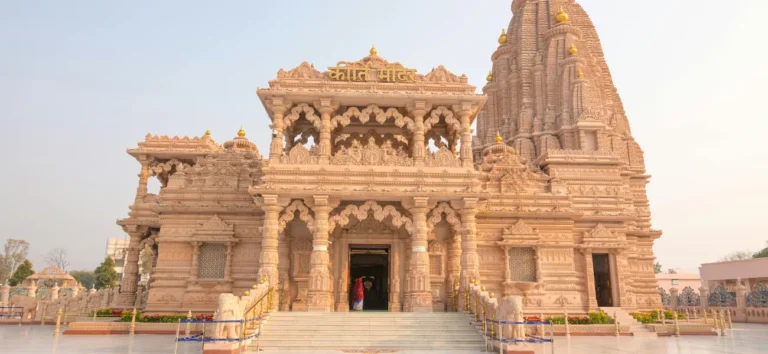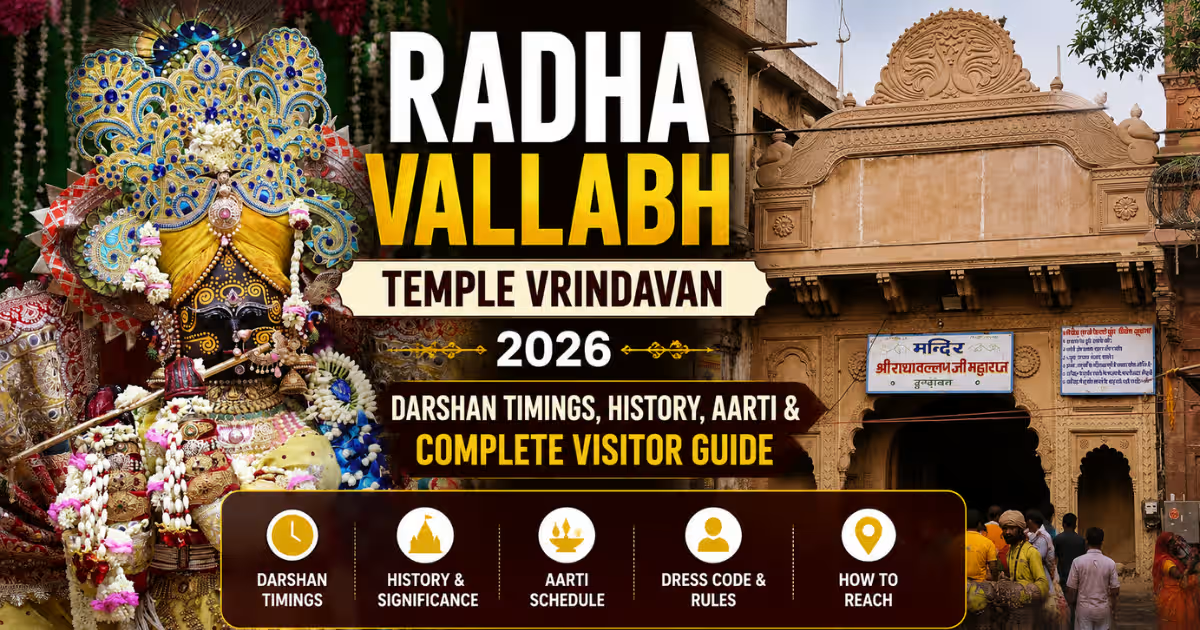
Radha Vallabh Temple Vrindavan darshan timings: Summer (April-October) 5:00 AM-12:00 PM and 5:00-9:00 PM. Winter (November-March) 5:30 AM-12:00 PM and 5:30-8:30 PM. Mangala Aarti at 5:00 AM (summer) / 5:30 AM (winter). Entry is free. Built in the 16th century by Goswami Hit Harivansh Ji – headquarters of the Radha Vallabh Sampradaya. Famous for samaj gayan (devotional community singing) and the unique crown placed beside the Lord. Guided Vrindavan tours with Experience My India from ₹1,999 per person. Call +91-7302265809.
Why Radha Vallabh Temple Occupies a Unique Position Among Vrindavan’s Temples
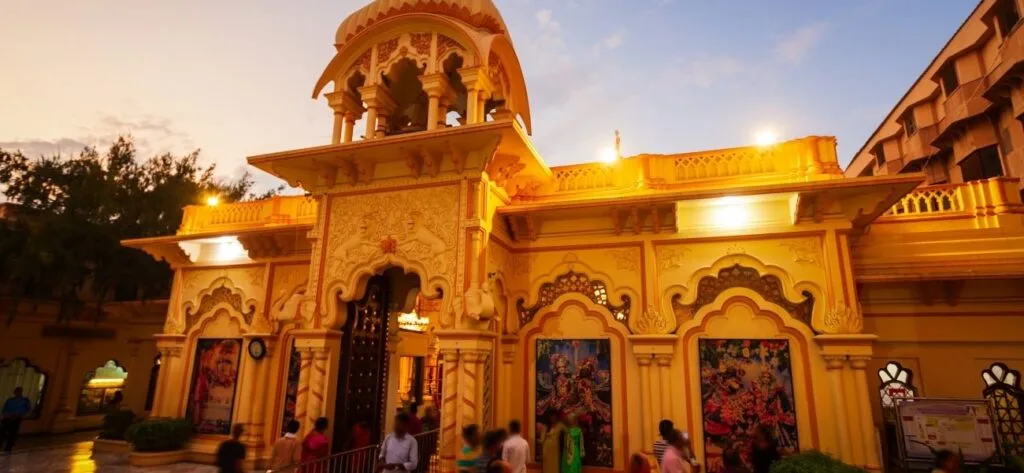
Among Vrindavan’s thousands of temples – ancient, modern, grand and intimate – the Radha Vallabh Temple holds a position that is theologically and architecturally distinct from all the others. It is the headquarters of the Radha Vallabh Sampradaya – the devotional school in which Radha Rani is the supreme divine reality and Lord Krishna is her eternal, devoted companion. This is the inverse of standard Vaishnavism, where Krishna is the supreme deity with Radha beside him.
This theological difference is visually expressed in the most distinctive feature of Radha Vallabh Temple: there is no separate idol of Radha beside Lord Radha Vallabh. Instead, a crown (mukut) is placed beside the Lord – symbolising Radha’s presence as inseparable from and supreme over him. For a devotee of the Radha Vallabh tradition, this is not an absence but the fullest presence: the crown of the Beloved placed beside the Lord.
I am Gurudutt, founder of Experience My India, born and raised in Braj Bhoomi and guiding pilgrims since 2018. I have attended the Radha Vallabh Temple’s Mangala Aarti at 5:00 AM on cool November mornings and the samaj gayan in the evening with more than 50,000 pilgrims over the years. In this guide you will find the complete 2026 darshan and Aarti timings, the temple’s history, the Radha Vallabh Sampradaya’s theology, the samaj gayan tradition, visitor rules, how to reach and nearby attractions. Call +91-7302265809 to plan with Experience My India. Tours from ₹1,999 per person.
Radha Vallabh Temple Vrindavan – Quick Overview
| Detail | Information |
| Full name | Shri Radha Vallabh Mandir |
| Location | Near Yamuna River banks, Vrindavan, Uttar Pradesh |
| Established | 16th century CE |
| Founded by | Goswami Hit Harivansh Ji Maharaj (ca. 1503-1552 CE) |
| Tradition | Radha Vallabh Sampradaya – Radha as supreme deity |
| Deity | Lord Radha Vallabh (Krishna) – with Radha’s crown (mukut) placed beside |
| Summer timings (Apr-Oct) | 5:00 AM – 12:00 PM · 5:00 PM – 9:00 PM |
| Winter timings (Nov-Mar) | 5:30 AM – 12:00 PM · 5:30 PM – 8:30 PM |
| Mangala Aarti | 5:00 AM (summer) / 5:30 AM (winter) |
| Entry fee | Free – no charges |
| Darshan style | Open sewa – no metal bars between devotee and deity (a distinctive feature) |
| Unique visual feature | No separate Radha idol – Radha’s crown placed beside Lord Radha Vallabh |
| Musical tradition | Samaj gayan – devotional community singing in classical ragas |
| Distance from Banke Bihari Temple | 400-500 metres |
| Distance from Mathura Junction | 14 km |
| Nearest landmark | Near Yamuna riverbank; close to Keshi Ghat area |
Experience My India includes Radha Vallabh Temple in all extended Vrindavan tour packages. View Our 3 Days Mathura Vrindavan Tour Package
Radha Vallabh Temple Darshan and Aarti Timings 2026
Complete Daily Schedule
| Session / Aarti | Summer Timing (April-October) | Winter Timing (November-March) | Notes |
| Mangala Aarti | 5:00 AM | 5:30 AM | Lord’s awakening – first Aarti of the day |
| Mangala darshan | 5:00-7:00 AM (summer) | 5:30-7:00 AM (winter) | Post-Mangala Aarti darshan |
| Shringar Darshan | 7:00 AM – 9:00 AM | 7:00 AM – 9:00 AM | Lord dressed and adorned – most visually intimate session |
| Rajbhog Aarti | 11:30 AM | 11:30 AM | Grand midday food offering |
| Morning session closes | 12:00 PM | 12:00 PM | Temple closed for afternoon rest |
| Afternoon closure | 12:00 PM – 5:00 PM (summer) | 12:00 PM – 5:30 PM (winter) | Closed for rest period |
| Utthapan Darshan | 5:00 PM – 6:00 PM | 5:30 PM – 6:30 PM | Lord awakening from afternoon rest |
| Sandhya Aarti | 6:30 PM | 6:30 PM | Evening Aarti – includes samaj gayan |
| Shayan Aarti | 9:00 PM | 8:30 PM | Final Aarti – Lord being put to rest for the night |
| Evening session closes | 9:00 PM | 8:30 PM |
Seasonal Overview
| Season | Morning Opens | Morning Closes | Evening Opens | Evening Closes | Mangala Aarti |
| Summer (April – October) | 5:00 AM | 12:00 PM | 5:00 PM | 9:00 PM | 5:00 AM |
| Winter (November – March) | 5:30 AM | 12:00 PM | 5:30 PM | 8:30 PM | 5:30 AM |
Key timing notes:
- Shringar Darshan (7:00-9:00 AM) is consistent year-round – this is the most devotionally intimate regular darshan window outside the Mangala Aarti
- The Rajbhog Aarti at 11:30 AM marks the grand midday food offering; the temple closes shortly after at 12:00 PM
- The evening Sandhya Aarti (6:30 PM) is when the samaj gayan is most fully performed – the most distinctive musical experience in the entire Vrindavan temple circuit
- The Shayan Aarti shifts by 30 minutes between summer (9:00 PM) and winter (8:30 PM)
Experience My India confirms the exact current Aarti timings on the morning of every Vrindavan tour. Call +91-7302265809.
Radha Vallabh Temple History and Significance
The Founder – Goswami Hit Harivansh Ji Maharaj
Radha Vallabh Temple was established in the 16th century CE by Goswami Hit Harivansh Ji Maharaj – one of the most important Braj saints of the Bhakti movement era. His dates are approximately 1503-1552 CE, placing him as a contemporary of other major Vrindavan Bhakti saints including Mirabai, Surdas and the Six Goswamis of Vrindavan (Rupa Goswami, Sanatana Goswami and others).
The Origin of the Deity
| Aspect | Detail |
| How the deity appeared | According to temple tradition, the Lord Radha Vallabh deity appeared naturally (swayambhu) – not carved by human hands – and was gifted to Goswami Hit Harivansh Ji by divine grace |
| Significance of “swayambhu” | A self-manifested deity is considered to carry direct divine presence – this status makes Radha Vallabh a particularly significant pilgrimage |
| Goswami lineage | The temple has been maintained by the same Goswami family lineage since Hit Harivansh Ji’s time – the temple’s management remains within this devotional hereditary line |
| Temple name | “Radha Vallabh” = Beloved (Vallabh) of Radha – Krishna named as Radha’s beloved, not the reverse |
Historical Timeline
| Period | Event |
| ca. 1503-1552 CE | Goswami Hit Harivansh Ji Maharaj’s life; Radha Vallabh Temple established |
| 16th century | Temple becomes the headquarters of the Radha Vallabh Sampradaya |
| Present | Active temple with continuous puja in the Hit Harivansh tradition; Goswami family lineage maintains daily worship |
Experience My India explains this full history before every temple visit. Call +91-7302265809.
🙏 Visiting Radha Vallabh Temple for the first time? Experience My India explains the Radha Vallabh Sampradaya’s unique theology – why there is no Radha idol, what the crown (mukut) represents and how samaj gayan differs from all other Vrindavan temple worship traditions – before every guided visit. From ₹1,999 per person · Same Day Mathura Vrindavan Tour.
Radha Vallabh Sampradaya – The Theological Foundation
The Radha Vallabh Sampradaya is one of the five main Vaishnava devotional schools centred in Vrindavan – alongside the Gaudiya Vaishnava tradition (ISKCON’s parent tradition), the Pushtimarg (Vallabhacharya’s tradition, followed at Dwarkadhish), the Nimbarka Sampradaya and the Ramanuja Sampradaya.
| Aspect | Radha Vallabh Sampradaya Teaching |
| Founder | Goswami Hit Harivansh Ji Maharaj (16th century CE) |
| Supreme reality | Radha Rani – not Krishna |
| Krishna’s position | Radha’s beloved and devoted companion – not the supreme deity |
| Name of the tradition | “Radha Vallabh” – the Beloved (Vallabh) of Radha |
| Primary scriptures | Hit Chaurasi (84 devotional poems by Hit Harivansh Ji) + Radha Sudhanidhi |
| Deity form | Lord Radha Vallabh alone – Radha represented by a crown (mukut) placed beside |
| Worship character | Intimate, domestic – the Lord treated as a family member |
| Musical practice | Samaj gayan – community devotional singing in classical ragas |
| Open sewa | No metal barrier between devotee and deity – unusually direct darshan access |
How this differs from other Vrindavan temples: At Banke Bihari Temple (Gaudiya tradition), the deity is behind a curtain that opens and closes in rapid jhanki. At ISKCON (also Gaudiya), the deities are behind a gate. At Radha Vallabh Temple, the open sewa tradition means devotees approach the deity without a metal barrier – the darshan is more direct and unmediated than at most other major Vrindavan temples.
Experience My India explains this theological context before every temple visit group. Call +91-7302265809.
What Makes Radha Vallabh Temple Unique
The Crown – Radha’s Presence Without a Separate Idol
The most immediately striking visual feature of Radha Vallabh Temple is what is absent: there is no separate idol of Radha Rani beside Lord Radha Vallabh. In its place, a beautifully decorated crown (mukut) is positioned beside the Lord. This is not a simplification or a later addition – it is a theological statement from Hit Harivansh Ji’s original establishment of the temple.
The theological implication: in the Radha Vallabh Sampradaya, Radha is not a separate entity beside Krishna. She is inseparable from him – and her crown beside him indicates her sovereignty. Lord Radha Vallabh is named as her Vallabh (beloved), not her lord. The crown is Radha’s; the temple is her house; the Lord stands beside her crown as her devotee and companion.
For most pilgrims who arrive at this temple after visiting Banke Bihari (where both Bihari and his Radha are depicted) or ISKCON (where Radha-Krishna are depicted together), this visual contrast is one of the most intellectually distinctive moments in the entire Vrindavan circuit.
Open Sewa – The Direct Darshan
Unlike the metal bars or curtain systems at other major Vrindavan temples, Radha Vallabh Temple maintains the open sewa tradition – devotees access the deity without a structural barrier between them and the Lord. The darshan is face-to-face, without protective gating. This openness reflects the Radha Vallabh tradition’s emphasis on intimate personal devotion over formal temple protocol.
Samaj Gayan – Vrindavan’s Living Devotional Music Tradition
Samaj gayan is the devotional musical practice for which Radha Vallabh Temple is most celebrated – a form of community devotional singing performed in the Vrindavan Rasik tradition, using classical ragas to sing Hit Harivansh Ji’s devotional poetry (Hit Chaurasi and other texts).
| Aspect | Detail |
| What it is | Community devotional singing – not solo performance, but a group of trained singers performing classical raga-based devotional poetry |
| Texts sung | Hit Chaurasi (84 poems by Hit Harivansh Ji), Radha Sudhanidhi and other Vrindavan Rasik poetry |
| Setting | Typically performed during the Sandhya Aarti (6:30 PM) session at the temple |
| Style | Classical North Indian raga-based; specific ragas for morning, afternoon and evening sessions |
| Who participates | Trained samaj gayan singers from the Radha Vallabh Sampradaya tradition; devotees sit and listen |
| Why it is distinctive | Samaj gayan is one of the most sophisticated forms of temple music in Vrindavan – it represents the living classical music tradition that the Braj Bhakti movement maintained for centuries |
| For visitors | Attending the 6:30 PM Sandhya Aarti + samaj gayan session is one of the most musically distinctive experiences available in any Vrindavan temple |
Timing for samaj gayan: The most complete samaj gayan experience is at the Sandhya Aarti (6:30 PM). Experience My India includes the Sandhya Aarti at Radha Vallabh Temple in all extended Vrindavan evening circuits. Call +91-7302265809.
Visitor Rules and Etiquette
| Rule | Detail |
| Entry fee | ₹0 – completely free |
| Dress code | Shoulders and knees covered; traditional Indian attire most appropriate |
| Footwear | Remove before entering the temple compound |
| Photography | Check with temple staff on arrival – photography restrictions vary |
| Mobile phones | Switch to silent inside the temple; avoid taking calls during Aarti |
| Samaj gayan attendance | Sit quietly; the samaj gayan is a classical musical performance – maintain appropriate silence and attention |
| Behaviour | The open sewa tradition makes this temple particularly intimate – respectful and quiet conduct is essential |
| Festival days | Radhashtami and Janmashtami: expect very high crowds – arrive 45-60 minutes before the Aarti for a good position |
On the open sewa tradition: The absence of metal barriers at Radha Vallabh Temple means the darshan space is more intimate – and also more dependent on the natural orderly behaviour of devotees. The tradition of maintaining a quiet, respectful presence in the darshan area is especially important here. Experience My India briefs all tour groups on this before entry.
How to Reach Radha Vallabh Temple Vrindavan
| From | Distance | Mode | Time | Notes |
| Banke Bihari Temple | 400-500 metres | Walking | 5-8 minutes | Most natural combination – same central Vrindavan area |
| Keshi Ghat | 800 metres | Walking | 10-15 minutes | Along Yamuna riverbank direction |
| ISKCON Vrindavan | 2 km | E-rickshaw | 8-15 minutes | Via Chatikara Road |
| Mathura Junction (MTJ) | 14 km | Cab or auto-rickshaw | 30-45 minutes | Via Mathura-Vrindavan road |
| Delhi | 155-165 km | Car | 2.5-3 hours | Via Yamuna Expressway |
Navigation note: Radha Vallabh Temple is in the old Vrindavan city area near the Yamuna riverbank – the same area as Banke Bihari Temple. Private cars cannot access the inner narrow lanes; travel to this area by e-rickshaw (₹20-₹40 per seat) or on foot from the nearest drop point. Experience My India handles all Vrindavan inner-city navigation. Call +91-7302265809. View Our 2 Days Mathura Vrindavan Tour Package
Places to Visit Near Radha Vallabh Temple
| Place | Distance | Travel Time | Significance |
| Banke Bihari Temple | 400-500 metres | 5-8 minutes walk | Most visited Vrindavan temple; 1864 CE; jhanki darshan; no Aarti |
| Keshi Ghat | 800 metres | 10-15 minutes walk | Daily Keshi Ghat Aarti at 6:30 PM year-round |
| Radha Damodar Temple | 1 km | 10 minutes e-rickshaw | 1542 CE – Prabhupada’s bhajan kutir |
| Radha Raman Temple | 500 metres | 6-10 minutes walk | 1542 CE; swayambhu deity; Shringar Darshan 8-9 AM |
| Nidhi Van | 400 metres | 5 minutes walk | Nidhivan – closes 8:30 PM strictly |
| Govind Devji Temple | 1.5 km | 10-15 minutes e-rickshaw | 1590 CE – finest Mughal-era temple in Vrindavan |
| ISKCON Vrindavan | 2 km | 10-15 minutes e-rickshaw | 6 daily Aartis; Mangala at 4:30 AM |
| Prem Mandir | 3 km | 15-20 minutes e-rickshaw | Fountain show 7:00/7:30 PM |
Recommended old Vrindavan morning circuit: 5:00/5:30 AM – Radha Vallabh Temple Mangala Aarti 7:00-9:00 AM – Radha Vallabh Shringar Darshan 9:30 AM – Radha Raman Temple (500 metres) 10:30 AM – Radha Damodar Temple (1 km) 11:30 AM – Banke Bihari Temple (before noon closure at 12:00 PM)
This circuit covers four of Vrindavan’s most historically significant 16th-century temples before the midday closures. Experience My India sequences this for all extended Vrindavan tour groups. Call +91-7302265809.
Book Your Mathura Vrindavan Tour Package
Best Time to Visit Radha Vallabh Temple
| Visit Type | Best Window | Why |
| Mangala Aarti | 5:00 AM (summer) / 5:30 AM (winter) | Lord’s awakening – most intimate Aarti of the day |
| Shringar Darshan | 7:00-9:00 AM | Consistent year-round – most visually intimate regular session |
| Samaj gayan + Sandhya Aarti | 6:30 PM | The most musically distinctive experience at the temple |
| Least crowded regular darshan | 7:00-8:30 AM weekday | Smallest crowd before the tourist circuit builds |
| Festival visit (Radhashtami) | Radhashtami (Bhadrapada Shukla Ashtami – August/September) | Radhashtami is the most important festival at this temple |
| Festival visit (Janmashtami) | August 17, 2026 | Second most attended festival; midnight celebrations |
Season-wise Recommendation
| Season | Temperature | Conditions | Verdict |
| October – February | 8°C-25°C | Best – comfortable for 5:00 AM Mangala Aarti and evening samaj gayan | ✅ Best season |
| March – May | 25°C-45°C | Hot afternoon; 5:00 AM Mangala + 7:00 AM Shringar darshan most comfortable | ⚠️ Morning only |
| June – September | 28°C-36°C | Monsoon cools; Radhashtami in August/September | ✅ Good |
| Janmashtami (Aug 17, 2026) | 28°C-33°C | High crowds; most sacred Vrindavan festival | ✅ Book 3 months ahead |
Experience My India recommendation: October to February, 7:00-9:00 AM Shringar Darshan on a weekday (combined with Radha Raman’s Shringar Darshan at 8-9 AM and Banke Bihari’s opening at 7:45/8:45 AM for a complete old Vrindavan temple morning). Call +91-7302265809.
Radha Vallabh Temple Experience Summary – Quick Reference
| Aspect | Information |
| Summer timings | 5:00 AM-12:00 PM · 5:00-9:00 PM |
| Winter timings | 5:30 AM-12:00 PM · 5:30-8:30 PM |
| Mangala Aarti | 5:00 AM (summer) / 5:30 AM (winter) |
| Shringar Darshan | 7:00-9:00 AM (year-round) |
| Rajbhog Aarti | 11:30 AM |
| Utthapan Darshan | 5:00-6:00 PM (summer) / 5:30-6:30 PM (winter) |
| Sandhya Aarti | 6:30 PM |
| Shayan Aarti | 9:00 PM (summer) / 8:30 PM (winter) |
| Entry fee | ₹0 – Free |
| Deity | Lord Radha Vallabh – with Radha’s crown beside (no separate Radha idol) |
| Darshan style | Open sewa – no metal bars |
| Tradition | Radha Vallabh Sampradaya (Hit Harivansh Ji, 16th century) |
| Unique feature | Crown (mukut) placed beside Lord; samaj gayan musical tradition |
| Best visit window | 7:00-9:00 AM Shringar or 6:30 PM Sandhya Aarti with samaj gayan |
| Distance from Banke Bihari | 400-500 metres walk |
| Distance from Mathura Junction | 14 km |
| EMI tour inclusion | Extended Vrindavan tours from ₹1,999 · +91-7302265809 |
What Nobody Tells You About Radha Vallabh Temple
After guiding pilgrims to Radha Vallabh Temple for years since 2018, here is what I – Gurudutt, founder of Experience My India – share privately before every visit:
Most first-time visitors to Radha Vallabh Temple are puzzled by the absence of a Radha idol – and this confusion can reduce the entire visit to a passing glance. The crown (mukut) placed beside Lord Radha Vallabh is not a temporary substitute for an idol under repair or a later simplification. It is the original and deliberate theological expression of the temple’s founding saint. Understanding this before you enter transforms what you see from “something missing” to “the fullest possible statement of devotion.” Experience My India explains this to every group before the temple gate.
The Shringar Darshan window (7:00-9:00 AM) is the calmest darshan period in the old Vrindavan temple area. The 7:00 AM to 9:00 AM window at Radha Vallabh is the same window as Radha Raman Temple’s Shringar Aarti (500 metres away) and comes after Banke Bihari’s opening (which draws the largest crowd). Pilgrims who arrive in the old Vrindavan area at 7:00 AM can attend Radha Vallabh Shringar Darshan, then walk 500 metres to Radha Raman’s Shringar Aarti – the two most historically significant 16th-century temples in Vrindavan in a 2-hour window.
The Sandhya Aarti (6:30 PM) with samaj gayan is one of the most musically significant temple experiences in all of Vrindavan – and it is largely undiscovered by the mainstream tour circuit. Most packaged Vrindavan tours take pilgrims to Banke Bihari, ISKCON, Prem Mandir and Keshi Ghat. Radha Vallabh Temple’s 6:30 PM samaj gayan is attended primarily by local Braj devotees and serious practitioners of classical Indian devotional music. For pilgrims with a background in North Indian classical music or the Bhakti poetry tradition, this 30-45 minute session is among the most valuable in Braj.
Radhashtami is the most important festival at Radha Vallabh Temple – more significant than Janmashtami. In the Radha Vallabh Sampradaya, Radha’s birthday (Radhashtami – Bhadrapada Shukla Ashtami, typically August/September) is the supreme festival. The temple observes it with particular elaboration. Experience My India plans Radhashtami visits for devotees of the Radha Vallabh tradition.
Experience My India plans all Radha Vallabh Temple visits around these realities. WhatsApp +91-7302265809.
Know Before You Visit Radha Vallabh Temple
- Summer timings: 5:00 AM-12:00 PM and 5:00-9:00 PM · Winter timings: 5:30 AM-12:00 PM and 5:30-8:30 PM
- Entry is completely free – no ticket, no donation required, no VIP access
- No separate Radha idol – a crown (mukut) is placed beside Lord Radha Vallabh – this is the temple’s founding theological position, not an absence
- Open sewa darshan – no metal barrier between devotee and deity; maintain respectful quiet throughout
- Best darshan window: Shringar Darshan 7:00-9:00 AM on weekdays
- Sandhya Aarti at 6:30 PM includes samaj gayan – the most musically distinctive Vrindavan temple experience
- Dress code: shoulders and knees covered; remove footwear at designated point
- Mobile phones: silent inside; avoid calls during Aarti and samaj gayan
- Radha Vallabh Temple is 400-500 metres from Banke Bihari – can be combined in the same old Vrindavan circuit
- Most important annual festival: Radhashtami (August/September) – second is Janmashtami (August 17, 2026)
- Experience My India includes this temple in extended Vrindavan tours. Call +91-7302265809.
Frequently Asked Questions – Radha Vallabh Temple Vrindavan
Radha Vallabh Mandir in Vrindavan has two unique features found in no other major Vrindavan temple: (1) There is no separate Radha idol – a crown (mukut) is placed beside Lord Radha Vallabh, symbolising Radha’s sovereignty as the supreme deity in the Radha Vallabh Sampradaya; (2) The temple practises open sewa darshan – no metal barrier between devotee and deity – creating a uniquely direct and intimate darshan experience. The evening samaj gayan (classical devotional community singing at 6:30 PM) is also distinctive. Experience My India explains this context on every guided visit – call +91-7302265809.
Radha Vallabh Temple Vrindavan darshan timings: Summer (April-October) – 5:00 AM to 12:00 PM and 5:00 PM to 9:00 PM. Winter (November-March) – 5:30 AM to 12:00 PM and 5:30 PM to 8:30 PM. Key Aartis: Mangala at 5:00 AM (summer) / 5:30 AM (winter), Shringar Darshan 7:00-9:00 AM, Rajbhog Aarti at 11:30 AM, Sandhya Aarti at 6:30 PM, Shayan Aarti at 9:00 PM (summer) / 8:30 PM (winter). Entry is free. Experience My India confirms timings on every tour morning – call +91-7302265809.
Radha Vallabh Temple is approximately 400-500 metres from Banke Bihari Temple – within the same old Vrindavan temple neighbourhood near the Yamuna riverbank. The walk between the two temples takes 5-8 minutes through Vrindavan’s inner lanes. Both temples are in the area of old Vrindavan that also includes Radha Raman Temple (500 metres from Radha Vallabh) and Nidhivan (400 metres). Experience My India combines all four in the old Vrindavan morning circuit – call +91-7302265809.
Radha Vallabh Temple is a 16th-century Vaishnava temple in Vrindavan (not in Mathura city – Vrindavan is 14 km from Mathura Junction). It was established by Goswami Hit Harivansh Ji Maharaj (ca. 1503-1552 CE) and serves as the headquarters of the Radha Vallabh Sampradaya – the devotional tradition in which Radha Rani is the supreme deity and Lord Krishna is her devoted companion. The deity Lord Radha Vallabh is accompanied by Radha’s crown (mukut) rather than a separate Radha idol. Experience My India includes this temple in extended Vrindavan tours – call +91-7302265809.
Samaj gayan is the classical devotional community singing tradition practised at Radha Vallabh Temple – performed by trained singers using North Indian classical ragas to sing Hit Harivansh Ji’s devotional poetry (Hit Chaurasi and other Vrindavan Rasik texts). The most complete samaj gayan experience is at the Sandhya Aarti (6:30 PM). Unlike the mass bhajans at other Vrindavan temples, samaj gayan is a more formal classical performance – the spiritual equivalent of an evening raga concert in a devotional context. Experience My India includes the Sandhya Aarti in extended Vrindavan evening tours – call +91-7302265809.
No – Radha Vallabh Temple is completely free to enter. No ticket, no mandatory donation and no paid priority access of any kind. All darshan sessions and all six daily Aartis (Mangala, Shringar, Rajbhog, Utthapan, Sandhya, Shayan) are open to all visitors free of charge. Experience My India includes the temple in Vrindavan tours at no additional site fee – call +91-7302265809.
The nearest railway station to Radha Vallabh Temple Vrindavan is Mathura Junction (MTJ) – approximately 14 km from the temple. Vrindavan does not have its own railway station. From Mathura Junction, take a cab or auto-rickshaw to Vrindavan (30-45 minutes); from within Vrindavan, use an e-rickshaw (₹20-₹40 per seat) to reach the old Vrindavan temple area near Banke Bihari, where Radha Vallabh Temple is located 400-500 metres away. Experience My India arranges all transport from Mathura Junction – call +91-7302265809.
Radha Vallabh Temple was established in the 16th century CE by Goswami Hit Harivansh Ji Maharaj (ca. 1503-1552 CE) – one of the Braj saints of the Bhakti movement era. The temple’s deity, Lord Radha Vallabh, is said to have appeared naturally (swayambhu) and was gifted to Hit Harivansh Ji by divine grace. The temple has been maintained by the same Goswami family lineage since its founding. It serves as the headquarters of the Radha Vallabh Sampradaya. Experience My India explains the full history before every visit – call +91-7302265809.
Both are 16th-century Vrindavan temples within 500 metres of each other, but they differ significantly. Banke Bihari (Est. 1864, Gaudiya tradition) features jhanki (curtain) darshan – a curtain rapidly opens and closes to reveal the deity; photography is banned; there is no regular Aarti. Radha Vallabh (16th century, Radha Vallabh Sampradaya) features open sewa – no barrier between devotee and deity; 6 daily Aartis; samaj gayan in the evening. Theologically, Banke Bihari depicts Krishna-Radha together; Radha Vallabh has no Radha idol, only her crown. Experience My India covers both – call +91-7302265809.
October to February offers the most comfortable visiting conditions. Within the day, the Shringar Darshan (7:00-9:00 AM) is the most intimate and accessible darshan window – consistent year-round, relatively manageable crowds on weekdays. The Sandhya Aarti with samaj gayan at 6:30 PM is the most musically distinctive experience at the temple. For the most sacred annual festival, Radhashtami (August/September) is paramount in the Radha Vallabh tradition. Experience My India plans for the optimal window – call +91-7302265809.
Yes – both temples are 400-500 metres apart in old Vrindavan and can be visited in the same morning circuit. Recommended sequence: Radha Vallabh Shringar Darshan (7:00-9:00 AM) → walk 500 metres to Radha Raman Temple (Shringar Aarti 8-9 AM) → walk 400 metres to Banke Bihari Temple (7:45 AM summer opening). This covers three of Vrindavan’s most historically significant temples in a 2-2.5 hour window. Experience My India sequences this circuit for every extended Vrindavan tour – call +91-7302265809.
Yes. Experience My India includes Radha Vallabh Temple in all extended Vrindavan 1-day tours (₹1,999 per person) – Shringar Darshan morning circuit + old Vrindavan temples – and in the overnight Vrindavan package (₹2,999 per person) for the 5:00 AM Mangala Aarti and 6:30 PM samaj gayan on the same day. WhatsApp +91-7302265809 – Vrindavan itinerary with Radha Vallabh Temple included in 30 minutes.
Recommended products
-

02 Days Mathura Vrindavan Tour
-
03 Days Mathura Vrindavan Tour
Original price was: ₹9,000.00.₹8,000.00Current price is: ₹8,000.00. -
04 Days Agra Mathura Vrindavan Tour
-
5 days Mathura Vrindavan Tour Package
Original price was: ₹7,500.00.₹7,000.00Current price is: ₹7,000.00.

🙏 Ready to Visit Radha Vallabh Temple Vrindavan with Experience My India?
WhatsApp us and receive your personalised Vrindavan itinerary within 30 minutes – Shringar Darshan timing confirmed for your visit date, old Vrindavan temple circuit correctly sequenced and the 6:30 PM samaj gayan session included. Tours from ₹1,999 per person.
WhatsApp +91-7302265809 – Book Now
Jai Shri Krishna 🙏