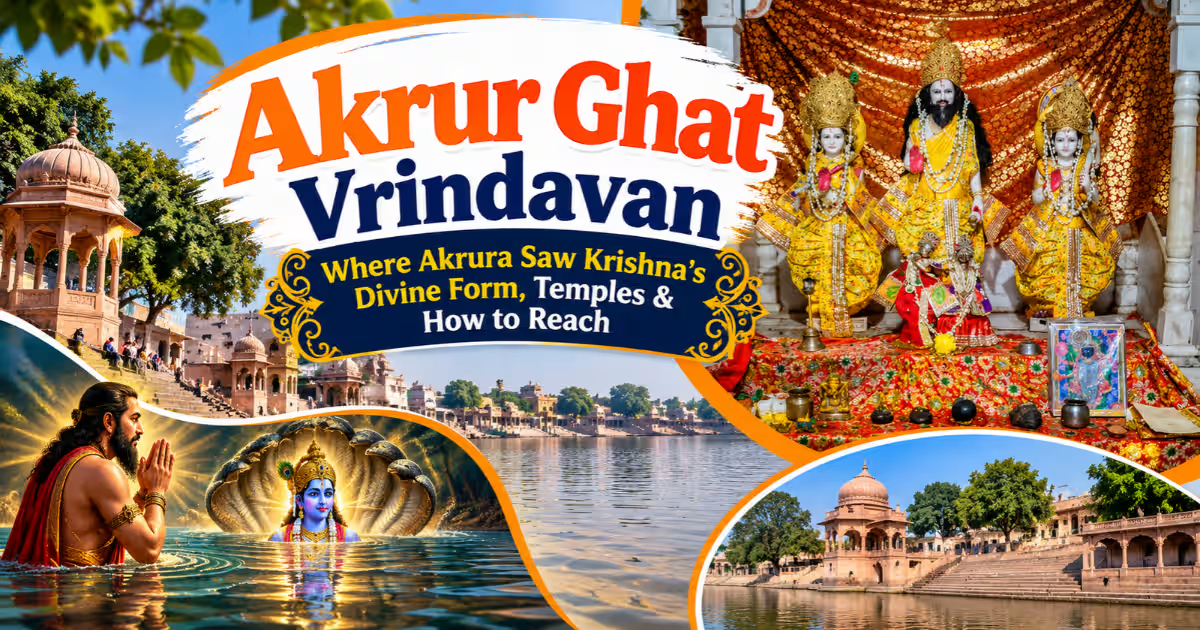
Akrur Ghat is a sacred Yamuna ghat on the west bank of the river, marking the traditional boundary between Mathura and Vrindavan. Named after Akrura – a devotee uncle of Lord Krishna – it is the site where Akrura, while bathing in the Yamuna on the way to Mathura, witnessed a profound cosmic vision: Krishna manifested as Maha-Vishnu (four-armed Narayana) reclining on Adisesha (Balarama as Ananta Shesha). The Adi Varaha Purana describes it as “the king of all holy places.” The Gopi Nath Temple on the premises houses deities of Krishna, Akrura and Balarama and preserves the lotus footprints of Sri Chaitanya Mahaprabhu. Entry is free. Experience My India. See our Mathura Vrindavan tour Package or message WhatsApp +91 7302265809.
The Ghat Where Krishna Revealed His Cosmic Form to a Devoted Uncle
Akrur Ghat sits in a quiet agricultural landscape between Mathura and Vrindavan – a modest, almost rural site that carries one of the most theologically profound episodes in the Srimad Bhagavatam. On this Yamuna bank, while Krishna and Balarama stood on the shore, their uncle Akrura stepped into the river for his morning bath and saw, submerged in the waters of the Yamuna, the complete cosmic form of the Supreme Being.
The Yamuna at Akrur Ghat is not merely a river. The Bhagavatam describes it as the medium through which an ordinary mortal – even a great devotee – crossed from his ordinary human perception into the direct sight of the universal form. Akrura looked up and saw two boys on a chariot. He looked down into the river and saw the Lord of the Universe.
This is one of the most dramatic theological contrasts in all of the Krishna narrative – and the ghat where it happened is still there, still visited, still bathed in.
I am Gurudutt, born and raised in Braj Bhoomi and founder of Experience My India. Since 2018, our team has guided over 50,000 pilgrims through the Braj circuit – including this site, which I include for every serious devotee who asks what should not be missed. For the complete Braj sightseeing context, see the top 25 places to visit in Mathura Vrindavan. The 3 Days Mathura Vrindavan Tour from Experience My India includes Akrur Ghat in the Mathura-Vrindavan heritage circuit. Call +91-7302265809.
Quick Facts at a Glance
| Attribute | Details |
| Full name | Akrur Ghat (also: Akrura Ghat, Akrur Tirth) |
| Location | West bank of the Yamuna River; between Mathura and Vrindavan |
| Traditional significance | Boundary between Mathura and Vrindavan cities |
| The event | Akrura’s cosmic vision of Maha-Vishnu on Adisesha while bathing in the Yamuna |
| Scriptural source | Srimad Bhagavatam, Canto 10 (the Akrura chapters) |
| Puranic status | Adi Varaha Purana describes it as “the king of all holy places” |
| Secondary significance | Sri Chaitanya Mahaprabhu’s base during his Vrindavan stay; footprints preserved here |
| Main temple | Gopi Nath Temple – deities of Krishna, Akrura and Balarama |
| Other features | Chaitanya’s footprints; ancient banyan tree; Pancha-mukhi Hanuman shrine |
| Entry | Free |
| Holy dip | Especially auspicious on Purnima (full moon) and during Kartik month |
| Yamuna note | The main Yamuna flow has receded 1 km from the original site due to natural geographical shifts |
For the complete Mathura and Vrindavan temple timings reference, see the Mathura Vrindavan temple timings guide. The 5 Days Mathura Vrindavan Tour includes the complete Mathura-Vrindavan heritage circuit. WhatsApp +91-7302265809.
Location – Between Mathura and Vrindavan
| Detail | Information |
| Position | West bank of the Yamuna; between Mathura and Vrindavan on the old connecting road |
| Sacred geography | Traditional demarcation boundary between Mathura and Vrindavan – where one sacred city ends and the other begins |
| Surroundings | Agricultural fields; relatively rural atmosphere; not in either city’s urban zone |
| Navigation landmark | Opposite Vatsalya Gram on the Vrindavan-Mathura main road |
| Distance from Mathura | 7-9 km |
| Distance from Vrindavan | 5-7 km |
| Yamuna note | Due to natural geographical shifts, the current Yamuna main flow is approximately 1 km away from the temple site – the original riverbank is now drier |
The location between the two cities is not coincidental in the sacred narrative – Akrur Ghat marks the literal transit point of Krishna’s journey from Vrindavan to Mathura. It was on this journey, between his childhood home (Vrindavan) and his destiny (Mathura, where he would defeat Kansa), that the cosmic revelation to Akrura occurred.
For the complete Vrindavan tour guide covering the Mathura-Vrindavan corridor, see the Vrindavan tour guide. The 2 Days Mathura Vrindavan Tour from Experience My India includes the Akrur Ghat heritage stop. Call +91-7302265809.
Who Was Akrura?
| Detail | Information |
| Full name | Akrura (Sanskrit: A-krura = not cruel / gentle; a name indicating benevolence) |
| Relationship to Krishna | Paternal uncle (on Vasudeva’s side) |
| Devotional status | A great devotee of Lord Vishnu/Krishna; recognised in Vaishnav tradition as a mahabhagavata (great devotee) |
| His role in the Bhagavatam | One of the most important transitional figures – he carries Krishna from the pastoral life of Vrindavan to the political-historical events of Mathura and Dwarka |
| Sent by Kansa | King Kansa sent Akrura specifically to bring Krishna and Balarama to Mathura under the pretence of a wrestling festival |
| Akrura’s internal conflict | Akrura was devoted to Krishna and knew what Kansa intended; the journey was therefore both a divine assignment and a deeply personal devotional moment |
| Significance | The cosmic vision at the Yamuna validated his devotion and revealed to him the true identity of the “boys” he was escorting |
The name “Akrura” – literally “not cruel” – is itself theologically meaningful. He was Kansa’s instrument but not Kansa’s devotee. His gentleness and his devotion are what opened the door to the cosmic vision in the Yamuna. Experience My India explains the Akrura character in full at this site. The top 10 places to visit in Mathura covers the Mathura circuit context. WhatsApp +91-7302265809.
The Cosmic Vision – What Akrura Saw Underwater
The Akrura vision episode is recorded in the Srimad Bhagavatam, Canto 10 – specifically in the chapters covering Krishna and Balarama’s journey from Vrindavan to Mathura.
The Journey
On Kansa’s instructions, Akrura traveled to Vrindavan and presented the “invitation” to Krishna and Balarama to come to Mathura for the wrestling festival. Yashoda, Nanda Baba, the gopis and all the Vrajavasis were grief-stricken at Krishna’s departure. The journey to Mathura was charged with emotion on all sides.
When the group reached the Yamuna River, Krishna and Balarama descended from the chariot and performed their morning rituals on the bank. They rested under a tree.
Akrura Enters the Yamuna
Akrura stepped into the Yamuna for his ritual morning bath (achamana and bath). Submerging himself, he opened his eyes underwater:
| Vision Element | What He Saw |
| First figure | Lord Balarama – but in his cosmic form as Adisesha (Ananta Shesha, the infinite multi-headed serpent who supports the universe) |
| Reclining upon Adisesha | Lord Krishna – but manifested as Maha-Vishnu (four-armed Narayana / Chaturbhuji), reclining in Yoga Nidra on the coils of Adisesha |
| Surrounding figures | Demigods, Devas and Saptarishis (the seven celestial sages) surrounding and worshipping Maha-Vishnu |
| The totality | The complete Kshir Sagar cosmic scene – within the waters of the Yamuna River |
The Double Revelation
| Action | What He Saw |
| Submerged in Yamuna | Maha-Vishnu on Adisesha; cosmic form; four arms; demigods in attendance |
| Head above water | Krishna and Balarama as young boys, sitting casually at the river’s edge |
| Submerged again | The four-armed Maha-Vishnu reappeared |
| Head above water again | The two boys, unchanged |
This repeated alternation – cosmic form underwater, human form above – is the theological centrepiece of the episode. The Yamuna itself was acting as a portal between ordinary human perception and divine reality. The same beings appeared differently depending on the level of perception brought to them.
Experience My India explains this episode in full theological detail at Akrur Ghat. The 8 Days Braj 84 Kosh Yatra covers the complete Braj circuit with all Bhagavatam narrative contexts. Call +91-7302265809.
The Significance of the Vision – Double Revelation
The Akrura vision teaches several principles simultaneously:
| Principle | What the Vision Demonstrates |
| The omnipresence of the Supreme | Krishna and Balarama are simultaneously the local boys on the Yamuna bank AND the cosmic beings supporting the universe – both are equally real and simultaneously true |
| The Yamuna as a cosmic medium | The Yamuna at Akrur Ghat is not merely a river – it is the medium through which divine reality becomes perceptible to those with devotion |
| The gift given to the devoted | Akrura was not an avatara or a divine being – he was a human devotee. The cosmic vision was given to him because of his devotion, not his spiritual qualification by birth |
| Balarama as Adisesha | The same Shesha Naga who forms Vishnu’s couch in the cosmic Kshir Sagar (the milk ocean) is Balarama in the earthly Vrindavan – the vision made this explicit |
| What “ordinary boys” actually are | The episode permanently resolves the question of who Krishna and Balarama actually are – through Akrura’s eyes, the devotee’s vision |
For the Gokul tourist places guide which covers the Shesha-Balarama connection at the Kshir Sagar Tank in Baldeo, see the dedicated guide. The 3 Days Mathura Vrindavan Tour from Ahmedabad and from Bangalore include the Akrur Ghat heritage stop. WhatsApp +91-7302265809.
Adi Varaha Purana – “The King of All Holy Places”
The Adi Varaha Purana, one of the 18 Mahapuranas of the Hindu tradition, makes a specific declaration about Akrur Ghat that gives it one of the highest tirth (pilgrimage) rankings in all of Braj:
“Akrur Ghat is the king of all holy places.”
| Significance Layer | Detail |
| Puranic authority | The Adi Varaha Purana is one of the 18 canonical Mahapuranas – its declarations carry scriptural weight |
| “King of all holy places” | This is a superlative ranking – placing Akrur Ghat above Varanasi (Kashi), Prayagraj and all other tirthas in this Puranic classification |
| The Vrajavasis’ vision | The Adi Varaha Purana also records that the residents of Vrindavan (Vrajavasis) saw the Vaikuntha planets reflected in the Yamuna waters at this location – extending the cosmic vision beyond Akrura to the entire community |
| Why the ranking | The ghat combines the Yamuna’s sacred status, the direct cosmic vision granted here, the Chaitanya connection and the boundary position between the two most sacred cities of Braj |
This Puranic ranking makes Akrur Ghat one of the most significant pilgrimage sites in all of North India – a fact that most mainstream pilgrimage itineraries entirely omit. Experience My India includes it specifically because of this ranking. For the complete Braj tirth context, the top 25 places to visit in Mathura Vrindavan covers the broader circuit. Call +91-7302265809.
Sri Chaitanya Mahaprabhu at Akrur Ghat
Akrur Ghat holds a second major devotional connection – centuries after the Bhagavatam events:
Sri Chaitanya Mahaprabhu (1486-1534 CE) – the Bengali Vaishnav saint who initiated the modern Krishna bhakti renaissance – made Akrur Ghat his headquarters during his extended stay in Vrindavan.
| Detail | Information |
| Who was Chaitanya Mahaprabhu? | The 15th-16th century Bengal saint credited with reviving the Vrindavan pilgrimage tradition; established the Gaudiya Vaishnav school of thought |
| When did he visit Vrindavan? | Around 1514-1516 CE during his South India and North India pilgrimages |
| Why Akrur Ghat? | He chose this specific ghat as his base – suggesting it was a recognised site of deep spiritual significance even in his time |
| What he did here | Bathed regularly in the Yamuna at this ghat; frequently entered states of deep spiritual ecstasy (samadhi) while submerged in the water |
| What is preserved | His lotus footprints (paduka) are preserved adjacent to the altar in the Gopi Nath Temple |
| The ancient banyan tree | The old banyan tree under which Chaitanya rested still stands on the temple premises |
Chaitanya Mahaprabhu’s choice of Akrur Ghat as his Vrindavan base – not the central temples, not the prominent ghats – is itself a theological statement about the site’s spiritual depth. He was drawn to the place of Akrura’s vision. Experience My India explains the Chaitanya connection in full at every Akrur Ghat visit. The Gayatri Tapobhumi guide covers another Mathura sacred site with deep scriptural roots. WhatsApp +91-7302265809.
The Gopi Nath Temple – What to See Inside
The main temple at Akrur Ghat is the Gopi Nath Temple – a modest, peaceful structure whose simplicity is entirely appropriate to the rural atmosphere of the ghat.
| Feature | Detail |
| Temple name | Gopi Nath Temple (Gopinath = “Lord of the Gopis”) |
| Character | Modest, peaceful, rural – not a grand paved complex; a genuine pilgrimage site rather than a tourist attraction |
| Main altar | Three deities: Lord Krishna (left), Akrura standing devoutly in the centre, Lord Balarama (right) |
| Surabhi cow deity | A deity of the sacred Surabhi (wish-fulfilling cow) is situated opposite the main altar |
| Chaitanya’s footprints | Lotus footprints of Sri Chaitanya Mahaprabhu preserved adjacent to the altar |
| Ancient banyan tree | The banyan tree under which Chaitanya rested; still standing |
| Pancha-mukhi Hanuman | A separate shrine within the compound for the five-faced form of Lord Hanuman |
| Entry | Free |
| Photography | Ask before photographing the deities |
| Active worship | Yes – priests perform daily seva |
The Unique Altar Configuration
The specific arrangement of the three deities – Krishna, Akrura and Balarama – at the main altar is distinctive and theologically intentional. Akrura standing devoutly between the two brothers visually recreates the scene from the Bhagavatam: Akrura accompanying Krishna and Balarama on the journey to Mathura. The altar is, in effect, a three-dimensional rendering of the moment just before the cosmic vision in the Yamuna.
Experience My India provides full altar-by-altar explanation at every Akrur Ghat visit. The Same Day Mathura Vrindavan Tour from Experience My India includes Akrur Ghat in the Mathura-Vrindavan corridor. Call +91-7302265809.
Yamuna River Note – Where Is the Water Today?
An honest and important note for pilgrims:
| Aspect | Current Situation |
| Original riverbank | The Akrur Ghat temple was built on the original west bank of the Yamuna – where the river’s waters flowed at the time of the Bhagavatam events and in Chaitanya Mahaprabhu’s time |
| Current situation | Due to natural geographical shifts in the Yamuna’s course over centuries, the main Yamuna flow has receded approximately 1 km from the original temple site |
| What this means for pilgrims | The temple premises and ghat steps are present; the main river water may not reach the ghat steps in the non-monsoon season |
| Sacred geography | The sacred significance of the site is attached to the ghat’s location, not to the current water level – the spot is the same regardless of water proximity |
| Monsoon | During and after monsoon (July-October), the Yamuna water levels rise and may return closer to the ghat |
This is a situation common to several Braj ghats – the Yamuna’s course has shifted significantly over centuries. The Akrur Ghat’s significance is not diminished by this; it simply requires an honest expectation-setting for pilgrims who expect to stand at the water’s edge. Experience My India advises every group about this before the visit. The Noida to Vrindavan distance guide covers the Yamuna Expressway approach to the region. WhatsApp +91-7302265809.
How to Reach Akrur Ghat
By Road (Local Directions)
The most reliable navigation for Akrur Ghat:
| Step | Direction |
| Start | Drive on the main road between Vrindavan and Mathura |
| Landmark | Look for Vatsalya Gram on your RIGHT side |
| Turn | Directly opposite Vatsalya Gram, turn LEFT onto a narrow asphalted road |
| Continue | Drive a few hundred metres past a small village |
| Arrival | The Akrura Ghat temple complex will appear on your RIGHT |
| GPS | Search “Akrur Ghat Vrindavan” on Google Maps – it is pinned |
Vehicle note: The road to Akrur Ghat is a narrow asphalted lane – cars can enter but it requires careful driving. Two-wheelers and autos navigate it more easily.
By Auto-Rickshaw / Cab
| From | Mode | Cost | Time |
| Mathura Junction (railway) | Auto or cab | ₹150-₹300 | 20-30 min |
| Vrindavan | Auto or cab | ₹100-₹200 | 15-20 min |
| Delhi (IGI Airport) | Cab via Yamuna Expy | ₹2,000-₹3,500 | 2.5-3 hrs |
For NCR-based pilgrims approaching via the Yamuna Expressway, see the Delhi to Govardhan distance guide for the full approach corridor. Experience My India includes Akrur Ghat as a navigation point on the Mathura-Vrindavan route for all group tours. The 3 Days Agra Mathura Vrindavan Tour passes Akrur Ghat on the transit between cities. Call +91-7302265809.
Visitor Information – Timings & Best Times
| Aspect | Information |
| Open | Dawn to dusk – the open-air ghat and temple compound |
| Entry fee | Free |
| Holy dip | Most auspicious on Purnima (full moon nights) and throughout Kartik month (October-November) |
| Best visiting time | Morning (6-10 AM) or late afternoon (4-6 PM) |
| Atmosphere | Peaceful, quiet, rural – very different from the busy central temples |
| Time needed | 30-60 minutes |
| Dress | Modest; remove footwear at temple entrance |
| Photography | Permitted in open areas; ask before photographing inside the temple sanctum |
Special note on Kartik: The Kartik month (typically October-November) is the most auspicious period for any Yamuna-bank pilgrimage in Braj. A dip at Akrur Ghat during Kartik is considered especially powerful for sin-purification. Pilgrims visiting during this period typically arrive before sunrise for the most devotionally charged experience. Experience My India advises on the Kartik pilgrimage window. The 5 Days Mathura Vrindavan Tour from Jaipur is popular for Rajasthan-based Kartik pilgrims. WhatsApp +91-7302265809.
Where to Place Akrur Ghat in the Braj Circuit
Experience My India’s recommended circuit sequence including Akrur Ghat:
| Stop | Site | Notes |
| 1 | Mathura (Janmabhoomi + Vishram Ghat) | City circuit in morning |
| 2 | Akrur Ghat | En route from Mathura to Vrindavan; 20 min stop; 5-7 km from Vrindavan |
| 3 | Vrindavan temples | Banke Bihari, ISKCON, Prem Mandir – afternoon/evening |
| Alternative | From Vrindavan → Akrur Ghat → Mathura | Morning; works as a Vrindavan-to-Mathura transition |
Akrur Ghat falls naturally on the road between Mathura and Vrindavan – adding it to any circuit requires only a 15-20 minute stop and minimal detour. For pilgrims doing both cities in one day, it is the perfect transitional stop between the two. Experience My India builds this into the Mathura → Akrur Ghat → Vrindavan sequence for all single-day circuits. The 2 Days Mathura Vrindavan Tour and 3 Days Mathura Vrindavan Tour both include this stop. The Prem Sarovar Barsana guide covers the outer Braj circuit for pilgrims staying longer. Call +91-7302265809.
Ground Truth – What Nobody Tells You About Akrur Ghat
After guiding 50,000+ pilgrims through the Braj circuit since 2018, here is what Experience My India knows:
Akrur Ghat is classified “the king of all holy places” by the Adi Varaha Purana – but virtually no mainstream Mathura-Vrindavan tour includes it. The five-stop Mathura itinerary (Janmabhoomi, Dwarkadhish, Vishram Ghat, ISKCON, Prem Mandir) misses the site that the Purana ranks above all others. Experience My India specifically added Akrur Ghat to the heritage circuit for this reason.
The Yamuna has receded 1 km from the ghat. Pilgrims expecting to step into flowing Yamuna water at the ghat steps will find a drier landscape than the scriptural description suggests. The sacred geography of the site is unchanged – the spot is the same – but the physical river is not at the ghat steps in the current era. This is important to manage expectations for.
The altar arrangement – Krishna, Akrura, Balarama – is one of the most theologically precise in Braj. Most temples depict Radha-Krishna or Krishna alone or various deity combinations. The specific three-figure altar at Gopi Nath Temple – the two divine boys flanking the devoted uncle – visually recreates the exact moment of the Bhagavatam episode. This is deliberate iconography and it rewards attention.
Chaitanya Mahaprabhu’s choice of Akrur Ghat as his headquarters in Vrindavan – rather than Banke Bihari or ISKCON (obviously not existing then, but Radha Damodar and Radha Raman were) – says something significant. He chose the site of the cosmic vision, the Puranic “king of all tirthas,” over the more prominent central locations. His footprints here are among the most quietly powerful sacred relics in all of Braj.
Know Before You Visit
- Location: West bank of Yamuna; between Mathura and Vrindavan; opposite Vatsalya Gram
- Distance from Vrindavan: 5-7 km; 15-20 min by auto
- Distance from Mathura: 7-9 km; 20-30 min
- Entry: Free
- Timings: Dawn to dusk; morning 6-10 AM and afternoon 4-6 PM ideal
- Yamuna: Main river flow 1 km from temple due to natural geographical shift
- Most auspicious: Purnima (full moon) and Kartik month (October-November)
- Navigation: “Akrur Ghat Vrindavan” on Google Maps; or landmark: opposite Vatsalya Gram on main road
- Time needed: 30-60 minutes
- Combine with: Mathura city circuit (morning) + Vrindavan temples (afternoon); natural transition stop
- Experience My India includes Akrur Ghat in all multi-day Braj circuits. WhatsApp +91-7302265809.
Frequently Asked Questions
Akrur Ghat is a sacred Yamuna ghat on the west bank of the river, traditionally marking the boundary between Mathura and Vrindavan. It is named after Akrura – a devoted uncle of Lord Krishna – who, while bathing here on his way to Mathura, witnessed a profound cosmic vision: Krishna manifested as Maha-Vishnu (four-armed Narayana) reclining on Adisesha (Balarama as the infinite serpent Ananta Shesha), surrounded by demigods and sages. The Adi Varaha Purana describes Akrur Ghat as “the king of all holy places.” Sri Chaitanya Mahaprabhu also used it as his headquarters during his Vrindavan stay. Entry is free. Experience My India. Call +91-7302265809.
Akrura stepped into the Yamuna for his morning ritual bath while Krishna and Balarama rested on the bank. Submerging himself underwater, he saw Balarama manifested as Adisesha (the multi-headed cosmic serpent Ananta Shesha) and Krishna manifested as Maha-Vishnu (four-armed Narayana) reclining gracefully upon Adisesha, surrounded by demigods, Devas and Saptarishis. When he lifted his head out of the water, he saw the two boys sitting casually on the bank as before. Submerging again, the cosmic vision reappeared. This double revelation showed him that the young boys were the omnipresent Supreme Souls – simultaneously ordinary in human form and cosmically vast underwater. Experience My India. WhatsApp +91-7302265809.
The main temple at Akrur Ghat is the Gopi Nath Temple, housing three deities: Lord Krishna (left), Akrura standing devoutly in the centre and Lord Balarama (right). A deity of the sacred Surabhi cow is situated opposite the altar. The temple also preserves the lotus footprints (paduka) of Sri Chaitanya Mahaprabhu adjacent to the altar and the ancient banyan tree under which Chaitanya rested still stands on the premises. A separate Pancha-mukhi Hanuman shrine (five-faced Hanuman) is also located within the complex. All open-air areas are accessible from dawn to dusk; entry is free. Experience My India. Call +91-7302265809.
Sri Chaitanya Mahaprabhu – the 15th to 16th century Bengali saint who revived the Vrindavan pilgrimage tradition and founded the Gaudiya Vaishnav school – made Akrur Ghat his headquarters during his stay in Vrindavan (approximately 1514 to 1516 CE). He bathed regularly at this ghat and frequently entered deep states of spiritual ecstasy (samadhi) while submerged in the Yamuna. His lotus footprints (paduka) are preserved adjacent to the altar in the Gopi Nath Temple and the ancient banyan tree under which he rested still stands on the premises. His choice of this ghat – the Puranic king of holy places – over more prominent central locations reflects its deep spiritual significance. Experience My India. WhatsApp +91-7302265809.
The Adi Varaha Purana – one of the 18 canonical Hindu Mahapuranas – specifically describes Akrur Ghat as “the king of all holy places,” ranking it above other major pilgrimage sites including Varanasi and Prayagraj in this Puranic classification. The same text also records that the residents of Vrindavan (Vrajavasis) were blessed to see the Vaikuntha planets (the eternal spiritual realms) reflected within the Yamuna waters at this location – extending the cosmic vision beyond Akrura alone to the entire Vrindavan community. This Puranic declaration gives Akrur Ghat one of the highest tirth rankings in all of Braj. Experience My India. Call +91-7302265809.
From Vrindavan: Drive on the main Vrindavan-to-Mathura road and watch for Vatsalya Gram on your right. Directly opposite Vatsalya Gram, turn left onto a narrow asphalted road; drive a few hundred metres past a small village and the Akrura Ghat temple complex appears on your right. Distance from Vrindavan: approximately 5 to 7 km, 15 to 20 minutes. From Mathura: approximately 7 to 9 km, 20 to 30 minutes via the same road. You can hire an auto-rickshaw from either city (₹100 to ₹300 depending on distance) and ask for “Akrur Ghat” directly. GPS: search “Akrur Ghat Vrindavan” on Google Maps. Experience My India. WhatsApp +91-7302265809.
Due to natural geographical shifts in the Yamuna River’s course over centuries, the main Yamuna flow has receded approximately 1 km away from the original Akrur Ghat temple site. The temple was built on what was then the direct Yamuna bank – where both the Bhagavatam events and Chaitanya Mahaprabhu’s bathings occurred. The sacred significance of the site is attached to the location itself, not to the current water level; the spot is the same place. During and after monsoon, the Yamuna levels rise and water may return closer to the ghat. For pilgrims specifically planning a Yamuna dip, the best season is July to October when water levels are higher. Experience My India. Call +91-7302265809.
The best times to visit Akrur Ghat are morning (6 to 10 AM) and late afternoon (4 to 6 PM) for the most peaceful and devotionally suitable atmosphere. The most auspicious occasions for visiting are Purnima nights (full moon) – when a holy dip is believed to cleanse all sins – and throughout the month of Kartik (typically October to November), which is the most sacred Vaishnav pilgrimage month for Yamuna-bank ghats in Braj. The open-air areas are accessible from dawn to dusk. Entry is free. Experience My India plans Akrur Ghat visits for the morning slot when including it as part of the Mathura-Vrindavan heritage corridor. WhatsApp +91-7302265809.
Recommended products
-
02 Days Mathura Vrindavan Tour
-
03 Days Mathura Vrindavan Tour
Original price was: ₹9,000.00.₹8,000.00Current price is: ₹8,000.00. -
04 Days Agra Mathura Vrindavan Tour
-
5 Days Braj 84 Kosh Yatra
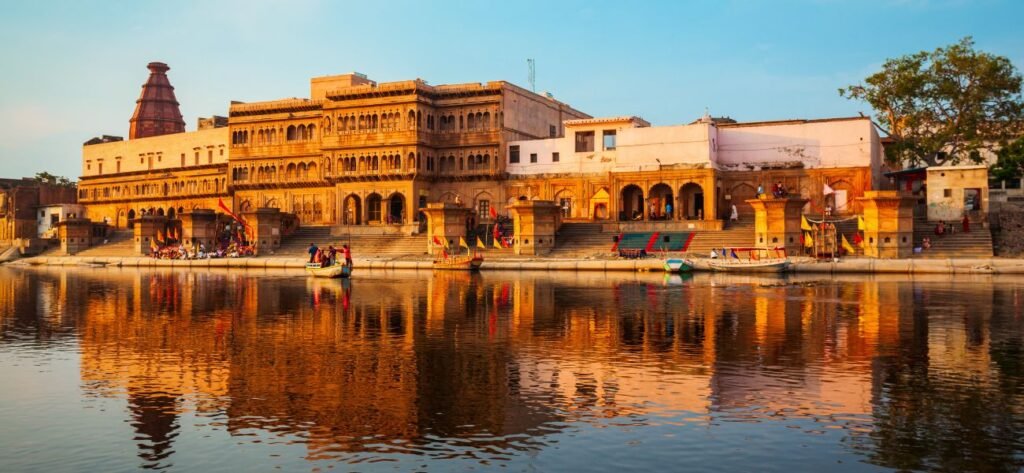
Ready to Visit Akrur Ghat with Experience My India?
WhatsApp us and receive your complete Mathura-Vrindavan heritage circuit plan – Akrur Ghat (with full Bhagavatam narrative, Chaitanya footprints, Gopi Nath Temple explanation), Mathura city and Vrindavan temples – all with a Braj-born guide who has stood at this ghat for 8 years explaining why the Adi Varaha Purana calls it “the king of all holy places.”
Braj Heritage Circuit Packages from ₹1,999 per person · Akrur Ghat included
WhatsApp +91-7302265809 – Book Now
Jai Shri Krishna 🙏