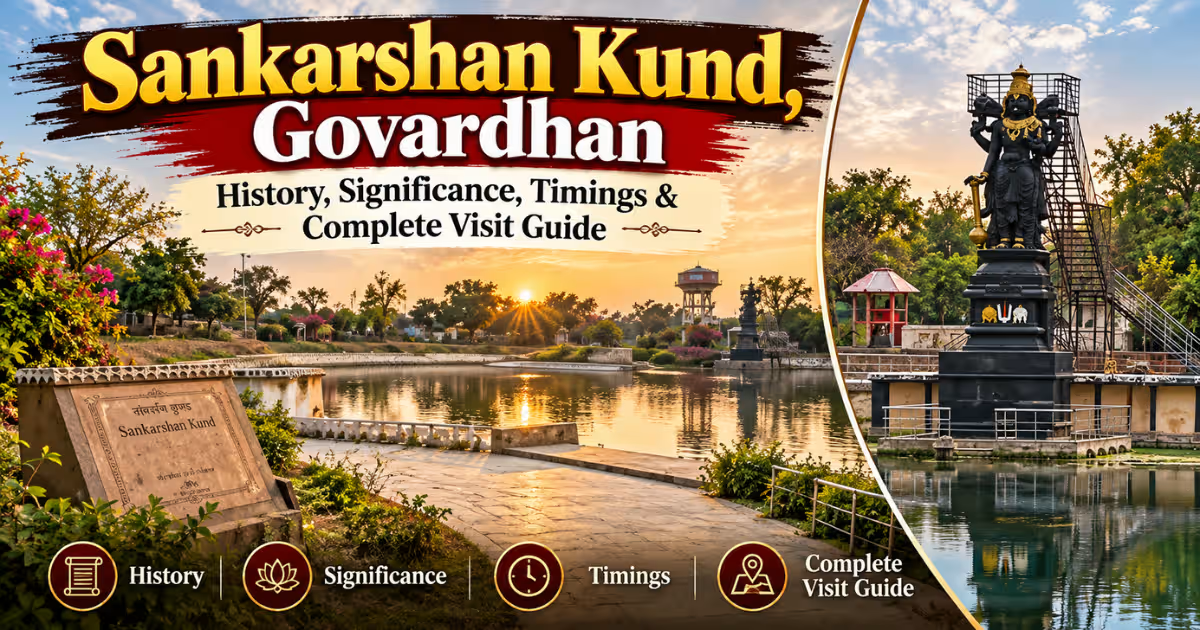
Sankarshan Kund is a sacred water body and heritage site located in Anyor village on the Govardhan Parikrama Marg, approximately 23 km from Mathura. It is dedicated to Lord Balarama (Sankarshan – Krishna’s elder brother) and houses the ancient Dauji Temple whose black-stone Balarama deity was reportedly recovered from the kund itself. The site also contains the samadhi of Kumbhandas Ji – a 16th-century Ashtachap poet-saint. Entry is free. Experience My India includes it in the 3 Days Mathura Vrindavan Tour from ₹3,999. WhatsApp +91-7302265809. See our Mathura Vrindavan tour Package or message WhatsApp +91 7302265809.
One of Braj’s Least Known – and Most Historically Layered – Sacred Sites
The Govardhan Parikrama Marg is 21 km of sacred path around Govardhan Hill – one of the most walked devotional circuits in the world. Most pilgrims who complete the parikrama focus on Daan Ghati, Mansi Ganga, Mukharavind, Radha Kund, Shyam Kund and Kusum Sarovar. Very few stop at Sankarshan Kund.
This is a significant gap. Sankarshan Kund, located in Anyor village along the parikrama path, is one of the most historically layered sacred sites in all of Braj – simultaneously a theological site connected to Lord Balarama, an archaeological site with a 5,000-year-old tradition anchored in the Garg Samhita, a literary pilgrimage site (the samadhi of one of the Ashtachap poet-saints is here) and a conservation site where modern restoration has brought a historically neglected kund back to visibility.
I am Gurudutt, born and raised in Braj Bhoomi and founder of Experience My India. Since 2018, our team has guided over 50,000 pilgrims through the Govardhan-Braj circuit. Sankarshan Kund is a site I include on every Govardhan circuit for pilgrims who want to go beyond the standard parikrama stops. For the complete outer Braj circuit context, see the top 25 places to visit in Mathura Vrindavan. The 3 Days Mathura Vrindavan Tour from Experience My India includes Sankarshan Kund on the Govardhan day. Call +91-7302265809.
Quick Facts – Sankarshan Kund at a Glance
| Attribute | Details |
| Full name | Sankarshan Kund (also: Sankarshan Kunda) |
| Type | Sacred water body (kund) + Dauji Temple + Kumbhandas Ji Samadhi |
| Location | Anyor village, Govardhan Parikrama Marg, Mathura district, UP |
| Distance from Mathura | 23 km |
| Distance from Govardhan town | On the parikrama circuit |
| Dedicated to | Lord Balarama (Sankarshan – Krishna’s elder brother) |
| Temple | Dauji Temple – black-stone Balarama deity recovered from the kund |
| Historical reference | Garg Samhita (sacred text); tradition of 5,000 years |
| Established by | Shri Vajranabh Ji (great-grandson of Lord Krishna) |
| Heritage feature | Samadhi of Kumbhandas Ji (16th-century Ashtachap poet-saint) |
| Royal visit | Raja Maan Singh (16th century) |
| Conservation | The Braj Foundation (modern restoration) |
| Entry fee | Free |
| Best visiting time | Morning (8 AM-12 PM) or late afternoon |
For complete Govardhan and Braj sacred site timings, see the Mathura Vrindavan temple timings guide. The 5 Days Mathura Vrindavan Tour from Experience My India gives enough time for Sankarshan Kund without rushing the parikrama circuit. WhatsApp +91-7302265809.
Location – Where Is Sankarshan Kund?
Sankarshan Kund is located in Anyor village, which sits directly on the Govardhan Parikrama Marg – the 21 km sacred circumambulation path around Govardhan Hill in Mathura district, Uttar Pradesh.
| Location Detail | Information |
| Village | Anyor (also written: Aunra, Anor) |
| On which route | Govardhan Parikrama Marg – the main 21 km circuit |
| Mathura district | Yes – Braj region, Uttar Pradesh |
| Distance from Mathura city | 23 km |
| Distance from Govardhan town | Part of the parikrama circuit between key stops |
| Nearest major sites | Govardhan Hill (parikrama route); Radha Kund; Kusum Sarovar |
| GPS navigation | Search “Sankarshan Kund Anyor Govardhan” on Google Maps |
For pilgrims planning the Delhi to Govardhan distance and route, Anyor village and Sankarshan Kund fall within the Govardhan outer circuit – best visited as part of the vehicle parikrama. Experience My India includes Anyor as a stop on the Govardhan circuit for all guests who request the complete parikrama. Call +91-7302265809.
History – Vajranabh Ji & the Garg Samhita
The tradition surrounding Sankarshan Kund places its origin approximately 5,000 years ago – at the end of the Dvapar Yuga, the age in which Lord Krishna lived.
Vajranabh Ji – Krishna’s Great-Grandson
After the end of Lord Krishna’s earthly pastimes, His great-grandson Shri Vajranabh Ji is recorded in the Puranic and Braj pilgrimage traditions as the person who identified, established and consecrated the major sacred sites of Braj – including the kunds, temples and sacred forests – to preserve their memory for future ages.
| Detail | Information |
| Who was Vajranabh Ji? | Great-grandson of Lord Krishna; grandson of Aniruddha (Krishna’s grandson) |
| His role | Established and identified sacred Braj sites after Krishna’s departure from earth |
| His legacy | Many of the oldest Braj sacred sites – kunds, deities, forests – trace their formal establishment to Vajranabh Ji |
| Sankarshan Kund’s connection | Tradition states the original temple and deity were established by Vajranabh Ji |
| Textual reference | The Garg Samhita (a Vaishnav sacred text focused on the life of Lord Krishna) references Sankarshan Kund |
The Garg Samhita Reference
The Garg Samhita – composed by the sage Gargacharya (the same sage who named Lord Krishna as a child) – is one of the primary Braj pilgrimage texts. Its reference to Sankarshan Kund gives the site scriptural authority within the Vaishnav tradition and connects it to the oldest layer of Braj sacred geography.
For pilgrims combining Sankarshan Kund with the broader Govardhan circuit, the 2 Days Mathura Vrindavan Tour from Experience My India covers the full outer Braj circuit on Day 2. WhatsApp +91-7302265809.
The Dauji Temple – Deity Recovered from the Kund
Adjacent to Sankarshan Kund stands the Dauji Temple – a temple dedicated to Dauji (another name for Lord Balarama, meaning “elder brother”).
The Recovered Deity
| Detail | Information |
| Deity name | Dauji / Sankarshan (Lord Balarama) |
| Material | Black stone (shaligram-like; considered svayambhu-type) |
| Origin of the deity | According to local tradition and temple records, the black-stone deity was discovered within the kund itself – recovered from the water |
| Significance of recovery | A deity discovered within a sacred water body is considered especially spiritually charged in the Vaishnav tradition |
| Temple character | Small, ancient, on-site; not a large modern temple |
| Daily seva | Active – priests perform daily rituals |
The Name “Sankarshan”
“Sankarshan” is one of the primary names of Lord Balarama – specifically referring to His cosmic identity as the first expansion of the Supreme Lord (Vishnu/Krishna). The name connects Balarama to Lord Sheshnaag (the infinite serpent who holds up creation) and to the concept of Anant Lok (the infinite transcendental realm). Sankarshan Kund thus carries not just a local Braj significance but a cosmic theological one – it is a site where the full cosmic identity of Balarama is specifically invoked.
Experience My India explains this theological context to every group visiting Sankarshan Kund. The Same Day Mathura Vrindavan Tour from Experience My India includes the Govardhan vehicle parikrama with Sankarshan Kund on request. Call +91-7302265809.
Spiritual Significance – Balarama, Sheshnaag & the Govardhan Storm
Lord Balarama at Govardhan
Lord Balarama – Sankarshan – is Lord Krishna’s elder brother and constant companion in the Braj pastimes. Most of the famous Govardhan sites are specifically associated with Lord Krishna. Sankarshan Kund is one of the few sites on the Govardhan parikrama that specifically honours Lord Balarama – making it distinctive within the circuit.
| Significance Layer | Detail |
| Balarama as Sankarshan | First expansion of the Supreme; cosmic identity connected to Lord Sheshnaag |
| Anant Lok connection | The kund is traditionally connected to the infinite transcendental realm of Sheshnaag |
| Holy dip significance | Taking a dip in Sankarshan Kund is believed to cleanse past material sins |
| Govardhan Storm legend | When Lord Krishna lifted Govardhan Hill and rains fell during the seven-day storm, local tradition holds that Lord Balarama managed and channeled the water into this area – Sankarshan Kund preserving that cosmic event in water form |
The Govardhan Storm Connection
The seven-day storm that Lord Krishna sheltered the Braj community from – by lifting Govardhan Hill – is the central legend of the Govardhan site. Sankarshan Kund’s specific connection to Balarama’s role in managing the flood waters during this event gives it a direct narrative link to Govardhan’s most celebrated sacred story.
For the complete Govardhan sacred sites guide, the top 10 places to visit in Mathura and the Prem Sarovar Barsana guide cover the broader Braj outer circuit. The 8 Days Braj 84 Kosh Yatra from Experience My India is the most complete Braj pilgrimage – all 84 kosh of sacred Braj including Sankarshan Kund. WhatsApp +91-7302265809.
Kumbhandas Ji Samadhi – The Ashtachap Connection
One of the most significant features of the Sankarshan Kund premises is the samadhi (memorial) of Shri Kumbhandas Ji – one of the eight Ashtachap poet-saints of the Pushti Marg tradition.
Who Was Kumbhandas Ji?
| Detail | Information |
| Name | Shri Kumbhandas Ji |
| Period | 16th century CE |
| Tradition | Pushti Marg; disciple of Shri Vallabhacharya |
| Role | One of the eight Ashtachap poet-saints – composers of devotional poetry (padas) for Shrinathji |
| Literary significance | His padas (devotional poems/songs) are performed at the Shrinathji Temple at Nathdwara (Rajasthan) and other Pushti Marg shrines to this day |
| Significance at this site | He lived and practised devotion near Sankarshan Kund; his samadhi is on the premises |
What Is the Ashtachap?
The Ashtachap (“eight seals”) refers to the eight poet-saints of the Pushti Marg tradition – contemporaries of Vallabhacharya and his son Vitthalnathjii – whose devotional compositions (padas) have been sung at the Shrinathji Temple in Nathdwara continuously for over 500 years. Kumbhandas Ji is one of the most revered of the eight. His samadhi at Sankarshan Kund gives the site an important connection to the bhakti literary tradition of 16th-century Braj.
Experience My India explains the Kumbhandas Ji significance to every group visiting Sankarshan Kund. The 3 Days Agra Mathura Vrindavan Tour from Experience My India includes the Govardhan circuit on Day 2 and can be extended to include Anyor. Call +91-7302265809.
Raja Maan Singh’s Visit – The 16th-Century Royal Connection
In the 16th century, Raja Maan Singh – the commander of Emperor Akbar’s army and one of the Mughal period’s most powerful Hindu noblemen – visited Sankarshan Kund to seek the blessings of Kumbhandas Ji.
| Detail | Information |
| Who was Raja Maan Singh? | Commander-in-chief of Akbar’s forces; Maharaja of Amber (Jaipur); one of the Navaratnas of Akbar’s court |
| His Braj connection | He built the Govind Devi Ji Mandir in Vrindavan (1590 CE) – one of the largest and most historically significant medieval temples in Braj |
| Visit to Sankarshan Kund | He visited specifically to receive the blessings of Kumbhandas Ji, the Ashtachap poet-saint residing here |
| Significance | Documents that Sankarshan Kund was known and visited by the highest political-military figures of 16th-century India |
This royal visit connects Sankarshan Kund to the same historical network as the Govind Devi Ji Mandir in Vrindavan – the temple Raja Maan Singh himself built. Experience My India explains this connection to every group that visits both sites. The Vrindavan tour guide covers the Govind Devi Ji Mandir context. The 4 Days Agra Mathura Vrindavan Tour gives enough time for both Vrindavan heritage sites and the Govardhan outer circuit. WhatsApp +91-7302265809.
Conservation – The Braj Foundation’s Work
Sankarshan Kund, like many of Braj’s sacred kunds, suffered significant neglect and encroachment over the 20th century. The Braj Foundation – an NGO dedicated to restoring Braj’s sacred ecology – undertook conservation work at Sankarshan Kund, including:
- Clearing the kund of encroachment and debris
- Restoring the ghat steps and perimeter
- Replanting native trees and vegetation around the kund
- Documenting the site’s heritage significance
This conservation effort is part of a broader programme across dozens of Braj kunds and is significant because it demonstrates that Sankarshan Kund, despite its obscurity to mainstream pilgrimage tourism, is recognised by heritage specialists as a site of genuine historical and ecological importance.
For the complete Gokul outer circuit that includes similarly restored sacred sites, see the Gokul tourist places guide. The 5 Days Mathura Vrindavan Tour from Jaipur gives Rajasthan-origin pilgrims ample time for the complete outer Braj circuit including Sankarshan Kund. Call +91-7302265809.
How to Reach Sankarshan Kund
Sankarshan Kund is in Anyor village on the Govardhan Parikrama Marg – reachable as part of the vehicle or walking parikrama.
| Starting Point | Distance to Sankarshan Kund | Time | Mode |
| Mathura city centre | 23 km | 40-50 min | Cab |
| Govardhan town (Daan Ghati) | Part of parikrama circuit | On parikrama path | Vehicle parikrama or walk |
| Radha Kund | Part of parikrama circuit | On parikrama path | Vehicle or walk |
| Delhi | 190-200 km | 3.5-4 hours | Via NH 44 |
| Vrindavan | 25 km | 40-50 min | Cab |
Navigation: From Govardhan town, proceed along the Govardhan Parikrama Marg. Sankarshan Kund at Anyor village falls on this circuit. Ask any parikrama walker or local auto driver for “Sankarshan Kund Anyor” – it is a known stop on the parikrama. GPS: search “Sankarshan Kund Govardhan” on Google Maps.
For NCR-based pilgrims, the Noida to Vrindavan distance guide covers the Yamuna Expressway approach to Mathura from where Govardhan is 22-25 km further. Experience My India arranges Govardhan circuit transport for all guests. The 3 Days Mathura Vrindavan Tour from Ahmedabad and from Bangalore include the Govardhan parikrama with Sankarshan Kund on the circuit. WhatsApp +91-7302265809.
Where to Place Sankarshan Kund in the Govardhan Parikrama Circuit
Experience My India’s recommended Govardhan parikrama sequence that includes Sankarshan Kund:
| Stop | Site | Notes |
| 1 | Daan Ghati Temple | Main Govardhan temple; start of parikrama |
| 2 | Mansi Ganga | Sacred lake created by Krishna’s mind |
| 3 | Mukharavind | The “face” of Govardhan Hill |
| 4 | Sankarshan Kund, Anyor | Dauji Temple + Kumbhandas Ji samadhi; sacred Balarama kund |
| 5 | Radha Kund + Shyam Kund | Most sacred kunds in Braj |
| 6 | Kusum Sarovar | 18th-century red sandstone reservoir |
Sankarshan Kund fits naturally between Mukharavind and Radha Kund on the vehicle parikrama circuit. Adding it adds approximately 20-30 minutes to the circuit – easily accommodated on a half-day Govardhan visit. Experience My India builds this into every Govardhan circuit for guests who request the complete parikrama. The 2 Days Mathura Vrindavan Tour includes Govardhan on Day 2 with the complete outer circuit. Call +91-7302265809.
Ground Truth – What Nobody Tells You About Sankarshan Kund
After guiding 50,000+ pilgrims through the Braj circuit since 2018, here is what Experience My India knows:
Sankarshan Kund is on the Govardhan Parikrama Marg but almost no standard parikrama guide or tour mentions it. The five standard stops (Daan Ghati, Mansi Ganga, Mukharavind, Radha Kund, Kusum Sarovar) dominate every parikrama itinerary. Sankarshan Kund at Anyor falls between Mukharavind and Radha Kund but is invisible on most tourist maps. Experience My India specifically navigates to Anyor for groups wanting the complete circuit.
The black-stone Dauji deity recovered from the kund is the theological centrepiece – but this story is almost never told to visitors. The fact that the temple deity was found within the kund itself is the most distinctive feature of this site. A deity recovered from water is understood in the Vaishnav tradition as a direct divine manifestation – not carved by human hands. Experience My India explains this at the site.
Kumbhandas Ji’s samadhi connects Sankarshan Kund to the living musical tradition of Nathdwara (Rajasthan). The padas composed by Kumbhandas Ji are sung at the Shrinathji Temple in Nathdwara every day. Pilgrims from Gujarat and Rajasthan who visit Shrinathji regularly are standing at the samadhi of the composer of those songs when they visit Sankarshan Kund. This is an extraordinary connection that almost no travel guide makes.
The Braj Foundation’s conservation work means the kund is now significantly more accessible than it was 15 years ago. Before restoration, the kund was heavily encroached and difficult to identify from the parikrama path. The restored ghat steps and cleared perimeter now make it a comfortable stop. The conservation effort is ongoing – the site’s condition continues to improve.
Know Before You Visit – Sankarshan Kund
- Location: Anyor village, Govardhan Parikrama Marg, Mathura district, UP
- Distance from Mathura: 23 km
- Entry: Free
- Temple: Dauji Temple (Balarama deity); active; daily seva
- Samadhi: Kumbhandas Ji – 16th-century Ashtachap poet-saint
- Holy dip: Believed to cleanse past sins; check current water quality before bathing
- Navigation: “Sankarshan Kund Anyor Govardhan” on Google Maps
- Best combined with: Govardhan vehicle parikrama (Daan Ghati → Sankarshan Kund → Radha Kund → Kusum Sarovar)
- Time needed: 20-30 minutes for the site
- No crowd: This is a genuinely off-the-tourist-path site – quiet even on busy parikrama days
- Experience My India includes Sankarshan Kund on the Govardhan circuit for all groups who request the complete parikrama. WhatsApp +91-7302265809.
Frequently Asked Questions
Sankarshan Kund is a sacred water body (kund) located in Anyor village on the Govardhan Parikrama Marg in Mathura district, Uttar Pradesh, approximately 23 km from Mathura city. It is dedicated to Lord Balarama (Sankarshan – Krishna’s elder brother) and houses the Dauji Temple, whose black-stone Balarama deity was reportedly recovered from the kund itself. The site also contains the samadhi of Kumbhandas Ji, a 16th-century Ashtachap poet-saint. Entry is free. Experience My India includes it in the Govardhan parikrama circuit. Call +91-7302265809.
According to the Braj pilgrimage tradition and the Garg Samhita (a Vaishnav sacred text), Sankarshan Kund was originally established by Shri Vajranabh Ji – the great-grandson of Lord Krishna – approximately 5,000 years ago at the end of the Dvapar Yuga. Vajranabh Ji is credited in tradition with identifying and consecrating many of the major sacred sites of Braj after Lord Krishna’s departure from earth. The Garg Samhita’s reference to Sankarshan Kund gives it one of the earliest scriptural attestations among Braj sacred sites. Experience My India provides this historical context during guided visits. WhatsApp +91-7302265809.
The Dauji Temple at Sankarshan Kund is a temple dedicated to Dauji – another name for Lord Balarama meaning “elder brother.” The temple houses a black-stone deity of Lord Balarama (Dauji/Sankarshan) that, according to local tradition and temple records, was discovered within the kund itself – recovered from the sacred water. A deity found within a sacred water body is considered especially spiritually significant in the Vaishnav tradition, as it is understood as a self-manifested rather than human-carved divine form. The temple performs active daily seva. Experience My India includes the Dauji Temple darshan in the Govardhan circuit. Call +91-7302265809.
Kumbhandas Ji was a 16th-century Vaishnav poet-saint and one of the eight Ashtachap – the group of devotional poets who composed padas (devotional songs) for the Pushti Marg tradition under Vallabhacharya and his son Vitthalnathjii. His padas are performed at the Shrinathji Temple in Nathdwara, Rajasthan and other Pushti Marg shrines to this day – continuously for over 500 years. Kumbhandas Ji lived and practised devotion near Sankarshan Kund and his samadhi (memorial) is on the premises. This gives Sankarshan Kund a direct connection to the bhakti literary tradition of Braj. Experience My India explains this significance during guided visits. WhatsApp +91-7302265809.
Raja Maan Singh – commander-in-chief of Emperor Akbar’s army and Maharaja of Amber (Jaipur) – visited Sankarshan Kund in the 16th century to seek the blessings of Kumbhandas Ji, the Ashtachap poet-saint who lived near this site. Raja Maan Singh is also famous in Braj for building the Govind Devi Ji Mandir in Vrindavan (1590 CE) – one of the largest medieval temples in Braj. His visit to Sankarshan Kund documents that the site was recognised and revered by the highest political and military figures of 16th-century India. Experience My India includes both Govind Devi Ji and Sankarshan Kund in the extended Braj circuit. Call +91-7302265809.
Yes – Sankarshan Kund is located in Anyor village directly on the Govardhan Parikrama Marg, the 21 km sacred circumambulation path around Govardhan Hill. It falls between Mukharavind and Radha Kund on the parikrama circuit. By vehicle parikrama, adding Sankarshan Kund at Anyor extends the circuit by approximately 20 to 30 minutes. By walking parikrama, it is a natural stop on the complete 21 km circuit. Experience My India includes Sankarshan Kund in all Govardhan vehicle parikrama circuits for groups that request the complete route. WhatsApp +91-7302265809.
According to the Braj pilgrimage tradition, taking a holy dip in the waters of Sankarshan Kund is believed to cleanse one of past material sins – a significance shared with other sacred kunds of the Braj region such as Radha Kund and Mansi Ganga. The specific theological significance of Sankarshan Kund is its connection to Lord Balarama (Sankarshan) and through him to Lord Sheshnaag and Anant Lok – the infinite transcendental realm. Pilgrims who wish to take a dip should check current water quality conditions on arrival, as the restoration work at the kund is ongoing. Experience My India advises on this during Govardhan visits. Call +91-7302265809.
The most practical way to visit Sankarshan Kund is as part of the Govardhan vehicle parikrama. The standard vehicle parikrama sequence – Daan Ghati → Mansi Ganga → Mukharavind → Radha Kund → Kusum Sarovar – can be extended to include Sankarshan Kund at Anyor village between Mukharavind and Radha Kund, adding approximately 20 to 30 minutes to the circuit. Ask your cab or auto driver for “Sankarshan Kund Anyor” – or search Google Maps. Experience My India builds Sankarshan Kund into the Govardhan circuit in the 2 Days, 3 Days and 5 Days Mathura Vrindavan packages. WhatsApp +91-7302265809.
Recommended products
-

02 Days Mathura Vrindavan Tour
-
03 Days Mathura Vrindavan Tour
Original price was: ₹9,000.00.₹8,000.00Current price is: ₹8,000.00. -
04 Days Agra Mathura Vrindavan Tour
-
5 Days Braj 84 Kosh Yatra

Ready to Visit Sankarshan Kund with Experience My India?
WhatsApp us and receive your complete Govardhan parikrama plan – Daan Ghati, Sankarshan Kund (Anyor), Radha Kund, Shyam Kund and Kusum Sarovar – all in one morning, with a Braj-born guide who explains the Vajranabh Ji history, the Kumbhandas Ji samadhi and the Dauji Temple deity origin.
Govardhan + Braj Circuit Packages from ₹2,999 per person · Sankarshan Kund included on request
WhatsApp +91-7302265809 – Book Now
Jai Shri Krishna 🙏